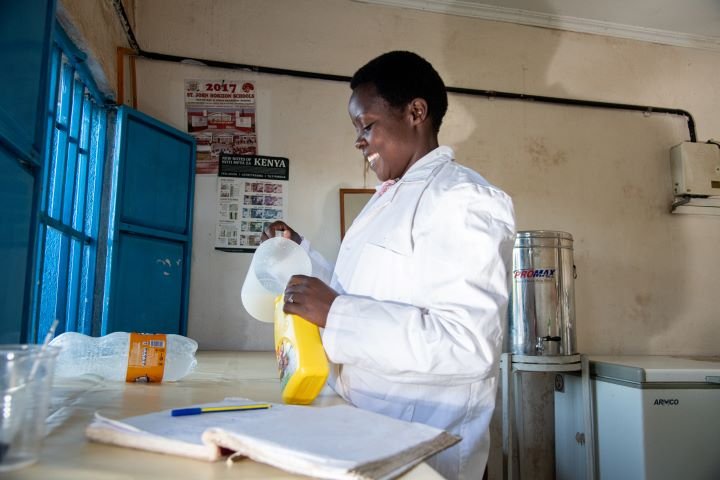
A milk vendor selling milk. Photo credit: ILRI/Georgina Smith
By Murimi Gitari, November 20, 2026, Kenya produces less than half of the milk it consumes, and the high cost and uneven supply of animal feed are keeping many smallholder dairy farmers from closing the gap, according to a new assessment by Heifer International Kenya.
The findings come from the organisation’s Dairy Value Chain Gap Analysis, which was presented on Thursday at a media roundtable in Nairobi. Journalists, government representatives, researchers, development partners, farmers, financial institutions and private-sector players attended, and they focused on feed and fodder systems.
Kenya’s annual milk production is estimated at 5.2 to 5.76 billion litres, against domestic demand of about 12.76 billion litres. The study also points to a national feed gap that the Ministry of Agriculture and Livestock Development’s investment plan puts at 30 million tonnes a year, based on 2021 figures.
The report acknowledges that the sector has made considerable progress through improved breeds, farmer training, milk collection infrastructure and processing. It finds, however, that access to affordable, quality feed, reliable agricultural services and well-functioning markets remains central to raising productivity and the incomes of smallholder farmers.
The study reviewed dairy interventions across 11 counties and carried out more detailed fieldwork in Nyandarua, Embu and Elgeyo Marakwet. It involved 54 field engagements, including nine farmer focus group discussions and interviews with cooperatives, input suppliers, service providers, processors, financiers, government officials and development actors.
Feed and fodder emerged as a constraint in all the dairy systems assessed. Farmers face high feed costs, seasonal shortages, inconsistent quality and limited access to mechanisation and conservation services. The assessment concludes that the solution lies not only in farm-level fodder production but also in the businesses and services that can keep quality feed available throughout the year.
The county findings show how the problem differs by region. In Nyandarua, smallholders commonly produce between 3 and 15 litres of milk per cow daily, compared with 25 to 30 litres on well-managed intensive farms. In Embu, high feed costs, small landholdings and concerns about feed quality affect production costs and profitability. In Elgeyo Marakwet, seasonal feed shortages, limited veterinary and breeding services and gaps in market infrastructure add to the challenge.
Farmers also raised concerns about what they earn from their milk. Luke Kesei, chairman of the Ainabkoi Dairy Cooperative Society in Uasin Gishu County, said unpredictable prices make it hard to invest. “Uncertainty in milk prices makes it difficult for farmers to plan and invest in feed and fodder production,” he told the roundtable. “Access to affordable financing, mechanization and extension services is equally important if we are to improve productivity and make dairy farming more profitable.”
Payment delays are another factor. In Nyandarua, some farmers reported waiting between 30 and 60 days to be paid through cooperative and processor channels, while informal buyers often pay immediately. That difference influences where farmers sell, the study notes, and it points to room for cooperatives to improve payment arrangements and offer more competitive and reliable marketing options.
Heifer International Kenya Country Director Wairimu Munyinyi-Wahome described feed security as the foundation of the sector.
“Feed and fodder security is not simply about responding to shortages,” she stated. “It is fundamental to dairy productivity, farmer incomes and the resilience of our food systems. This assessment gives us an opportunity to move beyond identifying challenges and focus on practical solutions through research, innovation, investment and stronger partnerships,” she said.
The assessment recommends an integrated approach that includes investment in commercially viable feed and fodder enterprises, better conservation and mechanisation services, and improved access to quality inputs and water. It also calls for stronger veterinary, breeding and advisory services, support for cooperatives to widen their services, better milk cooling and marketing arrangements, and financing designed for dairy farmers. It stresses that women and young people need better opportunities to own productive assets, access finance and enter higher-value dairy enterprises.
The report lands as Kenya pursues the National Agri-food Systems Investment Plan (NASIP 2026–2030), which lists commercial feed production, mechanised fodder production, conservation and storage as livestock investment priorities.
Paul Ndungu, Acting Director for Regulatory Services at the Kenya Dairy Board, who also represented the State Department for Livestock Development, called for joint action. “Government, development partners, processors, farmers and the media must work together to strengthen the dairy value chain,” he told participants. “Our efforts need to go beyond feed production to include conservation, storage, distribution and market access.”
From the private sector, Peris Chege, a nutritionist and technical adviser for ruminants at Unga Farmcare (EA) Ltd, said research is not reaching farmers. “Research has generated valuable knowledge on livestock nutrition, but we need to ensure this reaches farmers,” she said. “We must strengthen extension services and equip farmers with practical skills to produce, harvest and conserve fodder at the right stage of maturity, when its nutritional value is highest.”
The findings align with Heifer Kenya’s Transforming Yield through Feed and Fodder Access in Dairy (TYFFAD) project, which seeks to improve access to quality feed and build more commercially sustainable fodder markets.