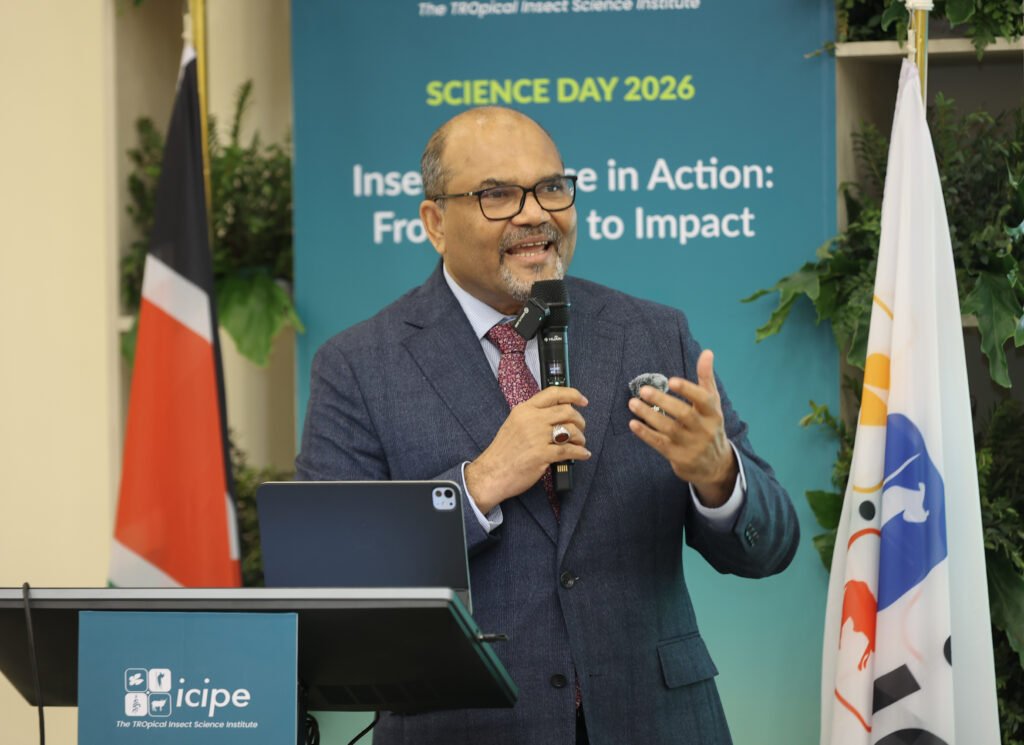
Prof. Shaukat Abdulrazak, Kenya’s Principal Secretary for the State Department for Science, Research and Innovation during the icipe Science Day 2026. Photo Credit: icipe
By Murimi Gitari, November 18, 2026, Kenya’s Principal Secretary for the State Department for Science, Research and Innovation, Prof. Shaukat Abdulrazak, has challenged scientists and research institutions to measure success by impact and commercial value rather than by publications, as he opened icipe Science Day 2026 at the International Centre of Insect Physiology and Ecology (icipe).
The event marked one year since icipe launched its Vision and Strategy 2026–2030. It was held under the theme “Insect Science in Action: From Vision to Impact”.
“We need to move our investment in research and development toward 1 percent of GDP,” Prof. Abdulrazak told the gathering. “But beyond the investment itself, we need to look at how research translates into innovation and, ultimately, commercialization.”
He called for venture financing, venture capitalists and industry partnerships to be brought together to move innovations “from the lab to the market”. Publishing alone is not enough, he cautioned. “I know the saying: ‘If you do not publish, you perish.’ But it is not enough just to have publications. It is not enough just to have innovation. Innovation must have impact.” Innovations should also be protected through intellectual property rights so that they can be developed and taken “to the people who need them”, he added.
The Government remains committed to providing an enabling environment for research, according to Prof. Abdulrazak. It continues to support icipe, which is “hosted here courtesy of the Government of Kenya and which has the potential to contribute to addressing socio-economic challenges in Kenya, the sub-region and the entire continent.”
Turning to the next generation of scientists, he urged mentorship so that young people can build on current achievements with emerging technologies such as artificial intelligence. “I always say that young people are our co-pilots,” he stated. “They are not the leaders of tomorrow; they are leaders of today.” He pointed to Kenya’s President interest in placing innovation at the centre of the development agenda, quoting the President’s view that “through innovation, we can re-engineer and reimagine our economy.”
On partnerships, Prof. Abdulrazak observed that science increasingly transcends borders. “Climate change, pandemics, food insecurity, biodiversity loss and emerging technologies require collective responsibility,” he said. “No country can address these challenges alone.” Institutions should move away from partnerships measured by the number of agreements signed, he urged, and towards those that deliver joint research, shared infrastructure, technology transfer, investment, scientific mobility and measurable societal outcomes. His guiding principle is simple: “Connect institutions. Integrate knowledge. Mobilize resources. Accelerate impact.”
Science, in his view, should be judged by “the number of lives we improve, the problems we solve, the enterprises we create, the jobs we generate, and the economic and societal value that we deliver.” He closed with a three-step challenge: “Move from discovery to application, from application to commercialization, and from commercialization to societal impact.”
For his part, icipe Director General Dr Abdou Tenkouano described a year spent turning strategy into practice. “One year into the launch, we are translating our strategic ambitions into action through scientific excellence, deploying insect science solutions, developing and cultivating stronger partnerships and expanding our African and global footprint,” he told guests. “Our staff are the first champions of our Vision and Strategy.”
Malaria, he noted, “remains one of the most significant causes of illness and death on the continent”. icipe’s research on *Microsporidia MB*, which he called “a big name for a very small microbe” that can infect mosquitoes, is “turning research into practical, scalable solutions for blocking malaria transmission.”
In livestock health, nagana, a disease spread by the bite of infected tsetse flies, “threatens animal health, livestock productivity and farmer and pastoralist livelihoods”. Tsetse repellent collars worn by animals, along with traps that use colours, shapes and odours to draw tsetse and other flies away from livestock, are being advanced for uptake in West and Central Africa.
Under the Red Palm Weevil Control project, icipe is developing biopesticides and deploying “farmer friends”, or beneficial insects, against an invasive pest that destroys date and other palm trees in the Middle East and North Africa.
On the environment, Dr Tenkouano said combining beekeeping with crop production and tree planting is restoring land and improving livelihoods. In Ethiopia, the Centre’s MaYEA project has helped farmers raise the productivity of their land and put more than 300,000 young people to work since 2023.
Fifteen icipe scientists were recognised in the 2025 edition of the World’s Top 2% Scientists ranking. The Centre has also launched a quarterly online forum that connects its crop pest and disease control innovations with agricultural businesses, opening a new pathway for technology uptake and commercialisation. The initiative echoes the PS’s call for innovations to reach the market.
Governing Council Chair Dr Ylva Hillbur told guests that the strategy rests on three pillars: research excellence, impact delivery and capacity development. icipe’s work addresses “pressing continental needs – from food security and vector-borne diseases to climate resilience” across five domains: agrifood systems, global health, environment and biodiversity, climate change, and policy.
“Through its strong programs for PhD and MSc students, icipe plays a vital role in strengthening research capacity for the future across many countries on the continent,” Dr Hillbur noted, adding that partners and donors “have been central to our work”. She closed with a vote of confidence: “On behalf of the Governing Council, I wish to reaffirm our confidence in icipe’s strong scientific foundation, clear roadmap, and commitment to Africa’s development.”
The event was also attended by Swiss Ambassador Mirko Giulietti, Burkina Faso Ambassador Dominique Kabore, and Canadian High Commission First Secretary for Development Alicia Sosa. Dr Segenet Kelemu, icipe’s former Director General and now Executive Director for Pan-African Programs at the Mastercard Foundation, was among the guests, together with donors, partners and staff. Visitors toured an Impact Exhibition showcasing the Centre’s research and met its scientists.