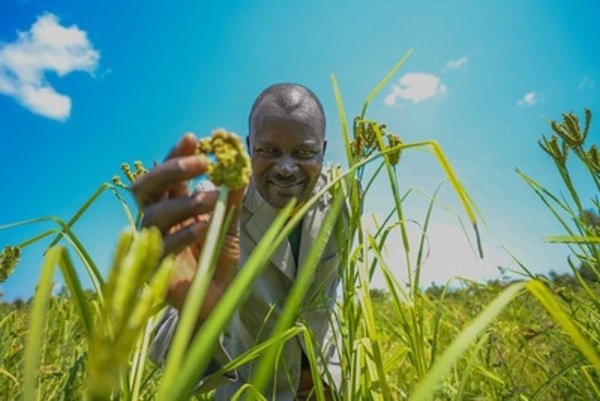
A researcher at a finger millet field. Photo Credit: ICRISAT
By Zablon Oyugi, 27 May, 2026: A new scientific breakthrough could accelerate the development of improved finger millet varieties, offering fresh hope for millions of smallholder farmers in Africa and Asia who rely on the drought-tolerant crop for food and nutrition security.
International Crops Research Institute for the Semi-Arid Tropics (ICRISAT) researchers have developed more reliable hybridization techniques for finger millet, overcoming one of the biggest challenges that has long slowed breeding efforts in the crop — its tiny flowers and highly self-pollinating nature. The findings were published in the journal Plant Methods.
Finger millet, scientifically known as Eleusine coracana, is widely cultivated in semi-arid regions because of its resilience to harsh climatic conditions and its exceptional nutritional value. According to the study, the crop contains high calcium levels, dietary fibre, minerals and essential amino acids, making it an increasingly important food crop in the face of climate change and malnutrition challenges.
Despite its importance, breeding improved finger millet varieties has remained difficult because the crop naturally self-pollinates. Researchers noted that spontaneous cross-pollination occurs in less than two percent of plants, making it extremely challenging for breeders to create superior hybrids with higher yields and improved stress tolerance.
The study evaluated three emasculation techniques — processes used to prevent self-pollination so breeders can create controlled crosses. Scientists tested a modified hot water treatment and two chemical agents, trifluoromethanesulfonamide (TFMSA) and gibberellic acid (GA3), alongside molecular marker technology to confirm successful hybridization.
Researchers found that dipping finger millet panicles in hot water at 52 degrees Celsius for two minutes achieved up to 83 percent successful hybridization. Similarly, the use of TFMSA at 10 milligrams and GA3 at 1500 ppm during the crop’s booting stage generated hybrid success rates of around 80 percent.
“The study revealed a successful emasculation rate of up to 80% using modified hot water treatment at 52 °C for 2 min,” the researchers said in the paper.
To confirm the purity of the hybrids, the team used 10 single nucleotide polymorphism (SNP) markers, which helped distinguish true hybrids from self-pollinated plants. The molecular tools provided faster and more accurate verification compared to conventional visual methods.
The research was conducted at the International Crops Research Institute for the Semi-Arid Tropics (ICRISAT) in Hyderabad, India, using diverse finger millet germplasm from Asia and Africa. The scientists said the improved methods could significantly speed up recombination breeding, enabling breeders to combine desirable traits such as drought tolerance, disease resistance and higher grain productivity.
Finger millet is considered the world’s third most important millet crop after sorghum and pearl millet. Globally, it is grown on about 2.2 million hectares with annual production estimated at 3.7 million tonnes.
The study noted that previous breeding successes, such as India’s Indaf finger millet varieties developed from Indian and African genetic crosses, increased productivity by more than 50 percent. However, limited hybridization capacity has slowed the release of new varieties over recent decades.
Researchers believe the new techniques could help unlock the crop’s untapped potential at a time when governments and scientists are increasingly promoting climate-smart and nutrient-rich crops to strengthen food systems in dryland regions.
The scientists concluded that integrating improved emasculation methods with molecular marker technology represents “an important step forward in finger millet crop improvement.”