
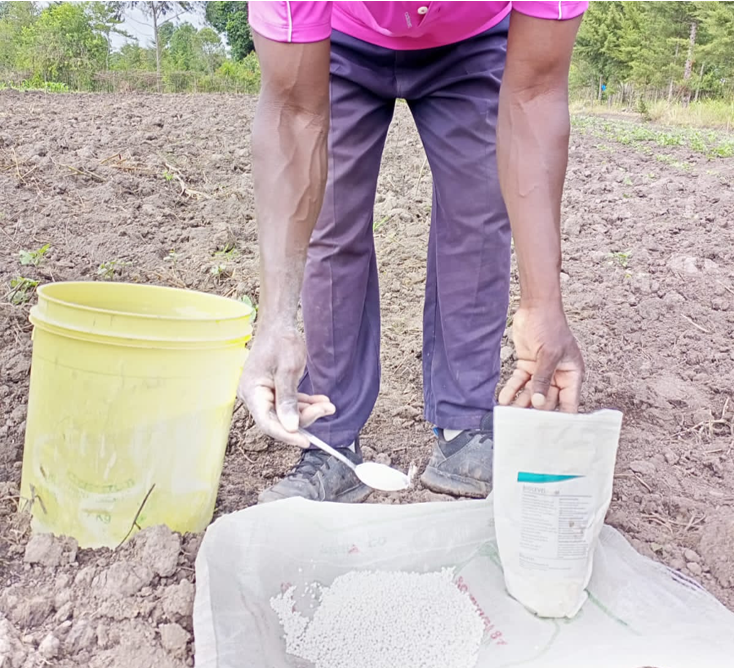
Bioline Agrosciences Africa’s new biological crop nutrition fertiliser ready for farm application. Photo Credit: Bioline Agrosciences Africa
By Zablon Oyugi, June 9, 2026: Biolevel, a global developer of microbial biofertilizer technologies, has entered into a strategic distribution partnership with Bioline Agrosciences Africa to introduce a new category of biological crop nutrition solutions to Kenyan farmers.
The agreement comes at a time when global agricultural markets are once again being tested by geopolitical uncertainty and fragile supply chains.
Events in critical shipping corridors such as the Strait of Hormuz, which handles a significant share of global fertiliser and energy-related cargo, have underscored how quickly disruptions in distant waters can ripple through to farming communities in Kenya and beyond.
For import-dependent economies, even minor shocks in global logistics often translate into immediate price pressure on farm inputs.
In Kenya, where most fertiliser is sourced internationally, farmers are particularly exposed to such volatility. Rising input costs are not only a budgeting concern but also a direct threat to productivity and food security, especially for staple crops like maize.
Against this backdrop, the partnership between Biolevel and Bioline Agrosciences Africa marks Biolevel’s formal entry into the Kenyan market while broadening Bioline’s portfolio beyond biological crop protection into crop nutrition.
Under the agreement, Bioline Agrosciences Africa will distribute Biolevel’s microbial-based crop nutrition products across Kenya, with planned expansion into East and Southern African markets.
The rollout follows multiple seasons of field evaluations conducted under local farming conditions. According to the companies, the trials showed consistent performance across varying agro-ecological zones, suggesting adaptability to Kenya’s diverse production systems.
The timing of the partnership reflects a deeper structural challenge in African agriculture: the rising cost of fertiliser and the diminishing returns many farmers are experiencing from increased application rates alone. Fertiliser typically accounts for between 30 and 50 percent of total production costs, depending on crop type and management system.
While subsidy programmes have helped improve access in several countries, affordability alone has not resolved efficiency gaps.
In many maize-growing regions, fertiliser use has risen steadily over the past decade, yet yields have often remained stubbornly low, frequently below two tonnes per hectare in parts of Eastern Africa.
In some cases, farmers have been forced to apply higher quantities each season simply to maintain previous output levels, raising concerns about soil health, nutrient imbalance, and declining efficiency.
Agronomists increasingly point out that the challenge is not only the quantity of nutrients applied, but how effectively crops are able to absorb and utilise them. Soil conditions, microbial activity, and root health all play a critical role in determining nutrient uptake.
Biolevel’s technology is designed to address this gap. Instead of supplying nutrients directly, its microbial formulations work by enhancing biological activity in the soil and improving the plant’s ability to access existing nutrients.
Applied at the seed or early growth stage, beneficial microorganisms support root development and activate natural processes such as nitrogen fixation and nutrient solubilisation. The result is improved nutrient-use efficiency throughout the crop cycle.
Field evaluation results shared by the companies indicate that the technology has the potential to reduce conventional fertiliser requirements by between 15 and 30 percent while maintaining expected yield levels. In some instances, yields reportedly improved even with reduced fertiliser application, pointing to gains in efficiency rather than input intensity.
For farmers, such improvements could have immediate economic implications. Lower fertiliser requirements translate into reduced production costs at a time when input prices remain highly unpredictable.
For a typical maize farmer investing thousands of shillings per acre each season on fertiliser alone, even marginal efficiency gains can free up capital for improved seed varieties, irrigation systems, crop protection products, or farm expansion.
Beyond cost savings, the partnership also aligns with a broader global shift toward biological agriculture. The use of microbial inputs, biofertilizers, and other nature-based solutions has become one of the fastest-growing segments in the agricultural inputs sector.
Rather than replacing conventional fertilisers entirely, these products are increasingly being integrated into existing farming systems to improve soil health and boost productivity in a more sustainable way.
For Bioline Agrosciences Africa, the introduction of crop nutrition products complements its existing focus on biological crop protection, enabling a more integrated approach to farm management.
“With the addition of Biolevel’s microbial biofertilizers, we can now offer a more comprehensive integrated farm management approach,” said Barnaba Rotich, Head of Commercial for Africa and the Middle East at Bioline Agrosciences Africa.
Kenya’s fertiliser subsidy programmes have helped cushion farmers from extreme price shocks, but persistent global uncertainty continues to highlight the limits of relying solely on input affordability. Energy costs, shipping disruptions, and geopolitical tensions remain capable of reshaping agricultural economics with little warning.