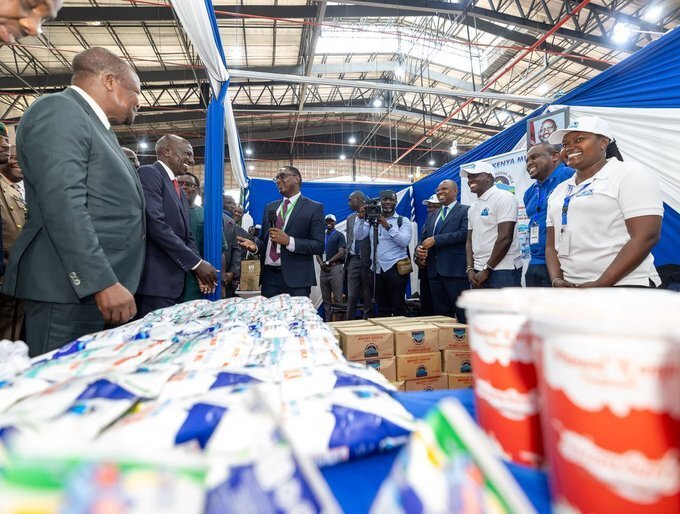
By Zablon Oyugi, October 12, 2026, Kenya has overtaken Egypt to become Africa’s largest milk producer, with annual output rising to more than five billion litres, as the government attributes the growth to agricultural reforms, improved farm productivity and measures aimed at increasing farmers’ incomes.
President William Ruto announced the milestone on Thursday, October 8, during the Agriculture and Food Security Transformation Summit at Jamhuri Park ASK Showground in Nairobi, saying national milk production had increased from approximately 4.5 billion litres to 5.6 billion litres in 2025.
Ruto linked the growth to interventions including subsidised fertiliser, which he said had reduced production costs and made it easier for farmers to grow fodder and prepare silage for their livestock.
“Farmers must put money in their pockets. Milk farmers today, you were getting Ksh.35 four years ago, today it is Ksh.50 going to Ksh.60 and we will move it. It’s not just the price going up, we are producing more milk today,” he said.
“We’ve moved production from about 4.5 billion litres to 5.6 billion litres last year. In fact, Kenya has overtaken the other two countries, we are now the largest milk producer in Africa. We want to improve it further,” he added.
The President said the government had subsidised 38 million bags of fertiliser since 2022, reducing the price from Sh7,500 to Sh2,000 per bag. He also attributed the increase in milk yields to improved access to farm inputs, saying daily production per cow had risen from 2.5 kilogrammes to more than 5.6 kilogrammes.
“It is contributed by fertiliser. Silage requires fertiliser so when you reduce the cost of fertiliser, you make it easier for farmers to do silage,” he said.
According to the Government Advertising Agency (GAA), the country’s milk production had risen from 4.6 billion litres to 5.4 billion litres by September 2026, enabling Kenya to surpass Egypt.
The agency reported that dairy exports had grown from Sh4.9 billion to Sh14.2 billion, reflecting expanding opportunities for processed dairy products in regional and international markets.
Livestock Development Principal Secretary Jonathan Mueke said the sector’s growth represented a broader effort to make livestock farming more commercially viable.
“These are not just statistics. They represent livelihoods transformed, families lifted, and a sector finally realising its immense potential,” Mueke said.
Deputy President (DP) Kithure Kindiki also highlighted the sector’s performance while opening the agriculture summit on October 7.
“Milk production had increased from 4.6 billion litres to 5.2 billion litres, while the value of dairy products had risen from Sh4.9 billion to Sh8.9 billion,” said the deputy president.
He said Kenya was now Africa’s leading exporter of processed milk, attributing the progress to government interventions intended to improve agricultural productivity and make farming more profitable.
“We are making sure that agriculture is a more profitable and predictable business,” he said.
He noted that the guaranteed minimum return for milk had increased from Sh37 to Sh50 per litre.
“In the dairy sector, the guaranteed minimum return for milk has increased from 37 shillings to 50 shillings per litre, while milk production has increased from 4.6 billion litres to 5.2 billion litres,” Kindiki said.
DP said farmers needed greater certainty about production costs, market access and expected earnings.
“The farmer needs to know three things: how much will it cost to produce, where will I sell, what will I take home in terms of income,” he said.
According to Kindiki, the government had registered 7.2 million crop farmers and three million livestock keepers, compared with approximately 300,000 farmers four years earlier. He also cited reductions in the cost of fertiliser, certified maize seed and sexed semen used in dairy breeding.
The government has further expanded livestock vaccination, with Kindiki reporting that 8.9 million cattle had been vaccinated under a programme targeting an estimated 22 million cattle and 50 million small stock.
Despite the reported gains, sustaining growth will depend on addressing production costs, reliable markets, storage and processing capacity. Kindiki said agricultural transformation required affordable inputs, access to finance, extension services, aggregation, cold storage, processing and dependable buyers.
Ruto also acknowledged broader food-security challenges, saying Kenya’s annual food import bill had risen to approximately US$3 billion, driven largely by imports of edible oil, wheat and rice.
“A country that imports its food imports inflation. Every distant drought, every broken supply chain and every spike in global prices finds its way into every Kenyan home,” he said.
The President said the government planned to expand irrigation from the current 778,636 acres towards 2.5 million acres through investments in dams and other water infrastructure.
While the rise in milk output strengthens Kenya’s position in Africa’s dairy industry, the figures reported by the three sources vary, ranging from 5.2 billion to 5.6 billion litres. The differences underscore the importance of consistent reporting periods and comparable production data as the government pursues further expansion.
The immediate challenge will be ensuring that increased output translates into sustainable earnings for dairy farmers, affordable products for consumers and stronger competitiveness in export markets.