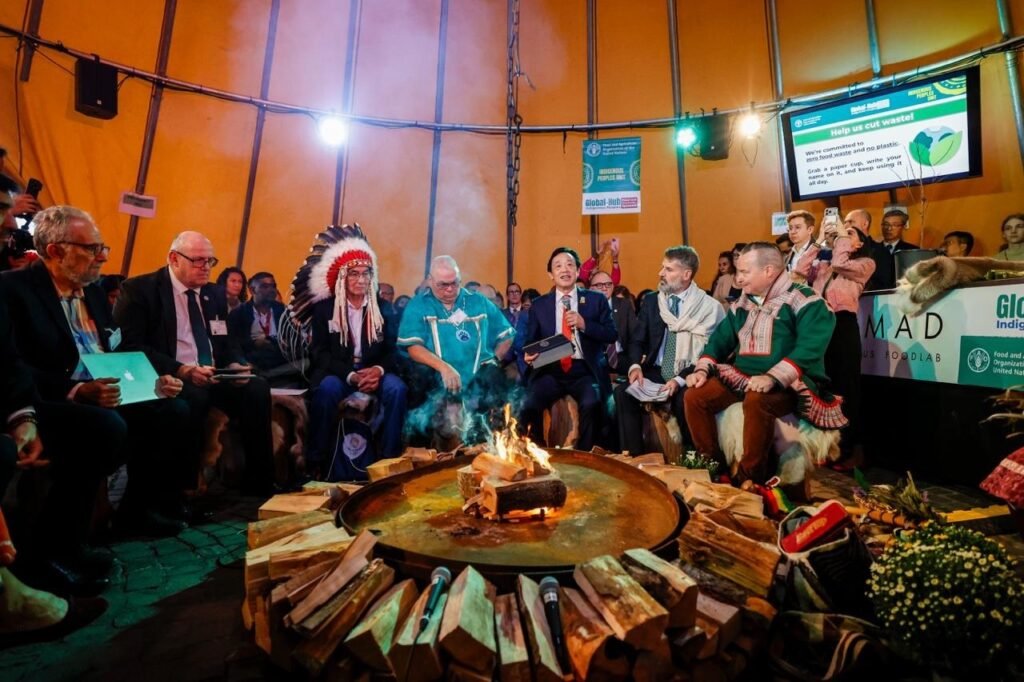
By Zablon Oyugi, October 13, 2026, Indigenous and non-Indigenous experts, government officials and knowledge holders from all seven sociocultural regions of the world have gathered at the Food and Agriculture Organization of the United Nations (FAO) headquarters in Rome to strengthen collaboration between science and traditional knowledge in addressing global food system challenges.
The gathering opened on Monday during the fourth annual meeting of the Global-Hub on Indigenous Peoples’ Food and Knowledge Systems, bringing together Indigenous Peoples’ leaders, researchers and policymakers to exchange experiences, co-create knowledge and promote the role of Indigenous knowledge in shaping sustainable food systems.
Hosted in two traditional Sámi nomadic tents, known as Lavvus, the meeting has established a dedicated Indigenous Peoples’ territory at the heart of FAO headquarters. The event is taking place during the week of World Food Day and the World Food Forum.
Opening the ceremony, FAO Director-General QU Dongyu acknowledged the shared history and ancestral connections linking all people to Indigenous Peoples, describing participants in the Global-Hub as humble intermediaries helping to transmit knowledge from one generation to the next.
He encouraged participants to learn from Indigenous Peoples and continue working alongside them to build a better future, while expressing appreciation to partners and supporters whose contributions sustain the annual gathering.
The proceedings began with a spiritual ceremony, followed by the Lighting of the Fire with Chief Deskaheh of the Haudenosaunee Nation.
María José Pinto, Vice President of Ecuador, highlighted the importance of Indigenous Peoples’ knowledge, cultures and traditions, sharing examples of their contributions to society.
Other participants included Oscar Mario Justiniano, Bolivia’s Minister for Sustainable Development, Environment and Water; Gita Chaudhary, Nepal’s Minister for Agriculture and Livestock Development; and government representatives from Guatemala, Ireland, Panama and South Africa.
Pedro Arrojo-Agudo, the United Nations Special Rapporteur on the human rights to safe drinking water and sanitation, and Pieternel Boogaard, Managing Director of the Office of Technical Delivery at the International Fund for Agricultural Development (IFAD), also attended.
Indigenous leaders and experts, including Anders Oskal of the Sámi people and Executive Director of the World Reindeer Herders Association, Valmaine Toki of the Māori people and Chair of the Expert Mechanism on the Rights of Indigenous Peoples, and Chief Wilton Littlechild of Canada’s Cree nation, participated in the opening ceremony, underscoring the importance of Indigenous expertise in global policy discussions.
Established in 2018, the Global-Hub has developed into a strategic think-tank bringing together 40 organisations and institutions, five international research networks and more than 250 experts. Its work focuses on the intercultural co-creation of knowledge to inform evidence-based policies, recognising Indigenous Peoples as key partners in achieving food security for all.
The 2021 White/Wiphala Paper, which highlights lessons from Indigenous Peoples’ food and knowledge systems, has become an important resource in global policy discussions. This year’s meeting will officially launch the White/Te Oranga Paper on Indigenous Peoples – Overcoming non-inclusive rural transformation, building on efforts to strengthen evidence for Indigenous Peoples-led policymaking.
The programme will explore science and innovation, vulnerability and prosperity, biocentric restoration and conservation, mobility, and nutrition. Knowledge exchanges will also examine biocentrism in the context of climate change and the rights of nature, alongside Indigenous Peoples’ roles as rights and knowledge holders in the 20th anniversary of the United Nations Declaration on the Rights of Indigenous Peoples.
The meeting will also mark the first anniversary of FAO’s HOPE Room, a dedicated space within the Food and Agriculture Museum and Network where Indigenous Peoples share their stories on their own terms.
Evening activities will feature country reflections around a burning hearth, dinners prepared by five Indigenous chefs, music and cultural showcases, providing opportunities to celebrate Indigenous cultures and amplify their voices on the global stage.