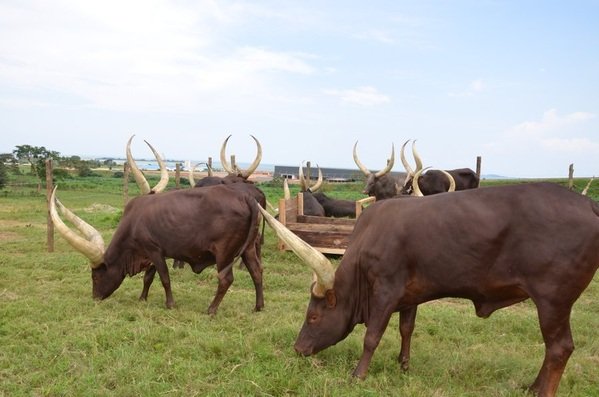
Ankole longhorn cattle in Uganda. Photo Credit: MAAIF_Uganda
By Zablon Oyugi, November 26, 2026, Uganda is urging livestock farmers to vaccinate their animals against Foot and Mouth Disease (FMD), warning that compliance with the compulsory vaccination programme is essential for farmers to continue trading and protect their livestock businesses.
According to the country’s Ministry of Agriculture, Animal Industry and Fisheries (MAAIF), vaccination is mandatory for cattle, pigs, sheep and goats, with farmers required to vaccinate their animals twice a year to help control the spread of the highly contagious disease.
In a notice to the producers, the ministry called on livestock farmers to take advantage of the vaccination programme.
The ministry said the vaccination exercise takes place during two designated periods: January and February, and July and August, with campaigns conducted every six months.
Under the government’s cost-sharing arrangement, farmers are required to pay UGX 8,000 per dose for cattle and pigs and UGX 4,000 for sheep and goats.
Farmers have been directed to register through their respective District Veterinary Offices to obtain a Unique Identifier number before making payments.
The ministry has designated Housing Finance Bank and Pearl Bank as the approved payment channels, warning farmers against making payments directly to individual veterinary officers or other persons.
Payments can be made through Housing Finance Bank branches or its mobile banking service using the USSD code 22510#, while Pearl Bank provides an agency banking option.
The vaccination drive forms part of Uganda’s broader strategy to control recurring FMD outbreaks, which have disrupted livestock production, restricted animal movements and affected access to domestic and export markets.
In June 2026, the government introduced compulsory biannual vaccination under a national cost-recovery scheme, with the government continuing to meet operational expenses, including vaccine distribution, cold-chain storage, disease surveillance and veterinary supervision.
Minister of State for Animal Industry Bright Rwamirama said the programme was intended to “progressively reduce FMD outbreaks, safeguard livestock investments, improve productivity, and support Uganda’s ambition to expand domestic, regional, and international trade in animals and animal products.”
FMD is a highly contagious viral disease affecting cloven-hoofed animals. It can cause fever, mouth and foot lesions, excessive salivation and lameness, while reducing milk production and affecting the reproductive performance of livestock.
Although mortality among adult animals is generally low, outbreaks can result in significant economic losses through reduced production, movement restrictions, quarantines and market closures.
Uganda’s vaccination strategy also includes plans to strengthen local vaccine manufacturing to reduce dependence on imported doses and lower costs for farmers.
In August 2026, Agriculture Minister Frank Tumwebaze told Parliament that Uganda had signed a partnership agreement with Egypt to establish a local FMD vaccine manufacturing facility.
“With the foot and mouth vaccines that we have in stock, we are vaccinating the four-hoofed animals. Cows are vaccinated at Shs8,000 and goats at Shs4,000. But when the factory is here, the price will drop substantially,” Tumwebaze said.
He added that the partnership had been signed, although he did not provide a timeline for the facility’s operations.
The planned manufacturing initiative is expected to improve vaccine availability and affordability, supporting the government’s efforts to achieve more consistent vaccination coverage.
Uganda is also strengthening regional cooperation in disease control, including coordination with neighbouring Tanzania on livestock vaccination and disease surveillance along their shared border.
The renewed vaccination appeal highlights the government’s efforts to protect livestock investments, sustain dairy and meat production and preserve market access for farmers as it seeks to strengthen the competitiveness of the country’s livestock industry.