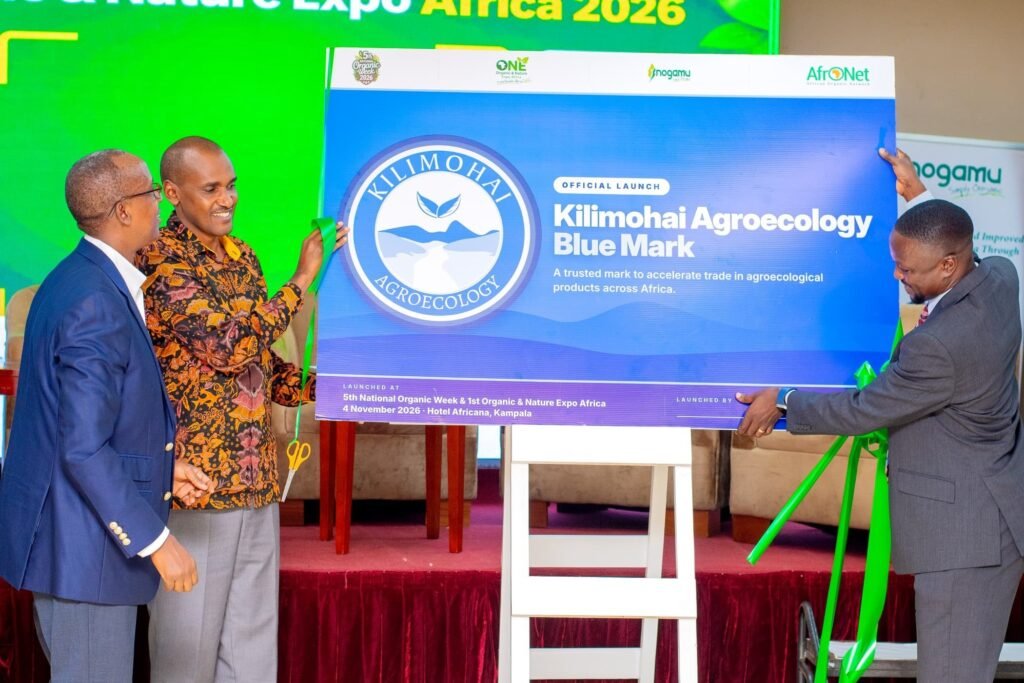
The launch of Kilimohai Agroecology Blue Mark in Kampala, Uganda. Photo credit: Maaifclf
By Zablon Oyugi, November 6, 2026: Uganda has launched a verification and certification tool to help farmers assess and promote agroecologically produced food in local and international markets, in a move aimed at strengthening consumer confidence, improving food systems and expanding opportunities for smallholder farmers.
The Kilimohai Agroecology Blue Mark was officially launched by Senior Presidential Advisor Odrek Rwabwogo, alongside the Minister of Agriculture, Animal Industry and Fisheries, Hon. Frank Tumwebaze, during the Organic & National Expo Africa 2026 in Kampala.
The new verification tool goes beyond conventional organic labels by assessing farming practices against agroecological principles, offering consumers greater assurance about how their food is produced while helping farmers demonstrate the sustainability of their agricultural practices.
The initiative is expected to strengthen the visibility and marketability of agroecological products, particularly those produced by smallholder farmers seeking to access premium domestic and international markets.
Speaking at the launch, Rwabwogo identified health and market value as two major drivers of growth in organic agriculture, highlighting the importance of preventive nutrition through affordable organic foods, vegetables and fibre-rich crops.
“The growing global demand for healthier food products presents significant economic opportunities for Uganda’s farmers and agribusinesses, provided they can meet market requirements and maintain consistent quality,” he said.
Rwabwogo also called for stronger food safety systems, proposing the establishment of a centralised food safety authority to coordinate certification, standards, documentation and quality assurance across the food value chain.
On market access, he urged farmers and agribusinesses to adopt a market-driven approach, emphasising the importance of conducting market research, identifying buyers and complying with international standards.
“Don’t produce things hoping someone will buy,” he cautioned, noting that poor record-keeping and inadequate documentation could prevent businesses from accessing lucrative export markets even when their products meet quality requirements.
He further called for increased investment in affordable financing, efficient transportation and improved storage infrastructure to support the growth of the organic sector.
Proposed interventions
Among the proposed interventions were product-based centres equipped with cold storage, drying facilities, farmer training, data collection and specialised logistics services to reduce post-harvest losses and improve competitiveness.
Rwabwogo also emphasised the need for collective action among farmers, businesses and industry stakeholders. “Collaboration is essential to achieving the production volumes, consistency and quality required in international markets.”
The launch comes amid growing interest across East Africa in affordable certification systems that enable smallholder farmers to demonstrate sustainable production practices and reach new consumers.
The Blue Mark is particularly significant because it provides a framework for recognising agroecological production beyond conventional organic certification.
Additionally, the system indicates that products have been assessed against 13 principles of agroecology through the Kilimohai Agroecology Assessment Tool. This distinguishes it from the Kilimohai Green Mark, which is associated with compliance with the East African Organic Product Standard.
Sustainable agriculture certification
The development also reflects wider regional efforts to make sustainable agriculture certification more accessible to smallholder farmers.
In Kenya, for instance, organic farmers are increasingly embracing Participatory Guarantee Systems (PGS), a community-based approach that allows farmers to assess one another’s production practices against agreed standards, reducing reliance on costly conventional third-party certification.
Local reports highlights growing demand for affordable certification as farmers seek to build consumer trust and access new markets noting that Kenya has approximately 64,000 certified organic producers, while its domestic organic market is valued at about KSh600 million.
As Uganda positions itself to benefit from the expanding market for sustainably produced food, the Kilimohai Agroecology Blue Mark could provide an important link between farmers, consumers and buyers seeking responsibly produced agricultural products.
Rwabwogo encouraged visitors attending the expo to explore Uganda’s countryside and discover the opportunities available beyond the country’s urban centres.
“Uganda’s organic agriculture sector has considerable potential to improve public health, generate incomes and strengthen the country’s agricultural economy, but unlocking these benefits will require investment, innovation, compliance with standards and stronger partnerships across the value chain,” he said.
The launch therefore marks an important step towards positioning agroecology as both a sustainable approach to food production and a viable economic opportunity for Uganda’s farmers.