
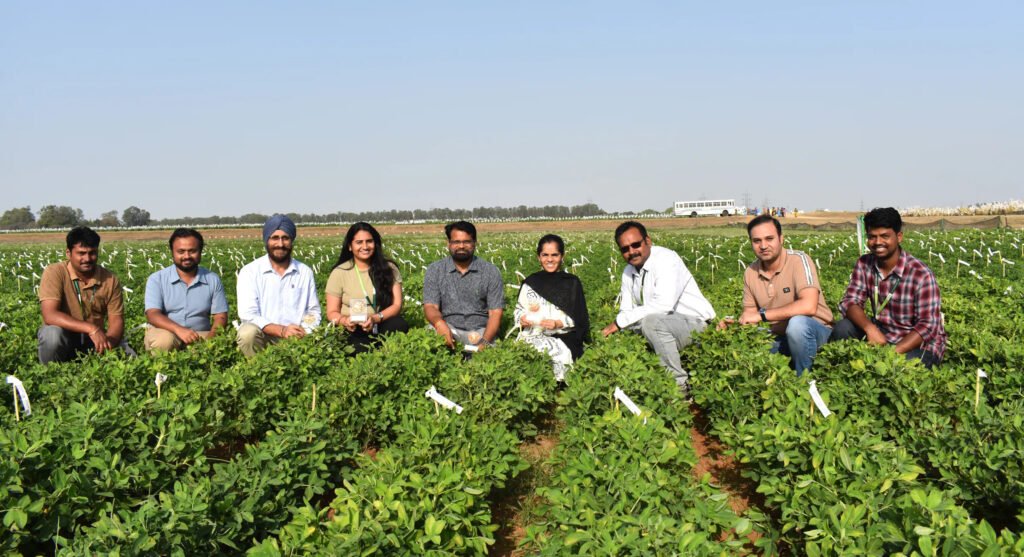
ICRISAT scientists pose for a photo in a groundnut farm. Photo Credit: ICRISAT
By Zablon Oyugi, April 27, 2026: Scientists at International Crops Research Institute for the Semi-Arid Tropics (ICRISAT) have identified key genes that make groundnuts easier to peel, a breakthrough expected to improve food processing efficiency and product quality across the industry.
The discovery focuses on a trait known as blanchability—the ease with which the thin outer skin of a groundnut can be removed. This step is essential in producing many popular foods such as peanut butter, chocolate, and snack bars.
However, many existing groundnut varieties have skins that are difficult to remove, leading to incomplete peeling, slower processing, and lower-quality final products.
The findings, published in the journals Communications Biology and BMC Plant Biology, provide the first detailed look at the genes responsible for this important trait.
According to ICRISAT Director General Himanshu Pathak, the research highlights how science can directly address real-world challenges faced by the food industry. He noted that the work is part of a broader effort to collaborate closely with partners to deliver practical and impactful agricultural solutions. He also pointed to the recently launched CATALYST initiative, which aims to strengthen partnerships between researchers and industry players to develop commercially relevant innovations.
In the study, scientists analyzed 184 different groundnut samples from the ICRISAT genebank. They identified specific regions in the plant’s DNA linked to blanchability and developed six practical genetic markers that breeders can use to select for the trait. One of these markers, known as S17_133752226, showed a strong and consistent link to easy peeling across multiple varieties.
Stanford Blade, Deputy Director General for Research and Innovation at ICRISAT, said the breakthrough demonstrates the importance of aligning crop breeding with market needs. He emphasized that private companies and markets play a key role in the agricultural value chain, and research must consider their requirements alongside those of farmers and consumers.
Further analysis revealed that the genes involved in blanchability are linked to processes such as cell wall changes, metabolism, and the loosening of the seed coat. These insights will help breeders develop new groundnut varieties that are not only high-yielding but also easier to process.
The study also identified several traditional groundnut varieties, known as landraces, that naturally show strong blanchability. Some performed well during the rainy season, while others were better suited to the post-rainy season. In particular, Spanish bunch-type groundnuts consistently achieved more than 60 percent peeling efficiency.
Another important finding is that one subspecies, known as fastigiata, generally has better blanchability than hypogaea, making it a strong candidate for future breeding programs.
Manish K Pandey, a principal scientist at ICRISAT, said the study provides a valuable set of tools that breeders can use to improve groundnuts. He added that similar tools developed by the institute have already helped speed up the creation of improved varieties with traits such as disease resistance and better nutritional quality.
The research was carried out in collaboration with partners including the Indian Council of Agricultural Research and received support from organizations such as the Council of Scientific and Industrial Research, University Grants Commission, Mars Inc., and the Bill & Melinda Gates Foundation.
The breakthrough underscores the growing importance of research that responds to industry needs, while also benefiting farmers and consumers through better-performing crop varieties.