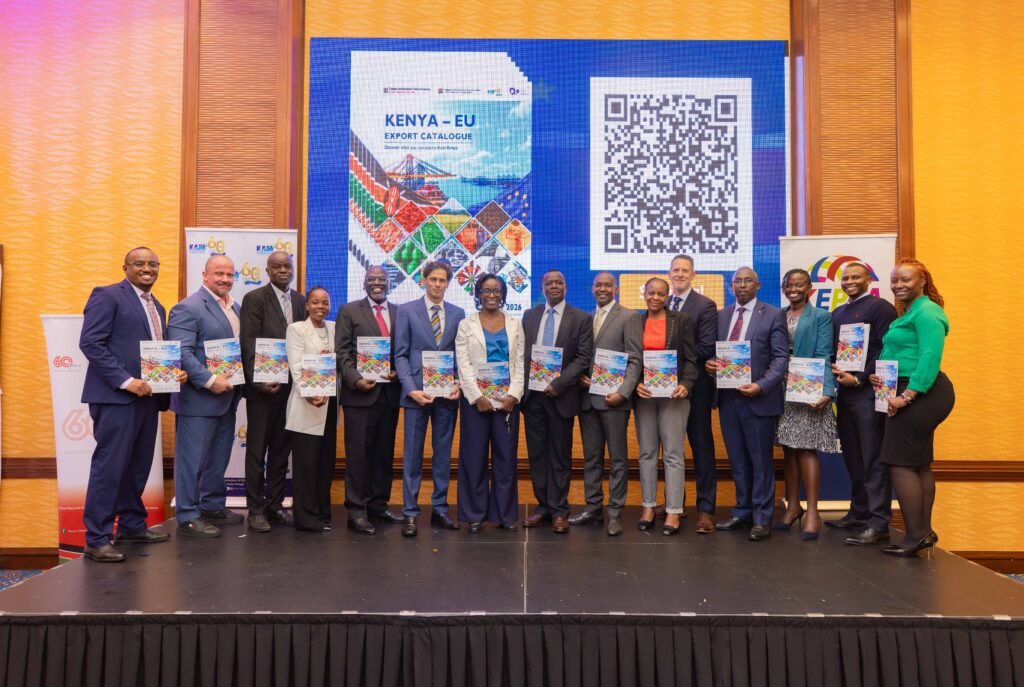
By Murimi Gitari, October 29, 2026, Kenyan manufacturers, producers and exporters now have a new way to reach buyers in the European Union (EU), after the Kenya Association of Manufacturers (KAM) launched the Kenya-EU Export Catalogue 2026 in Nairobi on Wednesday.
The catalogue was developed with the State Department for Trade, the State Department for Foreign Affairs and Danish Industries East Africa. It is meant to help European buyers find Kenyan suppliers, explore sourcing options and build lasting business relationships with local enterprises. It covers food and beverages, textiles and apparel, leather products, chemicals, furniture, pharmaceuticals, building materials and electrical products, alongside traditional exports such as flowers, fresh produce, tea and coffee.
The EU brings together 27 member states, more than 450 million consumers and a GDP above €18.8 trillion, while Kenya’s exports to the bloc currently stand at about US$1.85 billion. The catalogue is designed to push that figure higher by promoting value addition and encouraging manufacturers to scale up production to meet international demand.
Speaking on behalf of Principal Secretary Regina A. Ombam, Dr. Michael Mandu, Secretary at the State Department for Trade, urged stakeholders to ask why Kenya captures only a fraction of the EU’s import market.
“If Kenya is currently capturing only 10% of the European Union’s import market on flowers alone, we must ask ourselves what it will take to unlock the remaining 90% of the opportunity,” he said.
Dr. Mandu noted that preferential market access alone will not guarantee higher exports. Kenya, he said, needs a deliberate export strategy that identifies products with strong market potential, strengthens local enterprises, promotes value addition and removes the barriers that limit access to international markets. He described the Kenya-EU Economic Partnership Agreement (EPA) as a strong foundation and the catalogue as an important step, adding that the focus must now shift to turning access into real results through increased exports and stronger partnerships.
Director Evans Maturu of the Ministry of Foreign and Diaspora Affairs, speaking on behalf of Principal Secretary Dr. Korir Sing’Oei, said the Ministry is ready to support implementation of the EPA, which he called one of Kenya’s newest and most ambitious trade agreements. He cautioned, however, that the EU is a highly stringent market and Kenyan businesses must be well prepared to meet its standards.
Mr. Maturu said the Ministry is aligning the work of Kenya’s diplomatic missions with the country’s trade priorities and strengthening market intelligence for businesses seeking to enter or expand in Europe. Trade attachés and diplomatic representatives, he added, will help identify opportunities, share market insights and connect Kenyan enterprises with potential buyers and partners.
KAM Board Chairperson Hitesh Mediratta said Kenya is well placed to become a preferred sourcing destination for European buyers seeking reliable and diversified supply chains, but stressed that market access is not enough on its own. He pointed to structural barriers that continue to hold back manufacturers, including the high cost of production, expensive and unreliable energy, transport and logistics inefficiencies, complex regulatory processes and the cost of meeting international standards.
Mr. Mediratta said KAM works with government and development partners to push for policies that improve competitiveness, and helps businesses navigate EU requirements through market intelligence, internationally recognised certifications and capacity-building support. Through business linkages, training programmes and trade missions, he said, the association is connecting manufacturers with buyers and investors so that the opportunities under the EPA translate into increased exports, investment and industrial growth.
Mr. Erik Thomas Johnson, General Manager of Danish Industries East Africa Emerging Markets, said the visibility of local products and supplier capabilities is a key step towards creating new sourcing opportunities. “The Kenya-EU Export Catalogue provides a platform for European buyers to discover the breadth of products and capabilities available in Kenya,” he said, adding that stronger connections between businesses are essential for reliable supply chains and long-term partnerships.
Several key players in Kenya’s export ecosystem contributed to the catalogue. They include the Agriculture Sector Network (ASNET), Avocado Society for Kenya (ASOK), Fresh Produce Consortium (FPC), Fresh Produce Exporters Association of Kenya (FPEAK), Kenya Flower Council (KFC), Kenya National Chamber of Commerce and Industry (KNCCI) and Kenya Private Sector Alliance (KEPSA), together with the State Department for Trade, the State Department for Foreign Affairs and relevant government agencies.