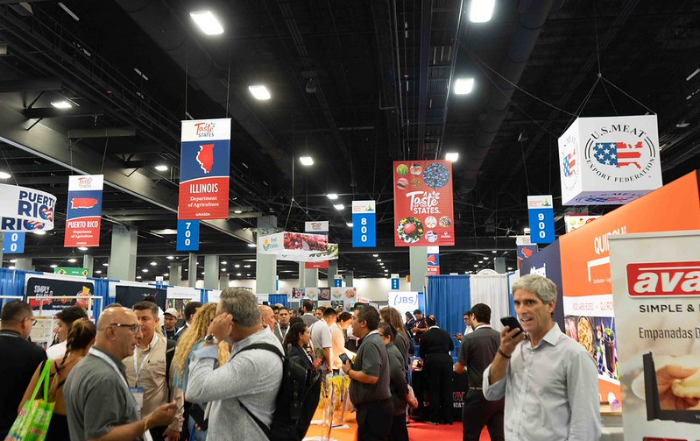
Buyers and exhibitors on the floor of the Americas Food & Beverage Show in Miami, where overseas buyers meet American suppliers in scheduled meetings. Photo Credit: NASDA
A trade mission to Morocco, two big US food shows and a Kenyan delegation to Indiana show how export relationships get built, and where Kenya might fit in.
By Murimi Gitari, November 03, 2026, Oussama Alaoui, the chairman and chief executive of the Moroccan firm Stellar International, was among the Moroccan buyers at the 2024 National Restaurant Association Show in Chicago.
They were there because of the relationships formed during a trade mission by the National Association of State Departments of Agriculture (NASDA) to Morocco.
Alaoui left Chicago having met 21 new US suppliers and identified five possible distributorship deals.
At the Miami show that year, Stellar’s senior business development manager, Youssef Tagma, projected purchases of $100,000 to $250,000 after meeting American exhibitors. By 2025 the reports were firmer. Charaf Dafer, general manager of Anouar Invest, cited about $1.2 million in purchases after the Chicago show, and Abdelaziz Guider of Panna Negoce cited between $100,000 and $250,000 in immediate purchases at the Miami show that September, with a similar amount still to come.
A reverse trade mission sponsored by the US Department of Agriculture (USDA) brought four more Moroccan buyers to Miami as well. The figures are the buyers’ own, relayed by the organisers, but they trace a clear line: a January 2024 mission, introductions at that year’s shows, and the largest reported purchase after the 2025 Chicago show.
A weeklong visit to California in June 2025 added another layer. It was held under USDA’s Regional Agricultural Promotion Program and organised with the Foreign Agricultural Service (FAS) office in Rabat, the California Department of Food and Agriculture and the Almond Board of California. The Moroccan delegation brought officials from the country’s food safety authority together with executives from Stellar, AMA Holding, Moulins Atlantic and Mundiriz.
At the Salinas Biological Summit the delegation met California Secretary of Food and Agriculture Karen Ross. Over the week it explored cooperation on artificial intelligence, regulatory alignment, port logistics, water and soil management, biotechnology, food safety, drought resilience and high-value crops such as tree nuts and citrus. NASDA’S chief executive officer, Ted McKinney, called the visit “an important step in further strengthening agricultural ties between Morocco and the U.S.” and said it was clear there is “a strong appetite on both sides to build long-term trade relationships”.
What the Moroccan story shows is how differently missions and trade shows work, and why the two do best together. A show puts buyers and sellers in one hall for a few days and turns introductions into orders. A mission does the slower work that makes those orders possible, bringing regulators, company executives and officials into one conversation about standards, food safety, port logistics and which products might travel.
The value of a show begins with scale, and the organisers say the Chicago show hosts buyers from more than 110 countries, and the pavilion for 2026 was the largest yet at 17,900 square feet. For the September edition in Miami they announced a 22,200-square-foot pavilion with 178 companies and organisations and 32 sponsored buyers from 23 countries, and said their Buyers Mission had held more than 1,500 scheduled meetings the year before. A buyer who might spend months travelling to meet suppliers one by one can meet dozens in a few days, and can compare prices, packaging and quality side by side.
Those meetings are arranged rather than left to chance, and the organisers say overseas buyers join through their local FAS office as part of a USDA/FAS delegation, which comes with meetings pre-matched with American producers, and that they recruit buyers from the Americas, the Caribbean and Africa. The next Chicago edition is listed for 22 to 25 May 2027 at McCormick Place.
Missions offer a different kind of return. The California programme put Moroccan food safety officials and company executives in front of the state’s agriculture secretary and its commodity bodies. Its agenda ran from regulatory alignment and port logistics to biotechnology and drought resilience. Questions of that kind decide whether a product can cross a border at all, and they are easier to settle when the people responsible for the rules have already met.
These fairs and other shows add a third benefit, which is information. They give producers and traders a direct read on what buyers want in volumes, specifications and pricing, and they let newer exporters test a product before committing to a market. The Moroccan buyers’ return visits across 2024 and 2025 show the other side of that, since the largest purchase reported came after the second year’s Chicago show, roughly twenty months after the January 2024 mission. The first meeting rarely closes the deal, and the value builds with each repeat.
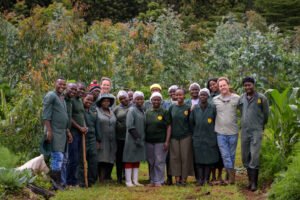
Kenya, which has high ambitions to grow its exports, has embarked on a similar mission in search of trade and investment opportunities. In October 2025, a high-level group drawn from government ministries, the private sector, academia and civil society spent a week in Indiana on a programme covering biotechnology, animal feed, biofuels and sustainable agricultural systems. The mix of participants echoes the Moroccan party, in which regulators and executives shared a programme, and it put Kenya’s public and private sectors in front of their American counterparts together.
State Department for Trade Principal Secretary Regina Ombam said at a past forum the government wants exports growing by 10 per cent a year, with agriculture and agro-processing among the areas marked for investment. She said Kenya can no longer afford to export agricultural commodities largely as raw materials while importing processed products.
“We are looking at really pushing the aspect of value addition so that our products also become competitive in the global market,” she said.
Ombam also said Kenya is positioning itself as a gateway to regional markets through the East African Community (EAC), the Common Market for Eastern and Southern Africa (COMESA) and the African Continental Free Trade Area (AfCFTA), which gives a buyer or supplier in Nairobi a reach beyond Kenya’s own borders.
Tom Onguru, Head of Strategy at the Kenya Association of Manufacturers, said stronger links between farmers and processors could strengthen local manufacturing, and noted that the country still imports more than 90 per cent of its rice.
Those priorities suggest where Kenya could gain in the way Moroccan firms did. Importers, distributors and processors who attend such shows as buyers can meet suppliers of ingredients, inputs and technology, and negotiate with several at once. Kenyan exporters, who are not the exhibitors at these US pavilions, stand to gain mainly through missions and other fairs, where relationships and market information are built. Coffee and cut flowers are already familiar names in the American market, and tea, nuts and avocado are seen as having further potential there, with import and policy decisions remaining a matter for Kenyan authorities.
Morocco’s record also hints at how a country can present itself to get the most from this system. Its delegations arrived as teams, with regulators and executives travelling together, and its buyers came back year after year rather than once. For Kenya, a similar approach would mean going to missions and shows with a clear story on value-added products, the regional market reached through the EAC, COMESA and AfCFTA, and the farmer-to-processor links that Onguru described, and with associations and government coordinating who attends and what each delegation is there to achieve.
None of that happens quickly, and Morocco’s purchases followed a mission, repeat visits to the shows and a programme that put officials and executives in the same room. While Kenya’s delegation to Indiana was a first step of that kind, what follows, including how many Kenyan businesses are in the room at the next missions and shows, will indicate how far the comparison holds.