
By Murimi Gitari
Kenya and the United States are exploring a new pathway to rebuild Kenya’s ailing agricultural extension system, one that runs through the country’s universities rather than around them.
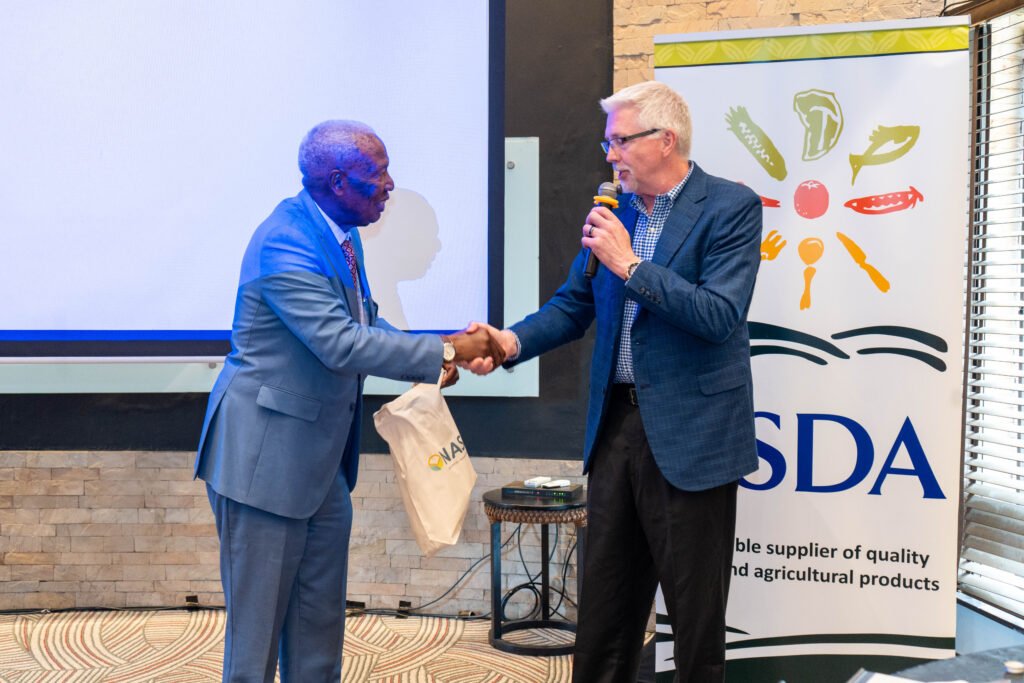
The idea took centre stage during a week-long visit by a delegation from the US National Association of State Departments of Agriculture (NASDA), which culminated in a forum jointly hosted by NASDA and its Kenyan implementing partner Rootooba.
The session brought together senior American state agriculture officials, industry leaders, and the academia led by Kenya’s university vice-chancellors to discuss what a modernised, university-anchored extension model could look like for Kenyan farmers.
At the heart of the conversation is a familiar problem: Kenya once ran one of the more effective agricultural extension systems in the region, but that machinery has steadily broken down.
The devolution of agriculture to county governments in 2013 fractured what used to be a centrally coordinated service, leaving counties with uneven capacity, thin budgets and little coordination with research institutions or universities.
Extension officers today are stretched thin, often lacking transport, training or modern communication tools to reach the smallholder farmers who need them most.
For the American delegation, the fix lies partly in a system their country has run for more than a century: the land-grant university model, in which teaching, research and extension are fused into a single, closely coordinated pipeline.
Doug Miyamoto, Director of the Wyoming Department of Agriculture, said that the same logic could be applied to Kenya’s universities, many of which already sit on strong agricultural research capacity that rarely reaches the farm gate.
“We believe that extension can provide a vehicle to get that great technical information that you have out to your farmers and ranchers,” Miyamoto said.
That framing resonated with Kenyan university leaders in the room, among them Prof Daniel Mugendi Njiru, chair of the Vice-Chancellors Forum for Public Universities in Kenya, and Prof Ratemo Michieka, Chancellor of Tharaka University. Prof Mugendi acknowledged that despite agriculture remaining the backbone of Kenya’s economy, the systems meant to connect research to the farmer have weakened considerably at the county level.
“As we all know, the issue of extension has not been handled very well in our counties, and yet agriculture is the backbone of our economy,” he said.
Kenya, he added, once had a comparatively strong extension architecture that has since fallen apart.
“We used to have an agricultural system here that worked very well in the 70s, in the 80s, and in the 90s, but somehow that broke down, and now we do not seem to have a very well-coordinated system,” Prof Mugendi said.
He noted that Kenya could draw on the US land-grant university model, which anchors extension work inside universities and creates a direct pipeline between research, innovation and farmers, one that could be adapted locally through stronger partnerships between universities, county governments and the national government.
The proposal now under discussion is to test what NASDA and Rootooba are calling a “triple-helix” model — a structured partnership linking county governments, universities and industry, with each playing a distinct role. Counties would provide coordination and policy support, universities would contribute research-based insight, and industry actors would bring in technical expertise and resources.
According to a concept note jointly developed by NASDA and Rootooba, the plan is to pilot this framework in selected counties chosen to align with USDA’s existing strategic partnerships, before evaluating whether the model can scale to other parts of the country.
Before any pilot begins, however, the partners intend to start with groundwork: a landscape assessment involving key informant interviews with universities, the Kenya Agricultural and Livestock Research Organization (KALRO), county-level extension officers and farmers, alongside a review of Kenya’s existing extension policy to identify where it aligns — or clashes — with the American model under consideration.
The timing is notable. Kenya’s National Assembly approved the Agricultural and Livestock Extension Services Bill June 10, 2026, opening the door to a more coordinated, technology-driven and farmer-centred extension system aimed at lifting productivity, raising incomes and strengthening food security nationwide. That legislative shift gives the NASDA-Rootooba proposal a policy framework to plug into, rather than having to build one from scratch.
NASDA’s chief executive, Ted McKinney, a former US Under Secretary of Agriculture for Trade and Foreign Agricultural Affairs, was careful to frame the initiative as an offer rather than a prescription.
“We’re here not to tell Kenya what to do. That’s not our business,” McKinney said. “But maybe there’s something that we can provide from our own rich experience with a robust extension system.”
McKinney was careful to note that Kenya would not be building from nothing.
“Kenya had an extension service, a formal extension service, many years ago. But maybe there is something that we can provide from our own rich experience with a robust extension system that might be of value to the Kenyan university, county, and government system,” he said. “It is not a complete do-over. It is not starting from scratch. You have got some history. But it will take some political will.”
That caution extends to the funding attached to the idea. McKinney said NASDA has committed modest resources estimated at between $100,000 and $200,000 to bankroll an initial study involving universities, government, farmers and food processors. The findings from that study, rather than any predetermined blueprint, are expected to shape whatever consultations and interventions follow. McKinney was equally clear that decisions on Kenya’s agricultural policy direction, including any changes to import rules, would remain entirely with Kenyan authorities.
That posture reflects why NASDA has singled out Kenya for deeper engagement on the continent in the first place. McKinney pointed to structural similarities between Kenya’s agricultural sector and those of many US states, a mix of smallholder-driven production, livestock systems and a policy environment grappling with how to modernise extension and regulatory capacity at the same time.
The extension discussion did not happen in isolation. It formed one of three themes on the delegation’s agenda, alongside barriers to US-Kenya trade in priority agricultural commodities and an emerging interest in livestock feed, genetics and distillers dried grains (DDGs) as an area for technical cooperation.
The numbers underline how much room there is to grow. In 2024, US agricultural exports to Kenya were valued at roughly $33 million to $43 million, enough to rank the United States only 98th among Kenya’s agricultural export markets, according to figures cited in briefing materials prepared ahead of the delegation’s visit.
Current American exports to Kenya are concentrated in vegetable oils, food preparations, planting seeds and pulses.
Bigger-ticket commodities such as corn and soy-based animal feed remain largely locked out, constrained by Kenya’s restrictions on genetically engineered products and by sanitary and phytosanitary approval processes that do not yet recognise US inspection certificates for a number of products.
Miyamoto said the US sees room to expand trade in both directions, pushing for greater access for American animal feed, while also supporting wider entry for Kenyan exports such as coffee and cut flowers into the US market.
McKinney added that the partnership could eventually open space for increased US exports of soybean meal, distillers’ grains and sorghum, a prospect that has gained additional relevance amid concerns over Kenya’s reduced maize harvests in recent seasons.
Even so, he reiterated that any decisions on what enters Kenyan markets, and on what terms, rest with Kenyan regulators.
The delegation that travelled to Kenya was led by McKinney and included four sitting state agriculture secretaries and directors: Wes Ward of Arkansas, Ed Wengryn of New Jersey, Jeff Witte of New Mexico and Doug Miyamoto of Wyoming.
They were joined by Jay Weiker, President of the National Association of Animal Breeders, and Dr. Jack Elliot, Regional Director for Africa and the Middle East at the Norman Borlaug Institute for International Agriculture and Development at Texas A&M University. Rootooba’s in-country leads, Esther Muchiri and Dr Charity Mutegi, hosted the week-long programme.
Over the course of the visit, the delegation held meetings with officials from the US Embassy, the Council of Governors, and various private-sector associations, alongside field visits to Kenyan agribusinesses and livestock operations.
NASDA itself represents the commissioners, secretaries and directors of the departments of agriculture across all 50 US states and four US territories, and works closely with federal agencies including the USDA, the FDA and the EPA, while facilitating collaboration with states, industry, universities and international partners.
Beyond the extension study, the broader partnership between NASDA and Rootooba envisions a fuller programme of engagement over the coming year, including a series of stakeholder roundtables on US-Kenya trade convened through Kenya’s Agriculture Sector Network, buyer recruitment for Kenyan exporters ahead of major US trade shows in Chicago and Miami, and the development of a market information dashboard intended to give Kenyan exporters and regulators a single point of access to trade and compliance data.
For now, though, the extension conversation remains at an early, exploratory stage, a study still to be commissioned, universities and county governments still to be formally brought on board, and a model still to be adapted, not imported wholesale, from the American experience.
If Prof Mugendi’s account of a system that “worked very well” decades ago but has since come apart captures the scale of the gap, McKinney’s insistence that the US is offering “something,” not instructions, may be the more telling signal of how this partnership is meant to unfold: incrementally, and on Kenya’s terms.