By Murimi Gitari
Agriculture in Kenya is more than just an economic sector. It is the backbone of livelihoods, food security, and national development.
Yet, it faces mounting pressures from climate change, population growth, and inequality, all of which demand urgent transformation of the systems that sustain it.
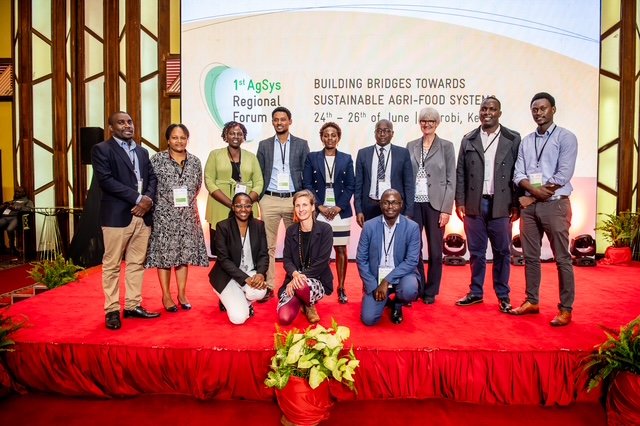
At the centre of this transformation is the Sustainable Agricultural Systems and Policies (AgSys) Project. Commissioned by Germany’s Federal Ministry for Economic Cooperation and Development (BMZ), the project is being implemented by Deutsche Gesellschaft für Internationale Zusammenarbeit (GIZ) GmbH in partnership with Kenya’s Ministry of Agriculture and Livestock Development (MoALD).
Through innovative financing, inclusive policy frameworks, and collaborative partnerships, AgSys is reshaping Kenya’s agrifood systems into resilient, sustainable, and inclusive engines of growth.
“AgSys as a global programme is implemented in several countries and aimed at translating international agendas and commitments into national action aligned with national policy priorities. One of GIZ’s core principles is cooperation and partnership. This means that AgSys has been planned and implemented jointly with partners, is demand-driven, context-specific, aligned with national priorities and owned by partner institutions,” says Dr Sophia Baumert, the project manager.
AgSys’s five core intervention areas are: promoting transformative agricultural policy, scaling proven practices and innovations, strengthening the inclusion of civil society particularly women and youth, aligning financial flows for sustainable agriculture, and linking national reforms with regional and global agendas.
Kennedy Okech, the lead for sustainable financing, notes that financing remains underutilised as a catalyst for transforming the agrifood systems, largely due to fragmented approaches and limited coordination between public and private stakeholders. One of the key gaps, he says, is the absence of a structured platform to collectively identify financing priorities and align efforts.
Another challenge is the limited awareness and technical capacity within financial institutions to tap into emerging opportunities such as nature-based solutions (NbS). Through its partnership with the Kenya Bankers Association (KBA), AgSys supported a study that identified viable investment opportunities in this space. The findings highlighted a clear need for capacity development particularly in blended finance to help institutions build strong investment pipelines and meet required financing criteria.
“I see blended finance models unlocking much needed investment in Kenya’s agri-food sector by reducing risk for both farmers and lenders. Through blended finance, public or donor funding is combined with private capital to share risk, making it easier for financial institutions to extend credit to smallholder farmers and agri-SMEs that are often perceived as too high-risk under traditional lending models,” Okech says.
Okech also sees policy and institutional gaps as a major constraint to effective delivery of agricultural financing. Working alongside the MoALD, AgSys has contributed to the development of a draft Policy Framework for Subsidy Management in Agriculture, which will contribute to more effective and efficient use of public resources with greater productivity and soil health outcomes.
“One recommendation I find particularly important is the proposed establishment of an Agriculture Development Fund (ADF). If implemented well, I believe this could improve how public finance is managed while also creating space for blended finance solutions that encourage greater private sector lending in the agrifood systems,” he says.
The proposed ADF is a government initiative to boost agriculture by providing affordable finance, grants, and training to farmers, cooperatives, and agribusinesses to raise productivity, cut post-harvest losses, and strengthen food security.
It prioritises youth and women, promotes climate-smart agriculture to build resilience to drought and soil degradation, and helps shift farming from subsistence to sustainable, commercial production by closing gaps in funding and technology.
Another issue that stands out is the lack of clear and consistent data on agricultural lending. In many cases, financial institutions place agriculture into a broad category or even classify agricultural loans under personal lending. This makes it difficult to truly understand how much financing is reaching the sector and how effective it is. To help address this, AgSys has partnered with ACELI Africa and the KBA to explore the development of a standardised agricultural credit taxonomy. Okech sees this as “a critical step toward improving data clarity, which can ultimately lead to better lending decisions, stronger policies, and increased investment in the agrifood sector.”
Another central innovation that AgSys is working on are Crop insurance solutions .
Crop insurance are helping farmers manage uncertainty by protecting them against losses from weather shocks and other risks.
For example, AgSys together with partners Clim-EAT and Acre Africa, is implementing a crop and livestock insurance pilot across Makueni, Nandi, Tharaka Nithi, and Meru counties. Within this initiative, Clim-EAT and Acre Africa lead monitoring, evaluation, learning, and technical support, including farmer and village champion training, as well as crop monitoring. AgSys complements these efforts by providing targeted insurance subsidies to farmers.
“From my experience working on the agriculture insurance pilot, I have seen just how important timely payouts are for farmers, and they really make a difference in helping farmers recover and remain resilient. I think it is important for the farmers to appreciate that while insurance does help to reduce the impact of climate risks, it does not take away all the losses,” Okech says.
AgSys works within a multi-stakeholder setting, including county governments, private sector actors, and farmer organisations. “To build trusted and productive partnerships, start with deep listening, ask questions and surface underlying interests so that stakeholders feel respected and less defensive in politically sensitive policy spaces. Make collaboration concrete and fair by jointly identifying opportunities and gaps, moving them into a design phase, co-creating specific intervention areas, and agreeing on roles, responsibilities, and resource allocation to avoid the risk of ‘talk shops’ and secure buy-in on all sides”, .” Dr Baumert shares lessons learned.
She adds: “We understand our role as partnership broker and facilitator; onethat can hold the process, balance interests, mediate conflict, keep power asymmetries on the table, and ensure quieter voices are heard. Practice transparency and accountability about motives, constraints, and risks – including what you cannot fund or promise – is essential to avoid perceptions of hidden agendas.”
Inclusivity in policy processes is another priority by the AgSys project. Okech explains that working at the macro level mainly supporting policies and their implementation, needs a deliberate and intentional approach towards inclusivity.
AgSys is supporting women and youth in their capacities to meaningful participate in policy processes and supports the Ministry in the implementation of inclusive stakeholder consultations.
“Through our engagement with so called “change agents” many described moving from being unsure or silent in public spaces to confidently speaking, influencing discussions, and even taking up leadership roles,” Okech notes.
AgSys has also reviewed public finances such as the Youth Fund and Women Enterprise Fund (WEF) to identify opportunities and barriers, with the next phase involving support to WEF to develop more inclusive products targeting women.
Measuring impact in policy projects is complex. Dr Baumert notes that policy change is nonlinear, collective, slow-moving, and embedded in complex systems where causality and data are messy. “We are rather following a contribution lens relying on qualitative evidence, process tracing, and plausibility arguments.”
Examples include strengthening the policy environment for agricultural input subsidies through inclusive consultations, reaching over 25,000 farmers with information on agricultural insurance, resulting in 3,000 policies taken up, and timely compensation payments that strengthened trust in insurance products. AgSys has also strengthened the enabling environment for private sector financing of nature-based solutions by generating investment evidence and supporting early adoption of nature-related financial practices.
Looking ahead, Okech sees the need for enabling environments to scale AgSys’s financing models. “Financing agrifood systems calls for a very different approach than the traditional lending which has not been successful in adequately financing the agrifood system..”
He emphasizes embedding de-risking tools into agricultural lending, strengthening digital infrastructure, and establishing Agricultural Development Funds.
“I’ve seen how these funds, successfully implemented in countries like Nigeria, Algeria, and Morocco, can play a catalytic role in attracting private investment into agriculture,” he says.
Dr Baumert reflects on her own journey, saying she has picked some important lessons along the way,
“I like policy projects because they sit at the strategic level where narratives, power, emotions and evidence come together, and that is where meaningful change can actually be shaped. My own journey, working with Kenyan and international partners on soil health, fertiliser policies, climate finance, and farmer level innovations, has shown me both the limits of projectised approaches and the power of aligning public and private players around a common direction,” she says.
Okech envisions AgSys shaping the future of climate-resilient financing across Africa.
“Looking ahead, I believe that expanding AgSys across Africa will take more than just good policies. It will require practical, forward-thinking solutions that make agricultural finance work better for everyone. I hope agriculture will no longer be seen as a high-risk sector, but as a strong and attractive investment opportunity. I want its legacy to be one of unlocking private capital, efficient public support, strengthening farmers’ resilience, and building inclusive systems where women and youth are at the forefront of Africa’s agricultural transformation,” he says.
“We have been part of the Financing Agrifood Systems Sustainably (FINAS) Summit and Dialogues since its inaugural conference in 2024, and GIZ is proud to have stood as the main sponsor from the start,” Dr Baumert and Okech note jointly.
“As we look ahead, we remain committed to supporting FINAS and call on all partners to join us in turning this vision into tangible impact across Africa’s agrifood systems.”
The Deutsche Gesellschaft für Internationale Zusammenarbeit (GIZ) GmbH is a German federal enterprise that provides services in international cooperation for sustainable development. Owned by the German government, it works in over 120 countries, focusing on economic development, climate protection, peace, security, and governance.
GIZ is a service provider and implementer in the field of international cooperation for sustainable development and education. Together with its partners, GIZ works to deliver effective solutions that offer people better prospects and sustainably improve their living conditions.