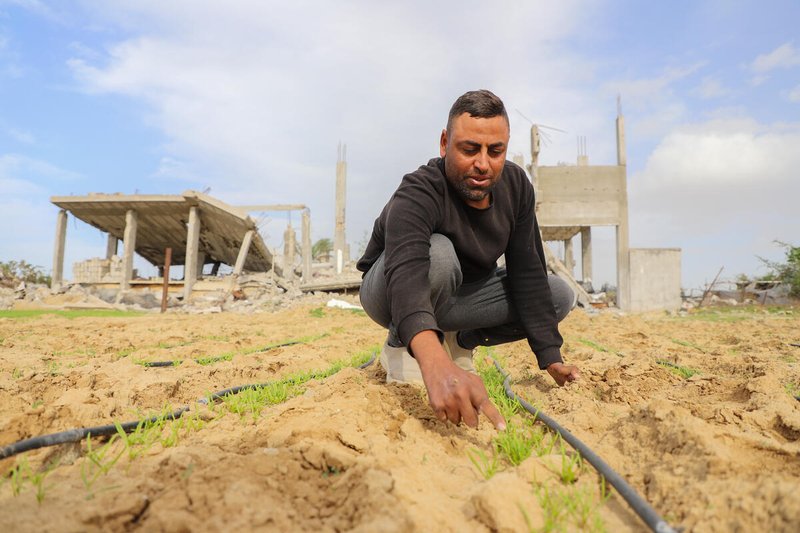
Millions of people in food-crisis contexts face high levels of acute food insecurity, driven by conflict, climate shocks and economic pressures. Photo Credit: FAO
Acute food insecurity and malnutrition remain alarmingly high worldwide, with crises increasingly concentrated in a handful of countries, according to the Global Report on Food Crises (GRFC) 2026 released today. The landmark tenth edition reveals that acute hunger has doubled over the past decade, with famine declared in Gaza and parts of Sudan last year, the first time in the report’s history that famine was confirmed in two separate contexts in the same year.
The report, published by the Global Network Against Food Crises, shows that ten countries — Afghanistan, Bangladesh, the Democratic Republic of the Congo, Myanmar, Nigeria, Pakistan, South Sudan, Sudan, Syria, and Yemen — accounted for two-thirds of all people facing high levels of acute hunger. Afghanistan, South Sudan, Sudan, and Yemen were among the hardest hit.
“Conflict remains the primary driver of acute food insecurity and malnutrition for millions around the world, with outright famine emerging in two conflict-affected areas in the same year — an unprecedented development,” said United Nations Secretary-General António Guterres.
In 2025, 266 million people across 47 countries and territories experienced high levels of acute food insecurity — nearly 23 percent of the analysed population. The number of people facing catastrophic hunger (IPC Phase 5) is now nine times higher than it was in 2016. Children have been particularly affected, with 35.5 million acutely malnourished last year, including nearly 10 million suffering from severe acute malnutrition.
The report warns that severe levels of acute food insecurity remain critical in multiple contexts this year. Ongoing conflicts, climate variability, and global economic uncertainty are expected to sustain or worsen conditions. The escalation of conflict in the Middle East is already exposing food-crisis countries to risks of global agrifood market disruptions, with rising energy and logistics costs eroding the purchasing power of vulnerable communities.
A sharp decline in humanitarian and development financing has limited governments’ and aid agencies’ ability to respond effectively. Data collection has also suffered, with fewer countries able to produce reliable food security and nutrition estimates.
European Commissioner Hadja Lahbib described the report as “multilateral cooperation at its best,” stressing that hunger is worsening and the findings must serve as an early warning. Her colleague Jozef Síkela added that food crises are “often the first signal of deeper fragility,” underscoring the importance of reliable data in guiding global action.
German State Secretary Niels Annen said: “Responding alone is not enough. Reliable data is the basis for effective interventions. The Global Report on Food Crises is therefore more relevant than ever.”
UK Minister for Development Jenny Chapman warned against complacency. “We must not grow numb to the harrowing impact of hunger and malnutrition — something I saw for myself when I visited the refugee camps in Adré on the border with Sudan last year.”
FAO Director-General QU Dongyu stressed the structural nature of the crisis: “This is no longer a series of crises, but a structural problem. We must shift from reacting too late to acting early, and from relying solely on food assistance to protecting local food production.”
UNICEF Executive Director Catherine Russell highlighted the plight of children: “Millions of children on the verge of starvation must be a wake‑up call to the world. In a world of plenty, there is no reason for a child to suffer or die because of malnutrition.”
World Bank Managing Director Paschal Donohoe emphasized preparedness: “Food crises are shaped by overlapping risks — conflict, global price volatility, and intensifying extreme weather events. With better data, smarter tools, and earlier action, we can build resilience that protects people and safeguards development gains.”
WFP Executive Director Cindy McCain said the situation has only worsened over the past decade: “Severe hunger has doubled, and famine has been declared in two places. We have the expertise, resources, and knowledge to break the cycle of hunger. What’s needed now is a collective effort to end conflicts and the necessary resources to drive real change.”
IFAD President Alvaro Lario pointed to the role of small-scale farmers: “Strengthening their resilience is not optional, but necessary. Investing in climate-resilient agriculture, rural finance, and market access is often the most effective way to prevent emergency needs from escalating.”
UNHCR High Commissioner Barham Salih underscored the link between displacement and hunger: “Forced displacement and food insecurity are deeply interconnected, forming a vicious cycle that reinforces vulnerability and hardship. Humanitarian aid saves lives, but it is not enough — we must invest in solutions that enable refugees to become self-reliant.”
And Helder da Costa, General Secretary of the g7+, called for a strategic shift: “We call for a shift from crisis dependency to self-reliance by investing in local food systems, removing structural and political barriers to food access, and aligning humanitarian, development, and peace efforts into one coherent strategy.”