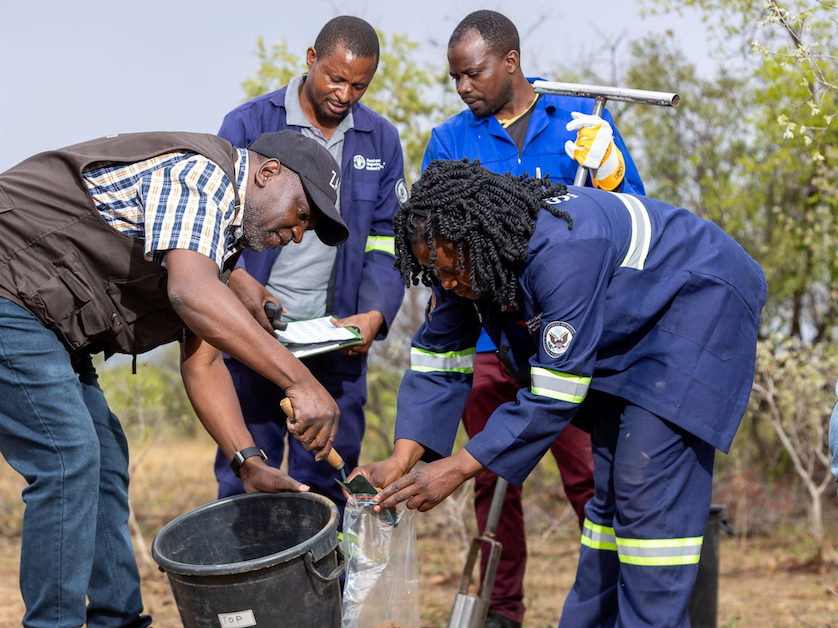
Extension teams collecting soil samples in Zambia. Photo Credit: FAO/Emmanuel Kabila
By Panagrimedia Correspondent, March 24, 2026, The Government of the Republic of Zambia, in collaboration with the Food and Agriculture Organization of the United Nations (FAO) and with support from the Government of the United States of America, has officially launched the Zambia Soil Partnership (ZSP) and the Global Soil Doctors Programme (GSDP) to strengthen national coordination on sustainable soil management and support more productive, resilient and market-oriented agrifood systems in the country.
These initiatives are being implemented under the Soil Mapping for Resilient Agrifood Systems (SoilFER) programme which is operational in seven countries across Africa and Central America and financially. SoilFER is funded by the United States Department of State and the Ministry of Foreign Affairs of Japan. The programme generates and transforms soil science and data into actions and inform decisions of farmers, governments and agribusiness actors for increased agricultural productivity, crop selection, optimized fertilizer use and strengthened agrifood value chains.
The launch took place during a national technical workshop held in Lusaka on 17 March, officially opened by the Permanent Secretary for Technical Services, Ministry of Agriculture, Republic of Zambia, Representatives of the United States Embassy and Department of State, a representative from the Embassy of Japan and the FAO Representative in Zambia. The event marks the start of a series of activities taking place from 17 to 24 March, including field-based training sessions at the ZARI Kabwe Research Station in Central Province and in Chongwe District, Lusaka Province, where extension agents and farmers will participate in hands-on training to strengthen practical knowledge on soil health and fertilizer management.
In Zambia, agriculture remains a key driver of rural livelihoods and economic growth. However, soil degradation and declining soil fertility continue to challenge sustainable agricultural production, making improved soil health essential for increasing crop productivity, strengthening local markets and rural livelihoods, and supporting long-term agricultural stability.
The ZSP will serve as a national multi-stakeholder platform bringing together government institutions, research organizations, universities, soil laboratories, farmer organizations, private sector actors and development partners. During the technical workshop on 17 March, stakeholders agreed on priorities and a roadmap for coordinated soil management actions under the ZSP. The event also marked the launch of the Global Soil Doctors Programme in Zambia, a farmer-to-farmer training initiative that equips farmers and extension agents with practical tools to assess soil health, identify soil threats and improve soil and fertilizer management.
Speaking at the launch event on behalf of Hon. Reuben Mtolo, Minister of Agriculture, Ndashe Kapulu, ZARI Director, highlighted the importance of strengthening soil health to support Zambia’s agricultural transformation agenda.
“The SoilFER programme demonstrates how investments in data, innovation, technologies, technical capacities and partnerships can transform agrifood systems to become more efficient, resilient, sustainable and productive,” said Ms Suze Percy-Filippini, the FAO Representative in Zambia, noting FAO’s continued commitment to supporting the Government of Zambia and national partners.
Ms Julie Kapuvari, Science and Policy Advisor, U.S. Department of State, highlighted the importance of strengthening agricultural productivity and the efficiency of input use through better soil information and innovation.
The establishment of the ZSP and the GSDP aligns with the framework of the Global Soil Partnership, a global initiative coordinated by FAO to promote sustainable soil management, protect soil resources, and contributes to regional efforts under the African Soil Partnership.
The launch of these initiatives marks an important step towards boosting agricultural productivity, expanding agrifood trade and encouraging greater private sector engagement across agrifood value chains.