By Zablon Oyugi, December 16, 2025, For years, limited access to equipment maintenance services has slowed agricultural mechanisation in Rwanda, as many smallholder farmers hesitate to invest in machinery they fear they would be unable to repair if it breaks down.
According to a recent report by Cordaid, an internationally operating value-based emergency relief and development organisation, this lack of reliable technical support has been a persistent barrier to productivity and farm modernisation.
However, across the country, youth and smallholder farmer cooperatives are reversing this trend by transforming agriculture from subsistence into a more professional, resilient, and opportunity-driven sector through skills development, savings schemes, and improved extension services.
One such story is that of Jean Denys Kwizera, a 24-year-old from Ruhango District, who once shared the scepticism common among rural youth. After completing secondary school, he drifted through periods of unemployment, convinced that agriculture offered “no future” without land or capital.
That perception changed when Kwizera joined the Ruhango Itoshye Youth Community and later enrolled in the Promoting Smallholder Agro-Export Competitiveness Project (PSAC), a nationwide training programme focused on agricultural equipment operation and maintenance. The project is funded by the International Fund for Agricultural Development (IFAD) and implemented by Rwanda’s National Agricultural Export Development Board (NAEB) in partnership with Cordaid.
Young mobile technicians
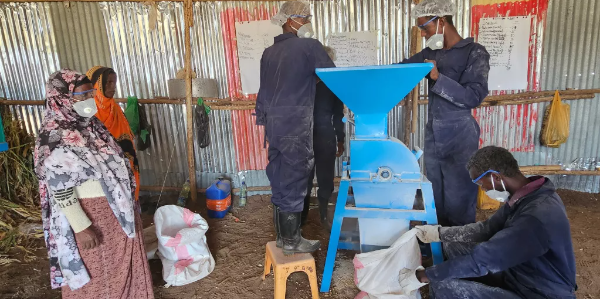
In July 2025, PSAC trained 136 young people across Rwanda’s four provinces in agricultural machinery operation and repair, creating a youth-led network of mobile technicians reaching farmers in areas long without maintenance services.
Kwizera quickly applied his new skills by repairing an irrigation pump for smallholder farmer Sabit Nkundukuzera under the guidance of a local agronomist, and although unpaid, the job was crucial in building trust and credibility within the community.
“Before this training, I never imagined I could earn a living in agriculture without owning land,” Kwizera says. “Now I see agriculture differently – it’s full of business potential.”
For farmers like Nkundukuzera, the impact has been immediate. “As smallholder farmers, we struggled significantly when our machinery broke down,” he explains. “Now, we have local youth who can help us. It’s a big relief.”
Kwizera and ten fellow trainees are now in the process of registering a business to provide repair and maintenance services across three districts. Their ambition is clear. “In three years, I see us running a fully registered company, employing youth and serving farmers throughout the region,” he says.
While these young technicians are addressing gaps in mechanisation and equipment servicing, other communities supported by PSAC are tackling additional constraints facing Rwanda’s agricultural sector – from limited financial inclusion and weak cooperative governance to poor market access.
Farming as a Business
Beyond mechanisation, PSAC is enabling farmers and youth to treat agriculture as a viable business. In Musanze and Rwamagana districts, cooperatives and young professionals have gained skills in financial literacy, collective marketing and business planning, allowing farmers to access formal markets, secure loans and invest in productive assets such as livestock.
Community savings groups, many led by women, are strengthening governance, building capital and improving household food security.
Together, these initiatives show how targeted training, youth engagement and inclusive finance are reshaping Rwanda’s agricultural landscape – proving, as Jean Denys Kwizera puts it, that even without land, young people can build a future in agriculture.