
By Prof Arun Tiwari
Climate resilience is often discussed in the language of science: rising temperatures, changing rainfall, carbon emissions, extreme weather and adaptation pathways.
All of this matters. But climate change is ultimately experienced not in graphs or models, but on a farmer’s field.
For a smallholder dependent on rainfed agriculture, climate resilience has a simpler meaning: Will the crop survive if the rain comes late, stops for three weeks or arrives all at once? Will the family still have food and income if one season fails?
This is where the climate challenge becomes deeply human.
Across Africa and parts of Asia, millions of smallholders cultivate relatively small areas with limited irrigation, little financial cushioning and restricted access to insurance, storage, technology and markets.
For them, climate variability determines whether seed becomes harvest, debt can be repaid, and families can remain on the land.
The problem is not simply that there may be less rain. Increasingly, the greater danger is that the rains cannot be trusted.
They may arrive too early or too late.
A promising start may be followed by a prolonged dry spell. Rain that once fell gradually may come in violent bursts, washing away fertile soil instead of replenishing it.
Heat can damage crops during flowering, while unusual combinations of temperature and humidity encourage pests and diseases.
Agriculture built around predictable seasons becomes fragile when the rhythm itself changes.
The first line of resilience is therefore water. Experience from India’s drylands shows that the answer does not always lie in large dams and major irrigation systems.
Thousands of smaller interventions—farm ponds, check dams, restored tanks, contour bunds, watershed management, and groundwater recharge—can transform a landscape’s ability to retain rainfall.
The principle is simple: slow the water, spread it and allow more of it to enter the soil instead of running away.
This lesson is highly relevant to Africa, where much farming remains rainfed. Countries need not wait for expensive irrigation networks to reach every farm. Decentralised water harvesting, soil-moisture conservation and efficient supplementary irrigation can provide powerful protection. A farmer may not need water for the entire season; sometimes one or two timely irrigations during a critical crop stage can save the harvest.
The second requirement is choosing crops suited to local ecology. Agricultural development has often encouraged commercially attractive crops without sufficiently considering rainfall, soil and water availability. Climate resilience demands putting the right crop in the right environment. Millets, sorghum, pulses and many traditional dryland crops tolerate heat and water stress better than more demanding alternatives.
Africa possesses an extraordinary diversity of indigenous grains, legumes, roots, tubers and farming systems. This biological wealth should be protected rather than displaced. Community seed systems, drought-tolerant varieties, short-duration crops and diversified cropping patterns can provide an important defence against climatic uncertainty. A farmer growing several crops that respond differently to drought, heat and pests possesses a form of biological insurance.
Resilience also lies beneath the farmer’s feet. Healthy soil absorbs and stores more water, supports microbial life and helps crops survive periods of stress. Soil depleted by erosion, repeated monocropping and loss of organic matter becomes increasingly vulnerable. Climate-resilient farming must therefore rebuild soil through compost, crop residues, green manures, legumes, mulching, reduced disturbance and appropriate agroforestry.
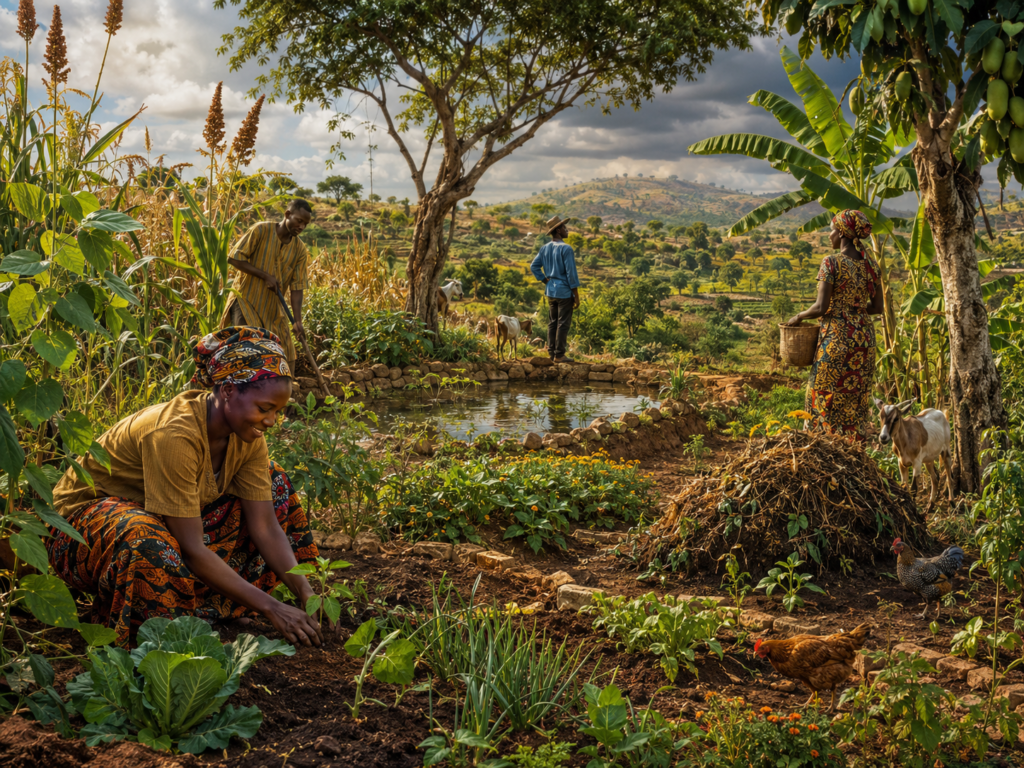
Trees can stabilise land while providing fodder, fruit, fuel and additional income. Livestock, horticulture, poultry and other enterprises can further diversify household livelihoods. A farm should not be seen merely as a field producing one crop, but as a living system connecting soil, water, plants, animals, trees and people. When one component is stressed, others can provide support. The next great opportunity lies in information. Farmers have always read clouds, winds, insects, soil and seasons.
That traditional knowledge remains valuable, but climate patterns are becoming harder to predict. Smallholders increasingly need timely information: Is rain likely next week? Is there enough soil moisture to sow? Which variety is safest? Is a pest outbreak approaching? What prices are available in nearby markets?
Digital technology can gradually turn climate resilience into predictive resilience. Mobile connectivity, local weather stations, satellite imagery, soil sensors and artificial intelligence can help farmers make decisions before a crisis develops. But technology must remain affordable, accessible and designed around real farming conditions. A sophisticated AI platform has little value if it cannot reach a woman cultivating two hectares in a remote village in a language she understands.
Africa has an important opportunity to learn early from development elsewhere. It can avoid excessive groundwater extraction, unsuitable water-intensive crops, loss of traditional seed diversity, overdependence on costly inputs and farming systems that maximise short-term production while weakening long-term resilience.
The goal should not be to replace small farms with industrial agriculture, but to make them stronger: water-secure, biologically diverse, digitally connected, scientifically supported and economically viable. Farmers also need functioning markets, storage, credit, insurance and protection against catastrophic losses. Climate adaptation cannot succeed through agronomy alone; the whole rural economy must become more resilient.
Climate resilience will not ultimately be measured by conferences, models or policy documents. Its real test will come in a small field when the rain is late, the temperature unusually high and the farmer must decide whether to sow, wait or change the crop.
If that farmer has healthy soil, stored water, resilient seed, reliable information, access to markets and some protection against catastrophic loss, climate resilience has become real. We may never again be able to trust the rains as earlier generations once did. But we can build farming systems strong enough that the failure of the rains does not automatically become the failure of the farmer.
aruntiwari.com