
By Murimi Gitari
In Africa’s vast landscapes, where millions of smallholder farmers cultivate the continent’s food security, the question of financing looms large. Traditional agricultural finance has long struggled to meet the needs of farmers and agri-SMEs, leaving gaps that threaten productivity, resilience, and sustainability. Today, a new approach — blended finance — is emerging as a potential game-changer.
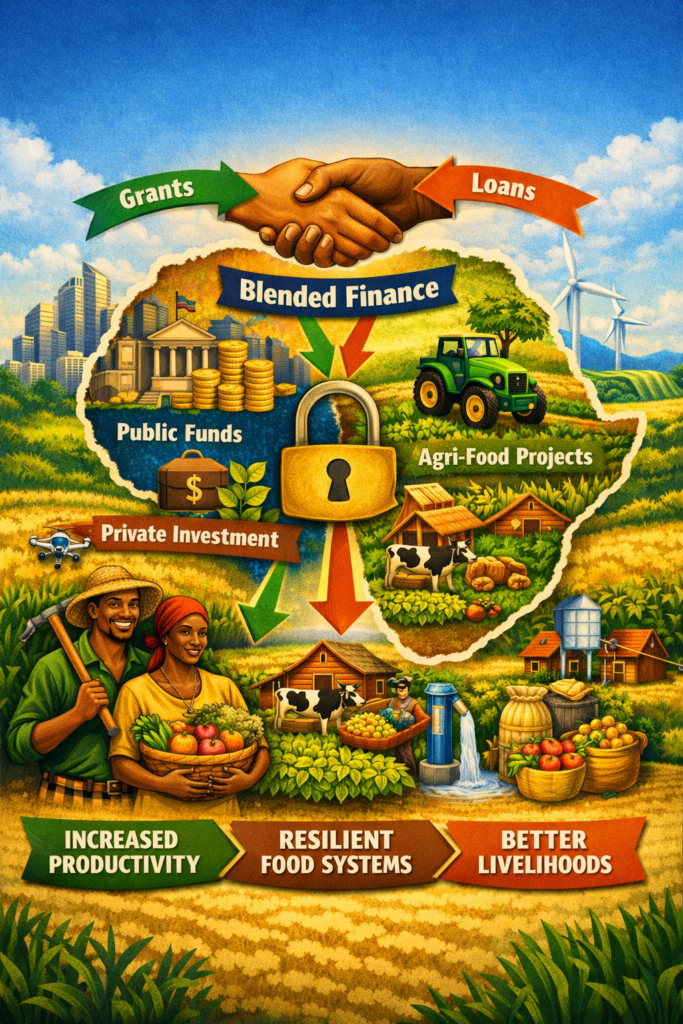
The World Bank defines blended finance as the strategic combination of public or philanthropic funding with private capital to finance sustainable development projects.
Blended finance uses concessional or lower-cost funds to de-risk projects, making them attractive to private investors who would otherwise avoid high-risk, low-return opportunities.
By combining concessional funds with private capital, blended finance can help bridge the financing gap and unlock investments in critical areas such as irrigation, storage, and climate-smart innovations.
For instance, in Kenya private investors, with donor-backed guarantees, are now funding digital platforms that connect farmers to markets, credit, and weather information.
In West Africa, concessional funds have supported rice and cocoa value chains, enabling small and medium enterprises (SMEs) to access loans that were once out of reach.
Similar models are emerging across the continent—from dairy cooperatives in Rwanda to horticulture exporters in Ethiopia.
Ravi Kiran Malik, a seasoned agricultural and rural development finance professional, says that blended finance should not be seen as a replacement but a complementary tool, one that could finally give agriculture the attention it needs.
“Although blended finance has the potential to facilitate and accelerate agricultural development in Africa on a sustainable basis, it would be premature to compare its effectiveness vis-à-vis traditional financing,” he notes.
Traditional agricultural financing, he argues, has never received the push it deserves in most African countries.
Africa’s agricultural sector faces unique challenges like low capital formation, heavy reliance on external aid, and limited capacity to generate internal revenues.
“Many governments depend on external support for agricultural projects. Under such a scenario, blended finance can be a good option,” Malik says.
Blended finance, he says, is particularly well-suited to support climate-smart agriculture and sustainable land use.
These require medium- to long-term investments, which concessional capital can help de-risk.
“The adoption of climate-smart practices should form an integral part of financial products offered under blended finance,” he says, adding that sustainability must be embedded in the design of financing instruments.
He also notes that scaling blended finance will require more than capital as it demands systemic reform, noting that many African countries still lack robust agricultural finance architectures.
“Unless we recognise agricultural finance as an integral part of the overall financial system, leveraging blended finance will be a challenge,” he cautions.
Governments, he argues, must mobilise their banking sectors—many of which they partly own—to fulfil their responsibility in supporting agriculture and food security.
Regional institutions like the African Union (AU) and the African Development Bank (AfDB) have a critical role to play.
Malik stresses that blended finance cannot work in isolation.
“It is necessary to create a robust agricultural finance architecture first,” he explains.
Regional bodies should help countries build the laws, policies, institutions, and monitoring systems needed to support blended finance at scale.
Technology, he believes, will be an indispensable ally with fintech, mobile money, and digital platforms having the capability to integrate seamlessly with blended finance, expanding access and efficiency.
“Technology is an enabler—it will find its way to integrate with the financial system for the benefit of agricultural stakeholders,” he says.
Blended finance is not a panacea, but it offers Africa a chance to reimagine agricultural financing. By de-risking investments, embedding sustainability, ensuring inclusivity, and leveraging technology, it can help transform agri-food systems into engines of resilience and prosperity.
Agriculture is inherently risky. Weather shocks, pests, poor infrastructure, and fluctuating commodity prices all conspire to make investment uncertain. For smallholder farmers, access to credit is often limited, while agri-SMEs struggle to scale due to lack of financing. Traditional banks see red flags where blended finance sees opportunity.