
By Lominda Afedraru
Sesame, locally known as simsim, is increasingly becoming a very important crop to small holder farmers in Uganda due to its wide benefits.
Experts say the crop is a critical cash and food security crop for smallholder farmers in Uganda, particularly in the Northern, Eastern and West Nile regions.
Uganda is the second-largest producer in Africa and fifth globally and the country benefits from its high quality, oil rich seeds, which are in high demand locally and internationally.
As such the scientists who are mandated to breed the crop for farmer uptake are currently engaging farmers in simsim growing regions to give them information about the preferred attributes which they will consider when improving on existing varieties as well as breeding new varieties for climate resilience.
Dr Walter Anyanga, the programme leader for oil crops at the National Agricultural Semi-Arid Resources Research Institute (NaSARRI), notes that simsim is one of the oldest oil crops domesticated 4,000 years ago
The wild species originated in sub-Saharan Africa, and the cultivated type sesamum indicum is believed to have originated in the Indian subcontinent.
It was historically cultivated in ancient Egypt and Mesopotamia and it arrived in Uganda in 1910 with farmers adopting it and referring to it as the queen of oil crop.
Dr Anyanga explains that most farmers are growing the traditional varieties whose yield is low.
He has developed improved varieties and is in the process of releasing about four new varieties at the end of this year with attributes of climate resilience.
In the breeding programme it is important to do it in consultation with farmers and his team recently met a team of farmers to determine the required attributes.
This is done under a three-year project funded by the International Maize and Wheat Improvement Center (CIMMYT) worth 1,500 US dollars.
Simsim is mainly grown in Northern and Eastern Uganda including West Nile, with farmers growing traditional varieties namely Ajimo, Acara, Ladong and Latin Onyweri.
These varieties have the challenge of poor yield and the capsules open unevenly while others take long to get mature. They are susceptible to web worm, which consumes the leaves, and gall midge, which attacks the capsules.
These varieties easily succumb to diseases such as Anthracnose and Fuzarium oxysporium, which destroys the roots and leaf.
Since 2002 the team has released three varieties namely Sesim I, II and III. Farmers have since adopted growing of Sesim II and III due to their good attributes including being tolerant to drought
These varieties are white seeded and liked by farmers and consumers and are good for export. Sesim II has high oil content of 48 percent and is tolerant to drought and pests and diseases.
Meanwhile Sesim III has hairy stems and capsules, meaning it withstands attacks by the Gall midge pest and matures faster to escape climate change challenges.
The project target is to ensure the experts breed varieties which have good aroma for confectionery and the seed is good for paste, oil processing and export.
Dr David Kalule Okello, the Director of NaSARRI, explained that simsim has been identified as a crop that will reduce oil importation into the country if grown on large scale.
Currently the production is between 100,000 tons and 173,000 tons per annum and the average yield of the improved varieties is 700kg per hectare.
It thrives well in humid areas, the reason most farmers growing it are in the Northern part of the country.
Since the crop is inbred, if kept well the seed can last for five years. It is the reason most seed companies are not interested in multiplying the seed because farmers can process their own seed.
It has readily available market in the USA and Europe, with demand in the confectionery industry.
Simsim is a major cash crop that provides income for over 1.5 million smallholder farmers. Improved varieties like Sesim II and Sesim III have increased yields to the tune of 280-700 kg per hectare, enabling farmers to cater to their families’ needs.
It has high-value export and the local market demand is high. It is being exported to countries including China, Turkey, Japan and Europe.
The prices have been rising, with farm-gate prices increasing from UgShs2,600 to over UgShs5,000 per kilogramme.
It is a climate-smart and resilient crop because it is a drought tolerant and can thrive in the semi-arid conditions of Northern Uganda, making it a reliable alternative to maize or sorghum when rainfall is unpredictable.
It has value addition opportunities where farmers can earn more by processing seeds into refined or unrefined oil, roasted paste and using the residue seed cake as high-protein livestock feed.
It is also used in the confectionery industry particularly in bread.
It is good crop for soil fertility improvement as it can improves soil structure and aids in moisture retention.
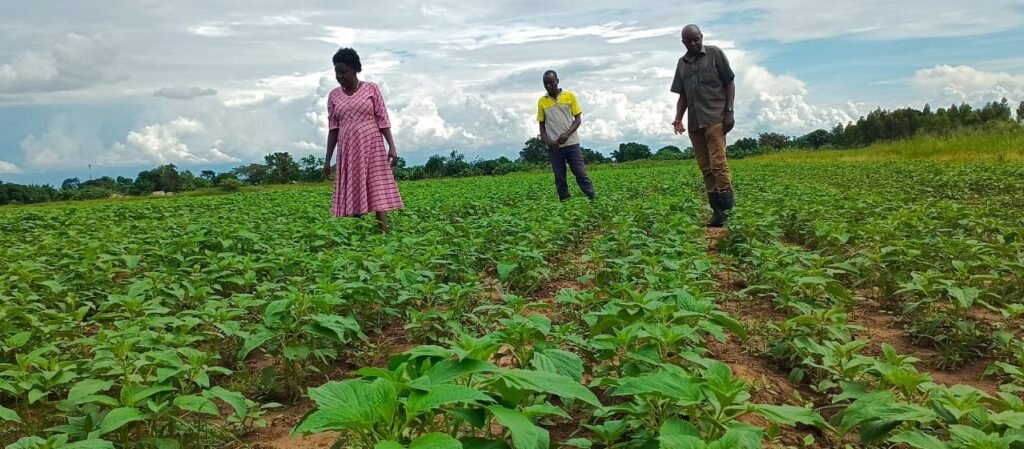
Farmers are advised to plant simsim in rows instead of broadcasting and to adopt proper drying and storage to meet international standards.
Ms Agness Owinyi is a farmer growing simsim in Atama village in Dokolo Northern Uganda.
She processes seed, which she sells to fellow farmers and she has been doing this since 2024 after getting advice from scientists at NaSARRI.
She says normally farmers grow a lot of simsim in the second season running from August to December but are challenged with climate change effects which affect the yield.
Ms Owinyi grows the crop on her five-acre land and the additional land is hired at Shs200, 000 per acre per annum.
She previously used to grow sunflower and soy bean but she says the marketing system for those crops is slow compared to simsim
She intends to venture into processing simsim bio products such as soap and oil to earn more income. At the moment she is able to process over 1,000 kg quality seed which is sold at Shs6,000- 8,000 per kg.