
By Zablon Oyugi
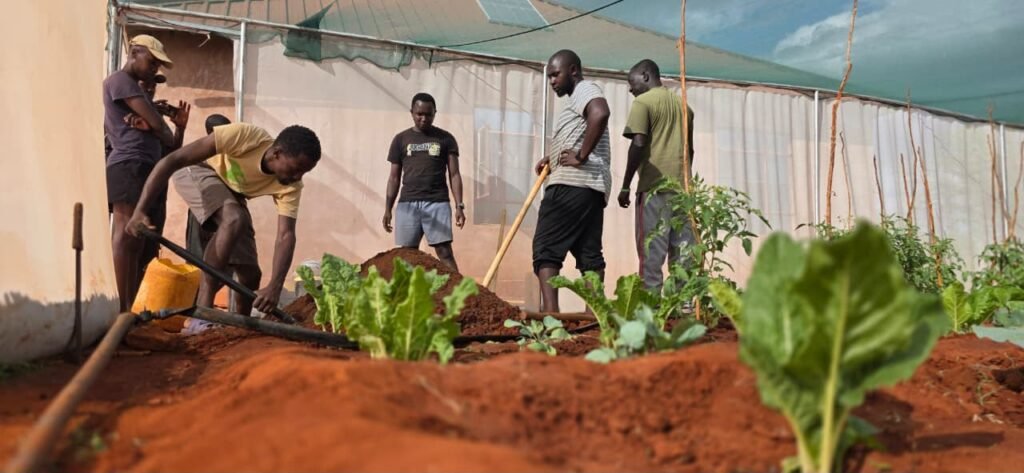
Shade-net gardens helping Kenya’s Lake Jipe farmers adapt to climate, wildlife pressures
Lake Jipe, a shallow border lake shared by Kenya’s Taita-Taveta County and Tanzania’s Kilimanjaro region, is shrinking as unpredictable rainfall and roaming elephants force surrounding communities to rethink how they survive.
For generations, fishing has been central to life around Lake Jipe, providing food and income for shoreline communities, but the lake has changed dramatically, shrinking from about 108 square kilometres in the 1970s to roughly 27 square kilometres today.
About 85 per cent of shoreline households still depend on fishing for income, while the endemic Jipe Tilapia, locally referred to as the Asilia fish, remains endangered.
“When a resource that is concentrated starts collapsing, you do not get gradual adjustment, you get exodus,” says Kipyegon Sigey, founder of Farmers Assistant AI, an AI-powered chat assistant designed to deliver agricultural knowledge instantly to smallholder farmers through WhatsApp. “Fishing was never going to hold this many households once the lake itself started disappearing.”
Zacharia Muteti, founder and CEO of Eco Jipe Program, says climate change is squeezing the community’s two traditional livelihood options at the same time.
“Rainfall that used to be predictable enough to plan a planting season around has become erratic while fishing and rain-fed farming are being squeezed by the same climate shifts at the same time,” he says.
As a result, women, youth groups and a local public school in the area are turning to climate-smart agriculture to grow food, build alternative incomes and reduce pressure on the fragile ecosystem.
Farming in an elephant corridor
The area lies along an important wildlife corridor used by elephants and other animals, meaning conventional open-field agriculture can bring farmers into direct conflict with wildlife.
According to Muteti, the project considered hard fencing, but community consultations showed that it could block wildlife movement.
“We did not want to solve one farm’s problem by closing the last routes elephants have left,” he says.
Instead, Eco Jipe and Farmers Assistant are helping communities establish enclosed shade-net farms.
The structures resemble greenhouses but use stronger poles and netting rather than conventional polythene.
Rather than fencing off large areas, a shade-net enclosure protects the relatively small garden a household needs.
“The main lesson came from the community itself: protect the point, not the whole line,” Muteti says.
All India Network Project (AINP) on Vertebrate Pest Management also says that fencing with nylon net around the crop field prevents the intrusion of wild animals and subsequent damages as the net possesses visual deterring effect to the animals.
The structures also moderate conditions inside the garden, reducing heat stress and evaporation while protecting crops from wind and hail.
“Pair that with sesame planted in the surrounding plots, a crop elephants ignore, and a farmer stops needing an elephant to change its behaviour at all,” Sigey says.
Water is another major part of the project, which is transforming agricultural production through solar-powered shallow wells connected to drip irrigation, with eight solar-powered wells now operating across the villages to enable participating farmers to irrigate their crops throughout the year.
“The core idea is to stop asking families to bet an entire season’s food and income on rainfall we can no longer predict,” Muteti says.
Solar energy removes the need for diesel, while drip irrigation directs water to the root zone and reduces waste. Sigey highlights the difference in Kachero, where one well serves close to 100 people.
“Before the wells, farmers had one real growing window a year, entirely dependent on the rains,” he says. “The eight solar-powered shallow wells we have installed since 2025, each paired with drip irrigation, take that constraint off the table.”
Bringing technology into the garden
Soil-moisture and humidity sensors installed in partnership with Geotto, a Nairobi-based innovative green energy and agritech company, provide information about conditions inside the gardens, helping farmers determine when irrigation is needed.
“We’re now integrating the Farm Assistant AI bot, which farmers can use to flag pests or diseases they don’t recognise and get a suggested response back,” Sigey says.
The project is also introducing cameras around garden edges to document elephant and other wildlife activity.
“You shouldn’t assume a deterrent works just because incidents drop,” Muteti says. “You need to know whether elephants are actually avoiding the structure or simply haven’t tried yet.”
Giving the lake room to recover
The agricultural transition is ultimately linked to conservation, with Sigey saying Malkia Nyuki, a beekeeping initiative in the area has already been estimated to have spared 24,768 kilogrammes of fish from the lake by providing 15 households with an alternative source of income.
“Every household that shifts a meaningful share of its income from fishing to a shade-house garden, sesame, or beekeeping is one less household adding effort to a fishery that is already past what it can sustainably give,” he says. The implications are significant for the Jipe Tilapia, or Asilia fish.
Muteti says the species was classified as Critically Endangered in 2021 and later reassessed as Endangered, but the change did not necessarily mean the population had recovered.
“The criteria shifted, the fish did not recover,” he says, adding that reducing fishing pressure could give breeding areas greater opportunity to recover.
Women and youth at the centre
Women and young people are among those driving the project, with more than 50 of the over 60 people involved in the beekeeping programme being women.
“Shade-net gardens suit women’s day-to-day constraints in a way a boat or a distant farm plot does not,” Sigey says. “They sit close to the homestead, don’t require the pre-dawn trip to the lake that fishing does, and the work fits around childcare.”
Muteti says the project is deliberately linking young people to technical skills.
“For youth, we have paired it with real technical skill, sesame value-chain work, IoT monitoring, and now the AI-assisted pest and camera systems,” he says.
A school discovers the power of farming
The project’s impact has also reached the classroom, with agriculture becoming the top-performing subject at Jipe School in the 2025 Kenya Junior School Education Assessment (KJSEA) – a national examination for Grade 9 students.
The school attributes the results to its garden programme, which produced 779 kilogrammes of food for students and teachers.
“The result that surprised even us came from the school, not the farm,” Sigey says. “Agriculture became the top-performing subject in Jipe School’s 2025 national exam.”
Building a model that can last
Muteti says the project needs long-term institutional support rather than a series of small, short-term grants.
“The difference between building two more gardens next year and building the kind of monitoring and training system that makes the tenth garden as good as the first is the funding structure,” he says.
Sigey points to strong community governance as another requirement, saying that a model like this can only scale across Lake Jipe and to other shrinking lakes in East Africa if the institutions carrying it forward are not dependent on the project’s founders.
“The lesson from Lake Jipe is bigger than the shade-net garden itself because climate change, biodiversity loss, declining fisheries and human-wildlife conflict are increasingly interconnected,” Sigey says.
By combining solar-powered irrigation, shade-net farming, monitoring, AI-assisted agricultural advice and alternative livelihoods, communities are building a model that gives families new options without asking them to abandon the landscape they call home.
For Lake Jipe, the approach offers a practical response to several interconnected pressures by creating livelihoods that allow both people and nature to survive.