By Roger R.B. Leakey
In my three previous articles I have indicated that there is now an opportunity to develop indigenous trees as mainstream food and medicinal crops to restore the imbalance between conventional monocultures with staple food crops and the much more diverse traditional land use systems.
African scientists are already leading the way in this endeavour by domesticating around 50 candidate species and capturing the “green gold” that exists in their inherent tree-to-tree genetic variation in the wild. These developments have two purposes: to meet the need of people and to address the serious environmental problems facing humanity and our planet.
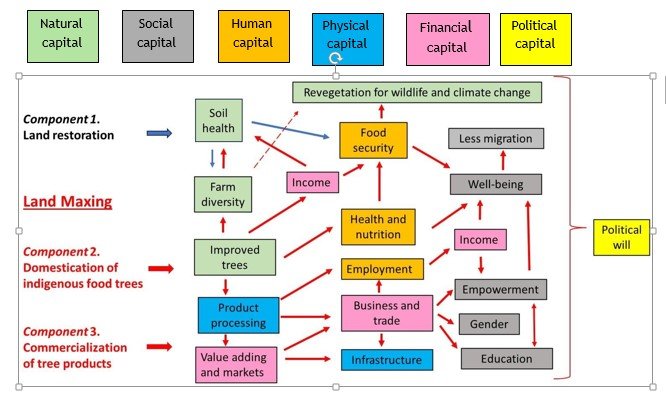
All of the techniques and skills needed to achieve the above lofty aims are easily adopted by local communities in programmes, described as “Land Maxing”, that rebuild the seriously degraded natural, social and human capital in farming landscapes, while at the same time building new physical and social capital by promoting new local businesses and even new local industries.
Why is this important? For decades now modern intensive farming has been seen to have high environmental costs in terms of deforestation, land degradation, climate change, loss of wildlife habitat, soil erosion and infertility. Likewise, it has left smallholder farmers marginalised and in poverty with hunger, malnutrition and social injustice. For decades now, international reports have been calling for a new and better way forwards to build a sustainable future, but no consensus has been
achieved about how to deliver on these aspirations. Instead, there has been the development of numerous approaches to mitigate the environmental impacts of agriculture which compete with each other for favour, and for donor funding.
While some of these seek small improvements in rural livelihoods, few – if any – generate sufficient income to lift farming communities out of the poverty that constrains the productivity of their food crops.
Thus, the missing ingredient has been a means to generate farm income. The consequent inertia has stifled political will, the sixth capital for a sustainable future.
Even the production of commodity cash crops has resulted in issues around the dependence on overseas regulated international trade, focused more on business interests than on the livelihoods of the producers.
The studies underpinning my previous articles showed how to come up with a supportive approach to smallholder agriculture in Africa that transforms rural livelihoods and builds business approaches. Both of these are based on the traditionally important indigenous trees that produce marketable food and other products with potential for expansion into new commercial processing and trade. However, more than that, they also deliver crucial environmental services that restore the fertility and ecological health of soils, leading to rehabilitated and productive farmland.
This allows the area under staple food crops to be reduced and revegetated with perennial crops in ways that mitigate against climate change and create wildlife habitat important for global and planetary health.
The processes targeted by this innovative Land Maxing approach rebuild the natural, social and human capitals that have been degraded by current approaches to farming. At the same time they generate the income needed to create new physical and financial capitals. This leads to a series of beneficial outcomes, many of which are unique to this holistic rural development programme.
Importantly, while unique in this way, the crux of Land Maxing is the generation of income to alleviate the poverty that stifles the lives of the rural population and its associated urban communities. Thus, the domestication, commercialisation and cultivation of indigenous trees producing domestically
useful, nutritious and marketable products also has the much wider potential to enhance the many named approaches that target environmentally beneficial land use systems.
In conclusion, if Land Maxing can be scaled up and scaled out to the wide range of biophysical and socio-economic situations across the African continent, there is the opportunity to address the unfulfilled ambitions expressed by numerous international reports seeking to resolve many of the big issues facing our world.