
By Ngalame Elias
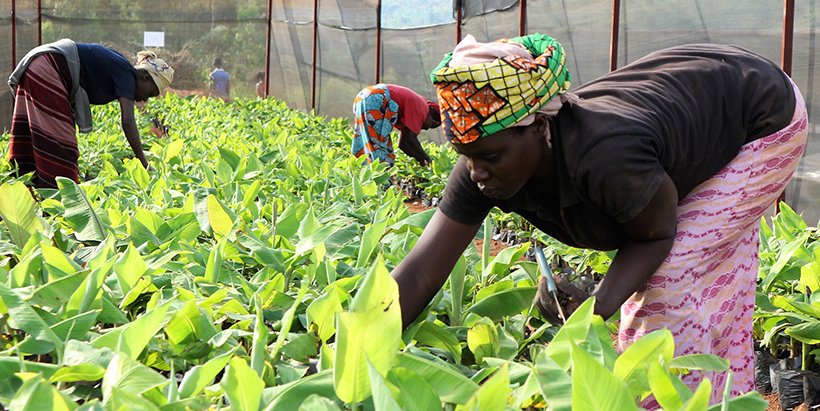
Some 300 young plantain farmers in Cameroon have undergone training in post-harvest loss management as part of a government-backed programme aimed at increasing production and farmer income.
The programme targets youth in key plantain production zones in the country.
National Association of Plantain Sector Actors (FBPC) President Samuel Tony Obam said post-harvest losses historically wipe out 35-40 percent of the total plantain production in Cameroon due to gaps in storage, processing and logistics.
FBPC is part of the tripartite partnership in the programme, alongside the Ministry of Agriculture and Green Springs Digital University Institute (GSDUI).
Under the programme, the farmers have acquired skills such as sucker treatment to reduce nematode infestations; mulching and fertiliser application to increase bunch mass and shorten planting-to-harvest cycles; and processing fresh plantains into longer shelf-life products like plantain flour (foufou) and dried chips to avoid the loss of overripe bunches.
“By deploying targeted processing methods and improved agricultural practices, farmers are preserving crop quality and improving their economic stability,” said Obam.
Establishing local community processing units has also helped farmers preserve excess yields immediately after harvest, generating higher-value products. The government has also been deploying trained extension workers and value-chain specialists directly to rural communities to help mitigate transit and market-level damage.
The pilot programme lays the ground for the rollout of a much larger industrialisation phase in the near future, which envisages the establishment of small-scale processing units within high production basins. These units are expected to transform plantains into higher value-added products, including chips and flour for export to neighbouring countries.
Official figures from the Ministry of Agriculture and Rural Development, shows plantain accounts for approximately 16 percent of rural producers’ incomes and contributes about 4.5 percent to the country’s agricultural GDP.
It is ranked as the fourth important staple crop after maize, rice and cassava.
The sector mobilises more than 700,000 actors nationwide, of whom over 92 percent are smallholder farmers. Production occurs throughout the year, with seasonal peaks recorded between November and March. Cameroon also cultivates an estimated 150 plantain varieties.
However, structural inefficiencies persist. Ministry data indicate that average yields in smallholder settings range between four and seven tonnes per hectare, compared to potential yields of 15 to 20 tonnes per hectare when recommended technical practices are applied.
Recent data from the Food and Agriculture Organization (FAO) confirm that plantain remains a critical food security crop across Central and West Africa, with Cameroon among the leading producers in the sub-region.
The World Bank has also identified value chain development and agro-processing as key levers for increasing agricultural productivity and rural incomes in Cameroon.