
By Jeffrey Ngari and Nicole Knorr
Kenya’s climate-smart agriculture journey: Lessons and questions for the next framework
Climate change has become a practical consideration in Kenya’s agriculture. Changes in rainfall, recurrent droughts, flooding and rising temperatures increasingly affect production decisions, water availability, livestock systems and agricultural livelihoods. At the same time, the policy and investment environment around agriculture has changed considerably over the past decade.
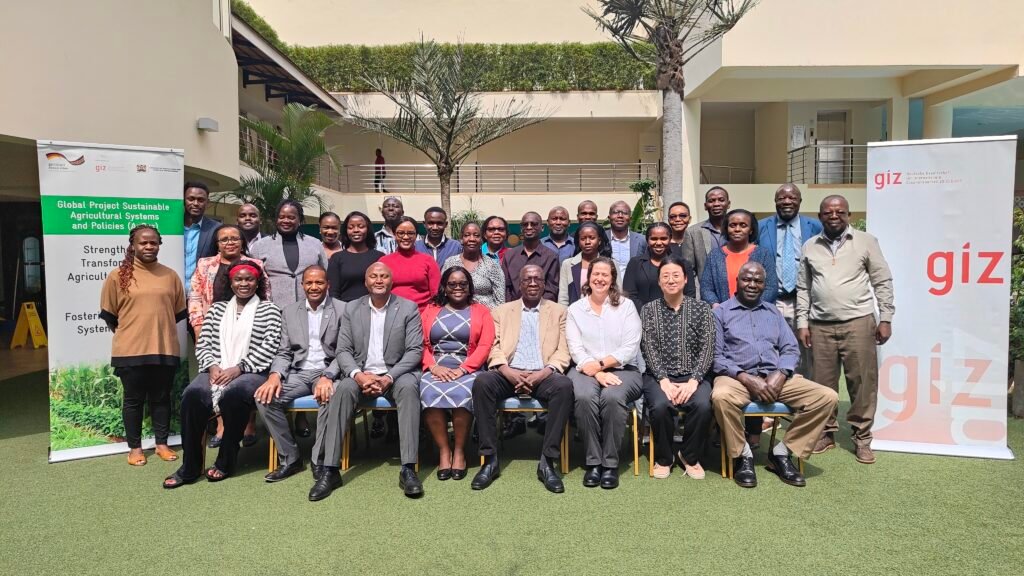
Kenya has been responding to these changes through a range of policies, programmes and investments. Among these is the Kenya Climate-Smart Agriculture Strategy (KCSAS) 2017–2026. As the strategy reaches the end of its initial ten-year period, its review – recently initialised by Ministry of Agriculture and Livestock Development (MoALD) – presents an opportunity to take stock of the experience so far and consider what should inform the next implementation framework. The GIZ global programme Sustainable Agricultural Systems and Policies (AgSys) is supporting this review process, alongside other partners.
The review presents an opportunity to ask some practical questions: What has changed since the strategy was adopted? Which approaches have gained traction? Where have implementation constraints persisted? And how has the context in which climate-smart agriculture is pursued changed?
What has the first decade taught us?
A useful starting point is implementation experience.
The KCSAS review is expected to examine progress across the strategy’s thematic areas, including achievements, gaps, barriers and lessons, alongside an updated assessment of climate risks, vulnerabilities, capacities and opportunities in agriculture.
The value of such an assessment lies partly in distinguishing between what was envisaged in the strategy and what has been possible in practice. Strategies are implemented through institutions, planning processes, budgets, technical capacities, programmes and partnerships. The experience of the past decade can therefore provide useful evidence on where these arrangements have supported implementation and where they may need to be strengthened.
This also raises a broader question for the next framework: what conditions have proved important for climate-smart agriculture priorities to move from policy to implementation?
A different policy and investment context
The context has also changed since 2017.
Kenya’s climate and agricultural policy environment has evolved, alongside international commitments and approaches. The next framework will need to relate to the country’s nationally determined contributions (NDCs), climate action and adaptation priorities, as well as broader agricultural and food-system objectives.
The review also needs to consider how the evolving agricultural and climate policy landscape – including digitalisation, climate and agricultural finance, carbon markets, gender and social inclusion, emerging climate risks and loss and damage, and wider sustainability and resilience priorities – should be reflected in the next framework.
The question is not necessarily whether each of these should become a separate priority. A more useful question is how they relate to the existing climate-smart agriculture agenda and to each other.
For example, climate finance may provide resources for agricultural adaptation, but its contribution ultimately depends on how it connects to agricultural priorities and implementation systems. Digital agriculture may improve access to climate information, but its value will depend on whether farmers and other actors can use that information in decisions. Carbon markets may present opportunities, but their relevance will depend on appropriate institutional arrangements, measurement and the distribution of benefits.
The next framework therefore has to make choices about connections, priorities and implementation responsibilities, rather than simply expand the list of issues under consideration.
Looking beyond farm-level interventions
Climate-smart agriculture is often discussed through practices, approaches, and technologies: improved varieties, water management, climate information, soil management, agroforestry and other measures that can strengthen resilience and productivity. These remain important. But their adoption is also influenced by conditions beyond the farm.
A farmer may have access to climate information but limited ability to act on it. A county may identify adaptation priorities but face constraints in planning, technical capacity or finance. A business may see an opportunity in climate-smart agriculture but require appropriate incentives, market information or evidence of returns. National institutions may have related mandates but need effective mechanisms for coordinating their work.
These are not solely technical questions. They concern the way agricultural development is planned, financed and delivered. This makes governance an important area for the KCSAS review. Not as a separate administrative issue, but as part of understanding implementation.
The county dimension
This question is particularly relevant in Kenya’s devolved system.
Climate risks, agricultural systems and institutional capacities vary considerably between counties. A pastoral county facing recurrent drought will have different priorities from a county whose agricultural economy is based on rain-fed crops, horticulture or intensive livestock production. A national framework therefore needs to provide a common direction while allowing for differences in local circumstances. The next framework provides an opportunity to examine more closely how national climate-smart agriculture priorities connect with county planning, budgeting, implementation and monitoring.
This includes the relationship with county integrated development plans (CIDPs) and annual development plans (ADPs), county climate-change structures, agricultural departments and existing multi-stakeholder arrangements. The issue is not necessarily to establish new structures, but to understand whether existing ones provide sufficiently clear channels for translating priorities into county action.
Finance as part of implementation
Financing is another area where the review can provide useful evidence. The KCSAS review identifies inadequate financing among the implementation constraints and points to climate finance and emerging mechanisms such as carbon markets as potential areas for consideration.
The discussion, however, need not be limited to how much additional finance can be mobilised. It is equally relevant to consider how existing public resources, climate finance and private investment relate to agreed priorities.
This raises practical questions. Are climate considerations adequately reflected in agricultural investment decisions? Are financing mechanisms aligned with the timeframes and risks associated with agricultural adaptation? Are responsibilities and expected results sufficiently clear for different sources of finance?
These questions can help move the discussion from financing as a resource constraint to financing as part of the implementation system.
Strengthening the learning function
The existing KCSAS has a monitoring and evaluation framework, and the review provides an opportunity to consider how this function should evolve alongside the next framework.
This matters because neither climate risks nor agricultural systems will remain static over the next decade. New technologies, markets, financing mechanisms and policy priorities will emerge. Monitoring therefore needs to do more than document activities and expenditure. It should help decision-makers understand what is working, where implementation is constrained and where adjustments may be necessary.
A useful next framework would consequently need a clear relationship between objectives, implementation, results and learning.
Questions for the next framework
The KCSAS review is ultimately an opportunity to learn from the first decade while taking account of a different policy and agricultural context.
Several questions are worth keeping at the centre of that process:
- What has KCSAS contributed to climate-smart agricultural development in Kenya?
- Which approaches have been implemented effectively, and under what conditions?
- Where have policy priorities been difficult to translate into plans, budgets and investments?
- How should national and county roles relate to each other?
- How should climate-smart agriculture connect with the wider agricultural and food-systems agenda?
- What financing arrangements are most relevant to implementation and scale?
- What evidence and monitoring arrangements are needed to support adjustment over time?
The answers should come from the review rather than being assumed in advance.
Kenya has accumulated significant experience with climate-smart agriculture policy and implementation over the past decade. The task now is to use that experience carefully. The next framework does not need to start again, nor does it need to assume that all existing approaches remain adequate.
Its value will depend on how well it captures what has been learned, responds to the changes in Kenya’s agricultural and climate context, and provides sufficient clarity on the priorities, institutions, financing and implementation arrangements required for the coming period.
Authors: Jeffrey Ngari, Policy and Governance Advisor; Nicole Knorr, Agricultural Advisor
Project: GIZ Global Programme Sustainable Agricultural Systems and Policies (AgSys) Kenya