
By Zablon Oyugi
In 2019, when Kirinyaga tomato farmer Catherine Wambui ventured into commercial tomato farming, getting her produce to the market was relatively affordable. Traders would drive directly to her farm, load the tomatoes onto trucks and transport them to urban markets where demand is high.
Today, soaring fuel prices, poor weather that damage roads and wider global tensions have made transporting fresh produce increasingly expensive and difficult for both traders and farmers. As a result, Wambui says her once-thriving tomato business is now weighed down by post-harvest losses and low market prices that often force her to sell produce at meagre prices.
“Sometimes you are forced to sell the tomatoes at throw-away prices because if you keep them for long, they spoil,” she says.
At her peak, Wambui could earn at least Ksh250,000 per season. But now, much of her harvest risks going to waste before reaching consumers, cutting deeply into her profits.
Her story mirrors the experiences of thousands of Kenyan farmers dealing in highly perishable products such as tomatoes, vegetables, fruits, herbs and spices. Without proper storage and post-harvest handling facilities, farmers are often trapped in a race against time to sell their produce before it spoils.
In fact, according to a March 2018 review by the International Food Policy Research Institute (IFPRI), post-harvest losses for fresh produce in Kenya remain severe, with an estimated 30-50 percent of horticultural produce — particularly fruits, vegetables and roots — spoiling before reaching consumers.
The losses translate to between Ksh72 billion and Ksh150 billion annually, largely driven by poor handling practices, limited cold-chain infrastructure and inadequate storage systems. The review, however, also highlighted hope for farmers through affordable technologies that can significantly reduce waste and increase incomes.
Through a series of field trials and cost-benefit analyses, the review identified several promising small-scale innovations capable of reducing post-harvest losses while improving farmers’ earnings by at least 30 percent.
Out of 32 technologies assessed and tested in the field, 21 were found to be profitable, while 17 increased farmers’ incomes by up to 33 percent.
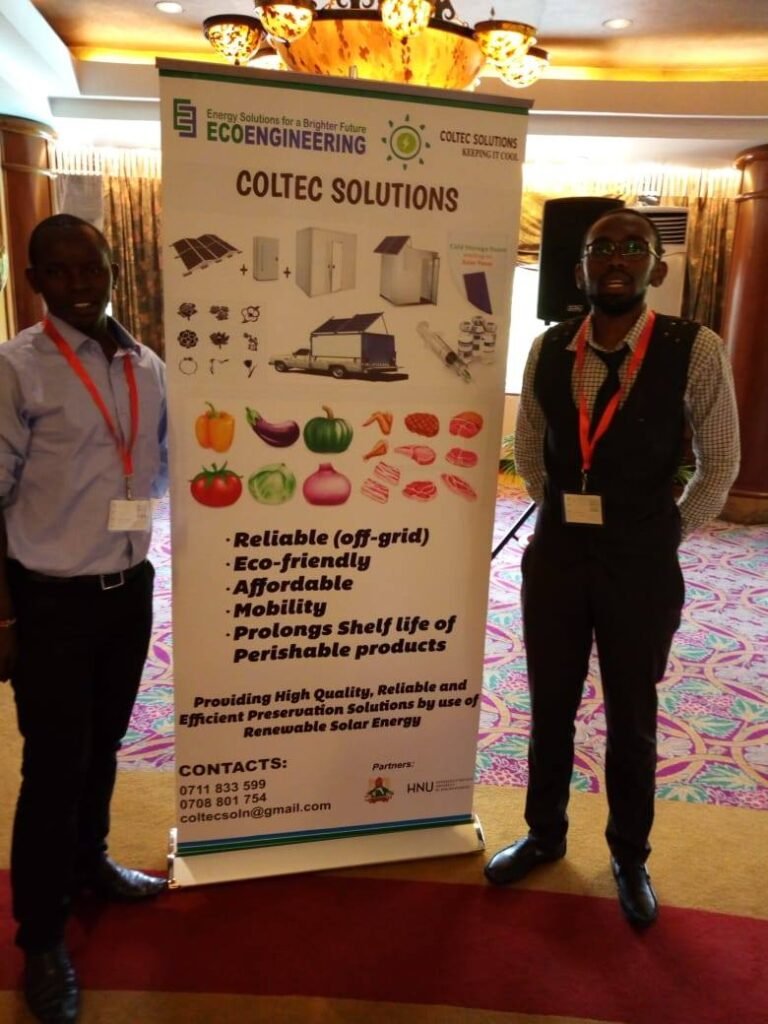
One such technology is that of Colreftec Solutions Limited’s cold-room systems, designed and fabricated locally by two young Kenyan engineers seeking to tackle one of agriculture’s biggest challenges — food spoilage.
The company was founded by Peter Mutua and Peter Muhoho, both mechanical engineering graduates from Kenyatta University.
Affordable solar-powered cold room services
Motivated by the reality that nearly half of harvested fresh produce in Kenya goes to waste between the farm and the market, the duo established the start-up in April 2019 to provide affordable solar-powered cold room services to farmers and traders.
“What really motivated us was the increasingly perishable products resulting in huge post-harvest losses for farmers,” said Mutua, the company’s chief executive officer. “Our aim is basically to prolong the shelf life of these perishable products that include fruits, vegetables and flowers.”
The innovation was first incubated at the Chandaria Business Innovation and Incubation Center, where the engineers developed and tested both mobile and fixed cold rooms tailored for small-scale farmers and traders.
Unlike conventional cold rooms that depend entirely on electricity from the national grid, Colreftec’s systems are powered by solar energy, making them significantly cheaper to operate in rural areas where electricity access and costs remain a challenge.
The innovators say farmers and traders using the technology can save up to 20 per cent on cold-room purchase costs and reduce electricity expenses by as much as Sh20,000 monthly. Their systems have also shown strong performance in Sub-Saharan Africa, where sunlight is available throughout most of the year.
“The main objective is to offer cost-effective, eco-friendly and energy-saving solutions ranging from individuals and small-scale businesses to institutions and corporate enterprises,” said Mutua.
How Colreftec cold room works
The cold room systems work by maintaining produce at controlled temperatures ranging between zero and five degrees Celsius using a digital thermostat. This helps preserve the freshness and nutritional quality of produce for longer periods, reducing the urgency for farmers to sell immediately after harvest.
The facilities are also fitted with standby batteries that store solar energy harvested during the day, enabling the cold rooms to continue operating at night or during periods of limited sunlight.
“Ideally, by use of solar panels, we harness solar energy and store it in the battery,” explained Mutua adding that they do sizing of the solar equipment to ensure sufficient flow of energy during the day and night.
The stored energy powers the condensing unit, security systems and lighting installed within the facility.
According to the engineers, the amount of energy required depends on the size of the cold room and the quantity of produce being stored. Before installation, the company assesses the client’s location and sunlight exposure levels to determine the most suitable solar power capacity.
“The solar cold room can operate in regions that have minimal sunlight,” said Mutua.
“We engage our clients to determine the regions where they come from to know the number of hours the region is likely to experience sunlight and use the information to calculate the amount of solar power required to harness adequate energy to be stored in the batteries.”
Fit for horticulture farmers
The technology is particularly attractive to horticulture farmers who often suffer huge losses during periods of market glut or transport disruptions.
For example, according to Mutua, a cold room measuring six feet by six feet by seven feet can store more than two tonnes of tomatoes for between 10 and 15 days while maintaining temperatures of between five and six degrees Celsius.
This gives farmers enough time to search for better-paying markets instead of rushing to dispose of produce at low prices.
“It reduces risks of wastage because farmers will not have to sell their produce at throw-away prices leading to losses,” he said.
The cold rooms are also helping address concerns around food quality and safety.
Mutua notes that solar-powered storage systems preserve food quality and nutritional value while also promoting environmentally friendly farming practices because they rely on renewable energy.
Experts say improved cold chain systems could become increasingly important as climate change, volatile fuel prices and poor transport infrastructure continue to disrupt agricultural supply chains across Kenya.
For farmers like Wambui, access to affordable cold storage may mean the difference between profit and loss.
Instead of watching tonnes of tomatoes rot after harvest, technologies such as solar-powered cold rooms can give farmers more control over when and where they sell their produce, observed the IFPRI review.