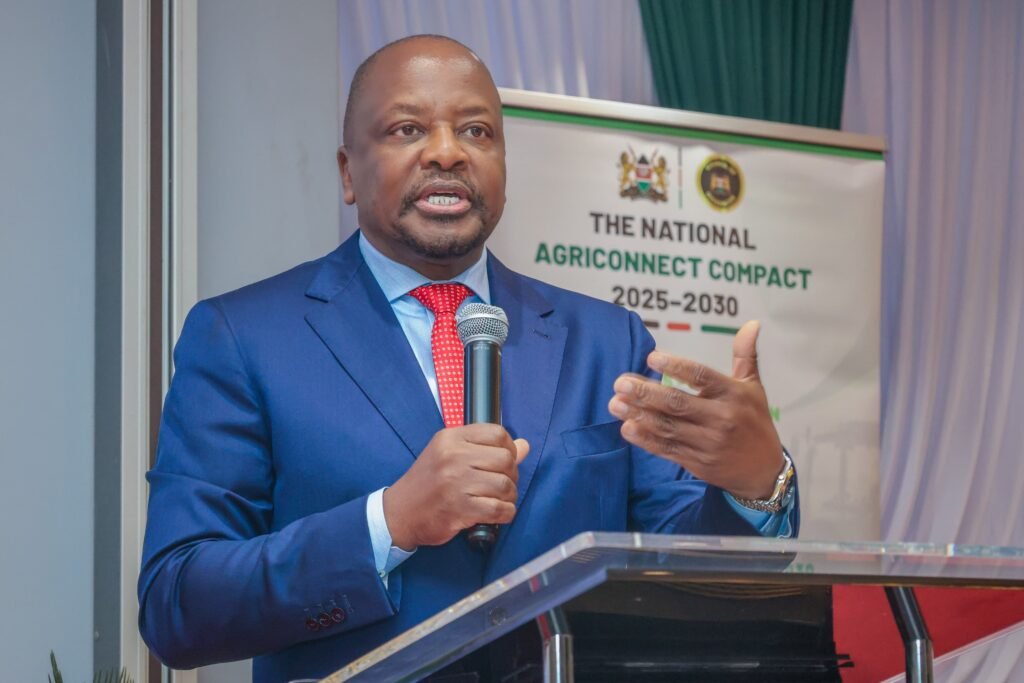
Kenya’s Cabinet Secretary for Agriculture and Livestock Development Sen. Mutahi Kagwe. Photo Credit: MoALD
By Zablon Oyugi, June 17, 2026: Kenya has launched an ambitious $11.4 billion agricultural transformation programme aimed at modernizing the country’s agri-food sector, boosting food security, attracting private investment, and creating millions of jobs by 2030.
Speaking during the launch of the Kenya AgriConnect Compact (2025–2030), Cabinet Secretary for Agriculture and Livestock Development Sen. Mutahi Kagwe described the initiative as a bold framework designed to transform agriculture from a subsistence activity into a modern, technology-driven and commercially viable sector capable of driving inclusive economic growth.
“The Agriconnect Compact positions agriculture not as a subsistence sector, but as a modern, technology-enabled, climate-smart, and investment-ready engine for inclusive economic transformation,” Kagwe said during the launch.
The initiative places digitalization and innovation at the center of Kenya’s agricultural development strategy. Key interventions include the deployment of digital extension services, agritech platforms that enhance market traceability, and advanced processing technologies aimed at reducing post-harvest losses that have long affected farmers and agribusinesses.
To support the transformation, the government will commit $3.8 billion in catalytic public financing, which is expected to leverage an additional $7.6 billion in private sector investment. The funding model is designed to create an enabling environment that reduces investment risks while encouraging greater participation by private capital.
According to Kagwe, the compact is intended to bridge public and private sector efforts in agricultural development.
“The Agriconnect Compact is a deliberate, strategic, and urgent framework to align public investment with private sector ambition where public investment finances foundational systems and public goods, reducing risks and creating an enabling environment that attracts large-scale private capital,” he said.
The framework will utilize public-private partnerships, blended finance mechanisms, and credit guarantees to improve access to financing and make agricultural investments more attractive. Priority value chains include dairy, edible oils, horticulture, and other high-potential agricultural sectors.
Beyond increasing production, the compact seeks to overhaul agricultural markets by improving infrastructure, introducing digital marketplaces, and developing structured trading systems. These reforms are expected to reduce inefficiencies across value chains and ensure farmers receive better returns for their produce.
Government projections indicate that the programme could cut imports of key food staples such as maize and rice by 50 percent while increasing high-value agricultural exports by 60 percent over the next five years.
Job creation is another central pillar of the strategy. The government estimates that the compact will generate or upgrade approximately 2.482 million jobs by 2030, particularly for young people in agro-processing, logistics, digital supply chains, and agribusiness management.
“The jobs to be created will be real jobs with dignity. The food security we achieve will mean that no Kenyan goes to bed hungry,” Kagwe said.
The initiative has secured backing from the National Treasury, the Council of Governors, and several international development partners. With the technical groundwork already completed, the government is now calling on private investors to play a leading role in implementing the strategy.
“We have the strategy. We have the investment framework. We have the political will. What we need now is private sector action,” Kagwe said, adding that Kenya is moving from planning to collective action to achieve food sustainability and broad-based economic prosperity.