
By Ngalame Elias
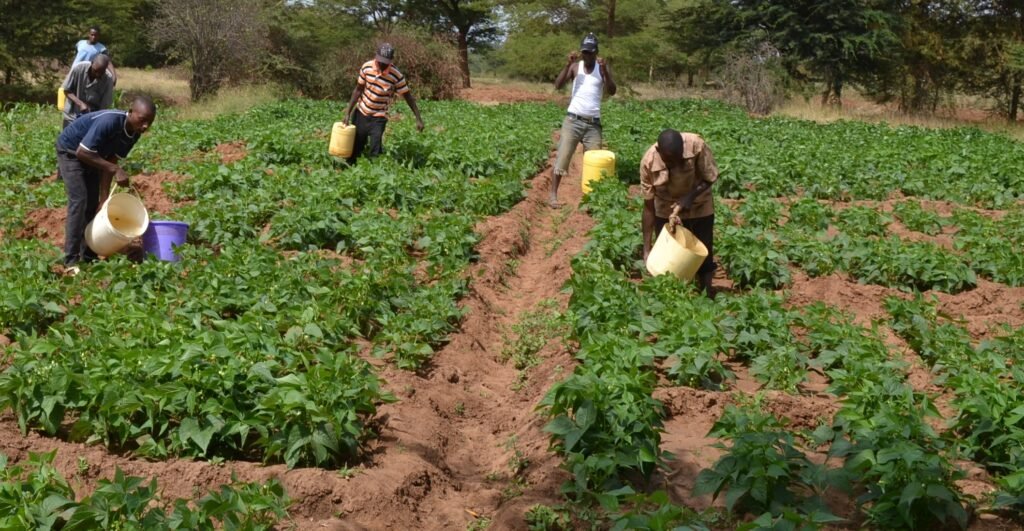
Cameroon is developing irrigation infrastructure in its northern region under a programme meant to strengthen agricultural production and climate resilience.
The programme involves the construction of five multifunctional hillside dams in the North Region, designed to capture seasonal runoff and provide controlled irrigation during the long dry season.
Njun Peter, technical agriculture adviser in the in the Far North region, said the dams support the growing of crops such as millet, sorghum, maize, and vegetables, while also providing water for livestock.
Community-managed water-user associations coordinate irrigation schedules, maintain infrastructure, and prevent overgrazing around reservoirs, ensuring equitable water distribution and sustainability.
Cameroon’s Minister for Agriculture, Gabriel Mbairobe, said the infrastructure development programme has been funded by loan obtained from the African Development Bank (AfDB) and €7.54 million ($8.7 million) from the Cameroonian government.
The first phase of the Northern Agro-Industrial Development Programme (PDAS-1) cost some €88.74 million (about $103 million).
The financing, approved on July 13, 2025, supported the construction of three multi-purpose hillside dams and the development of 618 hectares of irrigated farmland in the drought-hit Northern region.
“We are hopeful these dams will assist farmers fight against prolonged drought and thus improve their food crop production and livelihood,” the minister said during a visit to one of the dams in Poli recently.
“The reservoirs will also support livestock watering, fishing, and improved water availability.”
Authorities are also exploring whether the project can supply nearby communities with drinking water.
A consulting firm was sought earlier this year to assess local needs, existing infrastructure, and technical options, local authorities in the region said.
Based on the total project cost, the investment amounts to roughly CFA94.2 million per irrigated hectare, it was revealed.
That figure, however, goes well beyond the cost of irrigation infrastructure alone.
The financing also covers the construction of three multi-purpose dams, water storage and distribution systems, hydraulic equipment, engineering studies, construction supervision, environmental and social measures, livelihood restoration for affected communities, and overall programme management.
Although the project’s primary objective is agricultural development, the AfDB classifies PDAS-1 under the water and sanitation sector because of its broader focus on water resource management.
The programme is expected to generate activity in hydraulic engineering, civil works, environmental consulting, solar-powered irrigation, irrigation management, and agricultural processing.
Experts say agricultural innovations like irrigation schemes at the village level contribute to adaptation and mitigation of the impact of climate change.
“This will help to boost conservation agriculture because farmers have been encouraged to carry out agroforestry as a way of improving soil content and fight climate change,” Njun Peter said.
“These irrigation systems also play a crucial role in boosting agriculture with their ability to provide a reliable and consistent water supply.”
In many African countries, rainfall patterns are erratic and unpredictable, making rain-fed agriculture unreliable. Irrigation systems can help farmers overcome this challenge by providing a consistent supply of water for their crops. This can help farmers produce crops throughout the year, regardless of the rainfall patterns.
They also play crucial role in increasing crop yields and productivity in agriculture. With a consistent and reliable water supply, farmers can cultivate crops that require more water and grow them to maturity. This can lead to higher crop yields and improved productivity.