
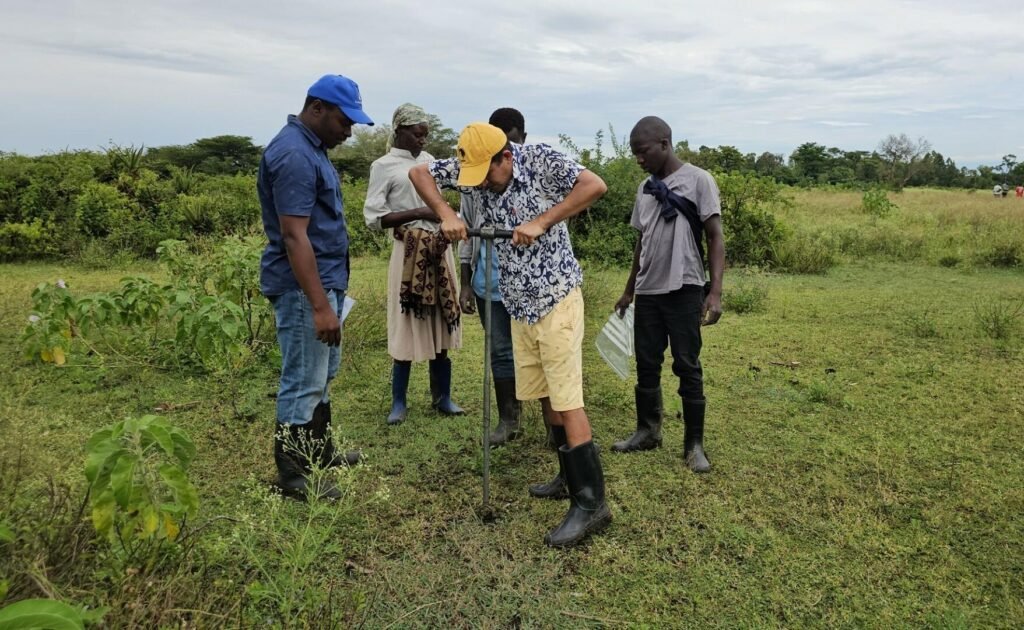
By Zablon Oyugi, November 4, 2025 – In Kenya’s intensifying efforts to transition to more sustainable food-systems, new research is shining a spotlight on an often-overlooked hero: the soil beneath farmers’ feet.
According to a 2024 baseline study conducted by scientists from Alliance of Bioversity International & CIAT (Alliance), the International Institute of Tropical Agriculture (IITA) and the Kenya Agricultural and Livestock Research Organisation (KALRO) in two western-Kenyan counties — Kisumu County and Vihiga County — reveals how soil microbes and biological vitality hold the key to sustainable agriculture and resilient livelihoods.
The study underscores that soils are far more than inert growing media — they are dynamic ecosystems brimming with microbes such as bacteria, fungi, actinomycetes, archaea and protozoa. These microorganisms play essential roles: cycling nutrients, decomposing organic matter, building soil structure and regulating plant health.
In the Kenya baseline report, researchers point out that “soil microbes are instrumental … facilitating nutrient uptake by plants, promoting plant growth, and even aiding in the mitigation of soil-borne diseases”.
For smallholder farmers in Kisumu and Vihiga — who operate on mostly less than a hectare of land — enhancing the biological vitality of soils could be a decisive pathway toward better yields and income.
Findings
The survey conducted between May and July 2024 across the counties included households in sub-locations such as Agoro East and Jimo East (Kisumu) and Vigulu (Vihiga).
It reveals key insights on soil, land and livelihood. For instance: the average farm size in Vihiga was approximately 0.6 hectares and many households were headed by women (about 32 %).
The soils in these areas, however, face multiple pressures: erosion caused by heavy rains, loss of topsoil and fertility, declining use of intercropping and crop rotation, and over-reliance on inputs rather than biological renewal. “Prolonged use of chemicals and fertilisers … exacerbated the loss of soil fertility and crop productivity,” reports the study team.
While the baseline study is mainly socio-economic and agroecological, the broader soil-health analysis conducted by the Alliance (published January 2025) emphasises that soil microbes and organic matter are central to restoring degraded soils.
What this means for sustainable agriculture in Kenya
For Kenyan agriculture — dominated by smallholder cropping systems and weakened by land pressure and climate variability — the implications are profound. By recognising that soils are living systems, and that microbes underpin soil fertility, crop health and resilience, policy and practice can shift in meaningful ways:
- Adopting nature-positive practices: The Nature‑Positive Solutions Initiative (NATURE+), under CGIAR, works with farmers in these counties to adopt agroecology, permaculture, intercropping and soil-biology boosting strategies.
- Erosion control and land restoration: As the study reports, 73% of households in the region face soil erosion. Restoring soils means rebuilding the microbial base through organic inputs, cover cropping and reduced tillage.
- Local seed-systems and biodiversity: By bringing back indigenous crops and diverse seedbanks in Vihiga and Kisumu, farmers support more active soil ecosystems and diversify diets and incomes.
A path ahead: linking microbes, markets and farmers
The baseline findings mark an important step in measuring change — but the real task lies ahead: translating those findings into on-farm shifts and policy. Reinforcing soil microbial life is not simply a scientific exercise; it requires farmer training, local seed-systems, input realignment and demonstration of financial benefits.
In Vihiga County, for example, the new Agroecology Policy launched in May 2025 recognises the need to emphasise soil biological health, reduce synthetic inputs, and revive soils for both productivity and food safety.
Farmers interviewed in Kisumu spoke of moving away from debt spirals caused by hybrid seeds and chemical fertilisers toward more regenerative systems: “We want to go back to nature,” one farmer said.
Going forward
As Kenya grapples with climate change, land-degradation and shrinking farm sizes, the microbial life in its soils may well offer one of the most cost-effective and sustainable avenues to future-proof agriculture. The baseline survey in Kisumu and Vihiga provides a benchmark — now the challenge is scaling up nature-positive, microbe-friendly, small-scale farming systems across the country.
If farmers can rebuild living soils enriched by microbial diversity, Kenya’s agriculture could shift from extractive to regenerative — and microbial activity may quietly become the deepest root of sustainable farming.