
By Zablon Oyugi
In the rolling landscapes of Kenya’s Kiambu and Makueni counties, fruit trees are doing more than producing food by restoring degraded landscapes, strengthening household incomes, creating opportunities for women and young people, and helping farmers adapt to changing climate.
These gains are among the lasting outcomes of the Fruit Trees for Climate Adaptation and Mitigation in East Africa project, supported by the Australian Centre for International Agricultural Research (ACIAR).
According to Prof Catherine Muthuri, the project leader, the initiative grew from lessons learned through an earlier ACIAR investment in Trees for Food Security across four countries in the region.
“We wanted to take the learnings into Kenya and also fill in the gaps identified during the study in Rwanda,” she says.
The project is implemented through a partnership led by the Center for International Forestry Research and World Agroforestry (CIFOR-ICRAF), Jomo Kenyatta University of Agriculture and Technology (JKUAT), government agencies and farming communities.
The goal was to increase fruit trees on farms while strengthening climate adaptation, food security and nutrition.
Planting the right trees in the right places
At the heart of the initiative was an understanding that successful tree farming depends not simply on planting more trees, but on choosing species suited to local conditions and farmers’ needs.
“Right from the start, we needed the right partners,” Prof Muthuri says.
CIFOR-ICRAF provided scientific leadership, while JKUAT strengthened capacity building. The approach, she adds, was guided by a simple principle: “the right trees for the right place”, backed by quality seedlings from nursery to farm.
Government involvement helped translate research into practical and lasting change. In Kiambu, avocado and macadamia emerged as priority crops because they could fit farmers’ relatively small landholdings while offering attractive economic returns.
Rachel Mwangi, a former Kiambu County government representative, says collaboration between the project and government helped align the intervention with county and national priorities while strengthening its prospects for sustainability beyond the project’s lifetime.
The partnership also helped farmers organise themselves into stronger groups as county officials supported the creation of cooperatives, established governance structures and trained leaders in management.
One of the clearest examples is the Avocado and Macadamia Cooperative, known as AVOMAC.
Its chairman, Patrick Gichia, recalls that the idea emerged after a training workshop in October 2022, where farmers learned that organising into a group could give them greater bargaining power and enable them to market their fruit collectively.
“Today, AVOMAC has evolved into a platform for more than selling produce. It helps farmers coordinate pruning and harvesting, organise training and bring young people into seasonal farm activities,” he says.
Most importantly, collective marketing has improved returns, with members receiving about five shillings more per kilogramme of produce—a gain of more than 70 percent.
Women and young people find new opportunities
The project also recognised that economic benefits from tree farming are not automatically shared equally within households.
Early assessments found that men often controlled decisions about trees and the income generated from farms. Addressing that imbalance became an important part of the intervention.
Dennis Wakaba, a socio-economist and gender officer, says the project deliberately sought to challenge those inequalities.
For Jean Vera Wambu, a farmer and an AVOMAC member, the cooperative has provided a route to greater economic participation.
“Men are increasingly encouraged to share trees with women, while the knowledge she has gained enables her to train other women in improved farming practices,” she says.
The project has similarly helped draw young people into agriculture at a time when farming is often perceived as offering limited opportunities.
Dr Leah Ndungu, ACIAR’s Regional Manager for Eastern and Southern Africa, says the project’s strong climate focus and emphasis on youth were important factors in its success.
For young farmer Mary Kunene, climate-smart agriculture represents both a business opportunity and a way to protect the environment.
“I look forward to reaching thousands of people through profitable and sustainable farming and believes young people could eventually benefit from participation in emerging carbon markets,” Mary says.
Science that farmers can use
While farmer experience and local knowledge remain central, scientific innovation has strengthened the project’s ability to respond to climate change.
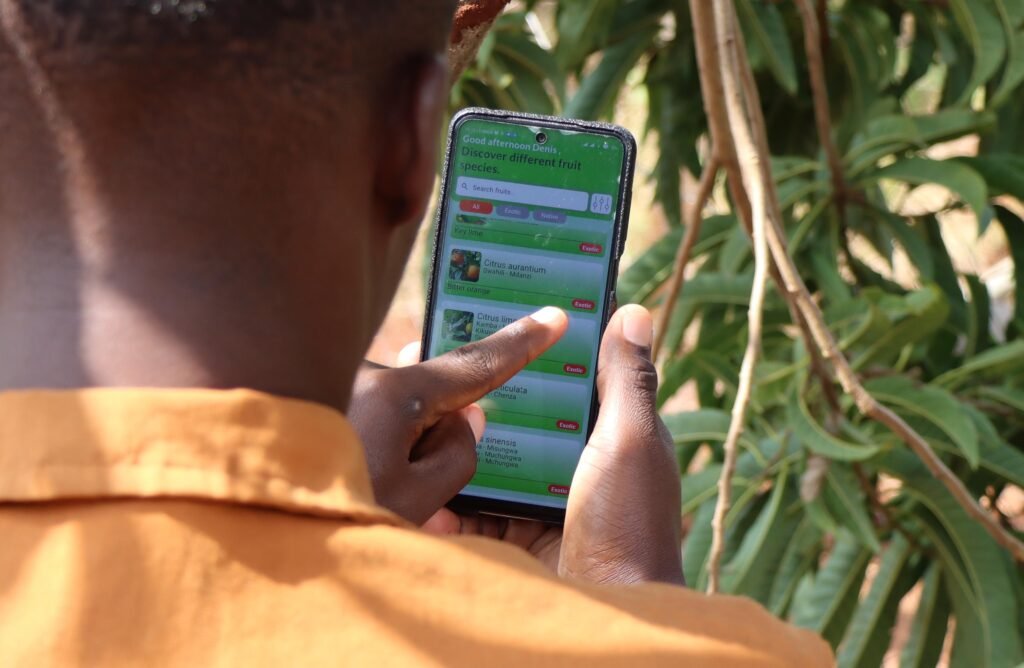
Researchers developed biomass equations for mango and avocado trees, simplified carbon measurement guidelines and created the Kuza Matunda mobile application to help farmers identify fruit tree species suited to their locations.
Research scientist Anne Kuria says the application was developed with farmers’ needs in mind. It combines information on 59 fruit tree species with data on past, present and projected climate conditions and is available in Kiswahili and local languages.
The project has also tackled one of the less visible challenges in tree farming: access to reliable planting material.
Nursery owner Mary Mwanza says certified seedlings have increased farmers’ confidence in establishing orchards.
“We can recommend species according to local conditions and advise farmers on planting techniques, including the use of biochar to improve moisture retention,” says Mwanza.
The Kuza Matunda Hub has also helped nurseries understand where different types of seedlings are needed, improving the connection between supply and demand.
For farmer Gideon Murai, participation in the research has brought both practical knowledge and new planting material. After volunteering five mature avocado trees for biomass studies, he received 50 replacement trees.
“The experience I have gained has equipped me to share knowledge about carbon measurement with other farmers and young people,” Murai says.
Growing resilience from the ground up
The experience of Kiambu and Makueni illustrates a broader lesson about climate adaptation in agriculture. Resilience is not created by a single technology, crop or intervention.
It emerges when farmers have access to appropriate planting material, useful scientific knowledge, functioning markets, supportive institutions and opportunities to participate in decisions about their livelihoods.
Fruit trees offer a particularly powerful combination. They can provide food and income while contributing to soil restoration, carbon storage and more diversified farming systems.
When farmers are organised into cooperatives, the economic benefits can become stronger; when women and youth are included, those benefits can reach further into communities.
The Fruit Trees for Climate Adaptation and Mitigation in East Africa project shows what can happen when scientific research is connected to farmer priorities and backed by government and community partnerships.
As fruit trees take root across Kenya and the wider region, their value extends well beyond the harvest. They are helping farmers build assets for the future, creating new economic opportunities and turning climate adaptation from an abstract challenge into something tangible growing on farms.
The promise is therefore not simply of more fruit, but of healthier landscapes, stronger communities and agricultural livelihoods better prepared for an uncertain climate.