
By Lominda Afedraru
With the extremely low public investment in agricultural research in Uganda, scientists mostly rely on grants from international development organisations to undertake research projects.
More often than not, the grants are hardly enough to cover the costs of data collection or procuring equipment.
Manual data collection is time-consuming, labour-intensive, prone to error and slows down selection cycles and drives up costs of crop breeding, for example.
Ms Laura Aladriru, a research assistant with Alliance Boiversity International and CIAT, said that scientists are now moving away from the old method of collecting data using paper work to using AI.
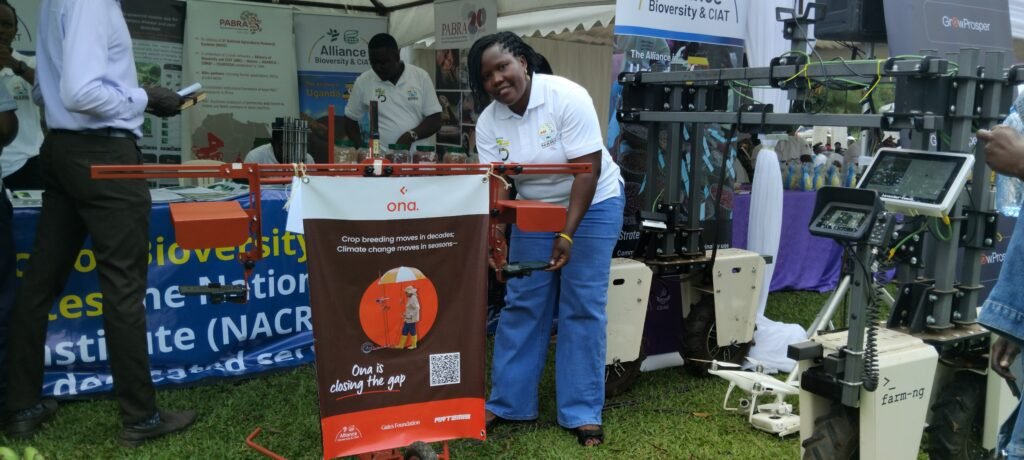
Researchers at Alliance Boiversity International and CIAT and National Crops Resources Research Institute (NaCRRI) are already using AI and robot for data collection in a bean breeding programme, which is showing promising results.
In 2025, the researchers began field testing using an innovative robot named Bruno, which automates the collection of data process into fully digital workflow.
The portable robot uses standard Android smartphones where an AI data collection app called ONA has been installed.
It is moved through experimental plots while phone cameras take detailed images.
These images are uploaded to secure cloud database. The data analysis is about plant stand counts, flower emergence and the number of pods that are growing.
By harnessing the robotics and artificial intelligence, the technology delivers faster plot assessment and reliable measurements.
It reduces data collection time by at least 70 percent and labour cost and eliminates human errors that occur when thousands of plants require phenotyping.
In addition, it captures traits such as the colour of the flower and pod, canopy architecture, disease severity symptoms as well as pest damage on the bean plants, expanding its utility across different growth stages.
Roy Odama, a breeder at Alliance Biodiversity, notes that the technology is a game changer because it accelerates the breeding cycle while significantly reducing errors.
Bruno was developed by the Alliance’s team based at the Arusha office in Tanzania under a project funded by the Gates Foundation.
It is built using readily available tools and it offers a low-cost, scalable alternative to drones and industrial imaging platforms.
Bruno’s adaptability to Uganda’s non-flat terrain has also proven its relevance for diverse African farming systems.
Dr Immaculate Mugisha, who works under the bean programme at NaCRRI, notes that the deployment of the technology in the bean breeding programme has shown faster acquisition of data and significant reduction in labour costs.
The team planted bush beans for the trial in September and varieties included Narobean2, Nabe4, 16 and 19 which has shown good results.
The rollout of the Bruno-ONA artificial intelligence for phenotyping technology to the Alliance, Uganda is a testament to effective regional collaboration.
The experiment has not only transferred knowledge but also empowered local staff to independently lead the next phases of Bruno’s deployment.
Since data collection is accurate, the team realised increase in bean yield in on-farm trial, meaning once the varieties are released to farmers, it will be of benefit to them.
The scientists contend that the integration of robotics and AI into field phenotyping points the way to the future of crop breeding in Africa.
Faster and more precise selection of promising bean lines will shorten breeding cycles.
For donors and partners, Bruno is proof of scalable innovation and for plant breeders, it unlocks a new era of data-driven precision.
For millions of smallholder farmers, it promises bean varieties that are better adapted to changing climates and more productive on the farm.
The scientists using AI technology will understand how to detect disease and classification for bean diseases such as angular leaf spot and bean rust leaf from the captured images with the goal of sending early warnings to farmers via mobile platforms.
The team contends that AI–powered mobile apps and platforms can analyse satellite imagery to provide farmers with guidance on optimal planting times, which helps mitigate risks from unpredictable weather patterns.
Apart from the AI robot tools, Alliance Bioversity and CIAT has advanced technologies such as Rova and Drone, which perform the same work of analysing data using satellite imagery.