
By Elias Ngalame
In Cameroon, authorities have identified fish farming as a key driver of economic transformation, with its potential to create opportunity for young people and women. Under the Livestock and Fish Farming Value Chain Development Project (PD-CVEP), the government plans to increase its annual fish production by 10,000 tons by 2027, reducing dependence on imports and improving food security.
The project financed by the African Development Bank (AfDB) is designed to strengthen the national fish farming sector.
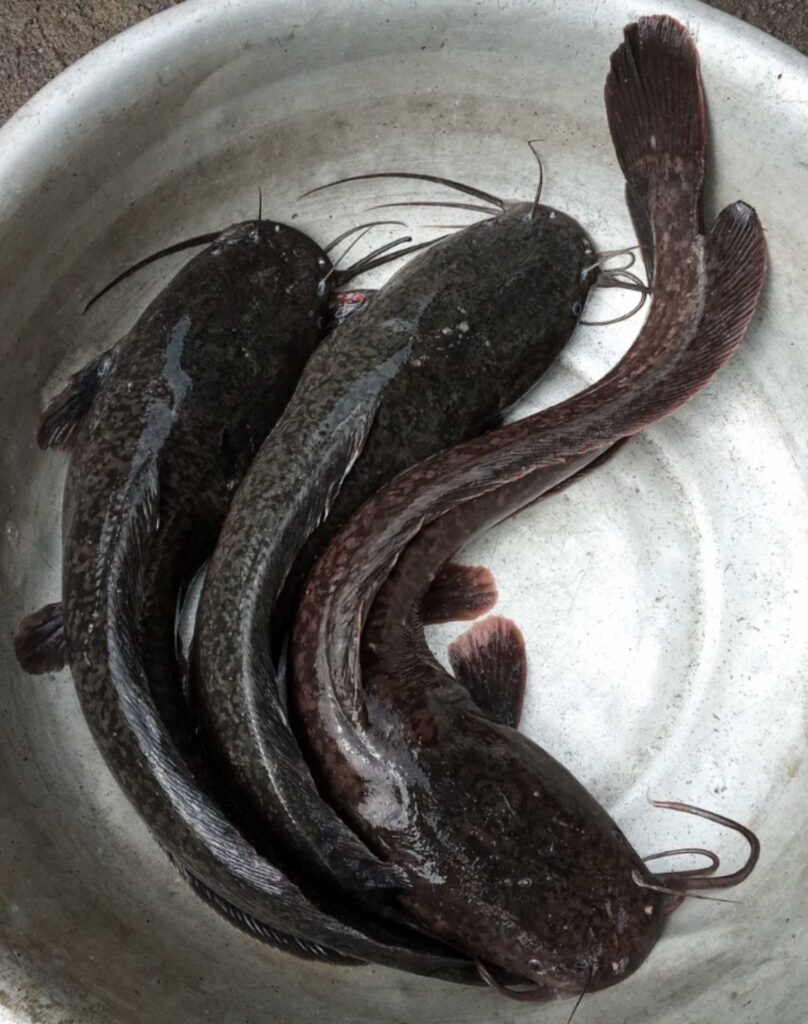
The government says this transformation is being driven by a strain of the African catfish (clarias), which has the advantages of rapid growth, low fat content, and low mortality. The strain was developed by Cameroon’s Agricultural Research Institute for Development.
An AfDB mission in April 2025 recommended accelerating the supply of improved clarias and tilapia broodstock to enrich the gene pool. A total of 15,000 broodstock (12,000 clarias and 3,000 tilapia) are to be delivered under an agreement signed with the Agricultural Research Institute for Development.
“The project has introduced improved, high-yield broodstock of clarias and tilapia with accelerated growth rates,” the Minister of the Economy and Regional Development Alamine Ousman MEY announced at press briefing on October 22, 2025 in Yaounde.
These new breeders are significantly more productive, reaching a marketable size of 350 to 500 grams in just five to six months, compared to eight or nine months previously, the authorities say. They also ensure a survival rate for fingerlings of 80 percent to 85 percent, a substantial improvement from the approximately 60 percent survival rate of older strains.
Each female can produce between 15,000 and 20,000 fingerlings per cycle, with up to three cycles annually.
The boodstock has been distributed to 50 pilot hatcheries, which have produced and sold more than 115,000 fingerlings, primarily for grow-out. In addition to distributing the breeders,
the project will train 280 fish farmers in hatchery management, floating cage farming, and aquaculture feed. It also includes the rehabilitation of fish farming stations in Bamenda, Yaounde, and Foumban to bolster the national supply of fingerlings. In the Littoral and Southwest regions, known for their dynamic fish farming, early beneficiaries are already reporting improved income and product quality.
“We received certified broodstock with very good yields. These are stable strains that grow faster and save us many problems related to the irregularity and lack of traceability of the old strains. This will transform our production,” said Hermine Kemedeu Tchuileu, a beneficiary based in Douala, the economic capital.
For Cameroon authorities, the initiative is strategic, aiming to reduce dependence on imports, secure local supply, and make fish farming a driver of economic and social transformation. Between 2022 and 2023, fish imports slightly decreased from 241,798 to 234,572 tons, according to figures from the National Institute of Statistics. Despite the proliferation of public projects and initiatives, concrete results have yet to fully materialise. Enhancing local production through fish farming, the government says, is the new option.
“The pilot hatcheries have used the broodstock to produce and sell more than 115,000 fry since October 2024, mainly to be grown to full size. Results in the pre-extension phase have been very encouraging,” the director of local fishery production said.
Most of the hatcheries have reported satisfactory performance. Some of the broodstock, which were still immature when received, required a period of about three months for further growth, which was incorporated into the production schedule, he added. Fish farmers have appreciated the support under the project. “The support given by the project is encouraging us to go further. We have real motivation to continue what we’ve started. We thank all the partners who have made this progress possible. Today, I feel better equipped to make a profit from fish farming,” said Fanta Njifondjou Oumarou, a female fish farmer in Limbé, a coastal town in north[1]western Cameroon.
The project goes far beyond the provision of broodstock, authorities say. It is part of an integrated vision for the development of fish farming. A total of 280 fish farmers from different regions of Cameroon have received comprehensive training on the fish value chain, from floating cage farming to reproduction, hatchery management, aquaculture feed, and business management. The aim is to strengthen the technical capacities of stakeholders, their economic resilience, and the quality of products offered on the local market.
A tripartite system involving the Institute, the project, and the ministry works closely with regional fish farming associations to ensure rigorous monitoring of the use and performance of broodstock. Quarterly technical reports, supported by a digital data collection system, enable monitoring of production levels, beneficiary satisfaction, and training effectiveness. Market demand is also undergoing a transformation. Market traders and restaurants appreciate the improved quality and taste of the fish produced from the new clarias broodstock.
“The flesh stays firm after grilling because it contains less fat than older strains. The flavour appeals to customers and my income has increased significantly,” said Ms Moukoudi Mbappé Dolie, who sells grilled fish in Douala. A field visit to the Deïdo and Dakar markets in Douala highlighted the difficult working conditions of fishmongers in Cameroon. This led to the inclusion in the project of an upgrading plan for sales facilities, including the installation of hygienic counters, access to ice and running water, and proper security.
“The project gives us hope. Working in better conditions isn’t a luxury – it’s a necessity. Clean and secure counters will help us preserve the fish better and to sell with dignity,” said Marthe Epoko, a vendor at the Deïdo market. In the longer term, ongoing improvements to fish farms in Bamenda, Yaoundé, and Foumban will significantly strengthen the national supply of quality fish fry. These regional hubs will become strategic supply centres for hundreds of fish farmers across the country, officials said.