
By Zablon Oyugi
In the densely populated Lake Victoria region of East Africa, the need to increase fodder production has never been more urgent. Rising populations, shrinking land sizes and intensifying climate shocks are piling pressure on smallholder farmers to up livestock production.
According to a June 2025 publication in the Environmental Development journal, per capita demand for animal products in sub-Saharan Africa is expected to be 55 percent higher in 2050 compared to 2020 and for a region where dairy and beef production is largely in the hands of smallholders, this projection signals both an opportunity and a looming crisis.
To meet this demand, farmers must ensure a steady supply of fodder for ruminant livestock throughout the year. Yet even in high-rainfall areas around Lake Victoria, where Napier grass and other forages grow abundantly during the wet season, many farmers struggle with poor fodder handling and storage.
Without reliable storage techniques, surplus forage cannot be preserved for increasingly frequent droughts driven by climate change, leading to feed shortages that reduce milk yields, cause weight loss in livestock, force distress sales or costly feed purchases, and ultimately entrench poverty and weaken farmers’ resilience.
The Food and Agriculture Organization (FAO) identifies the high cost and unsuitability of imported machinery from developed countries as a key barrier to scaling mechanisation in Kenya and across the region. Most hay balers and forage equipment are designed for large-scale commercial farms, putting them far beyond the reach of smallholders who typically own two to five cows.
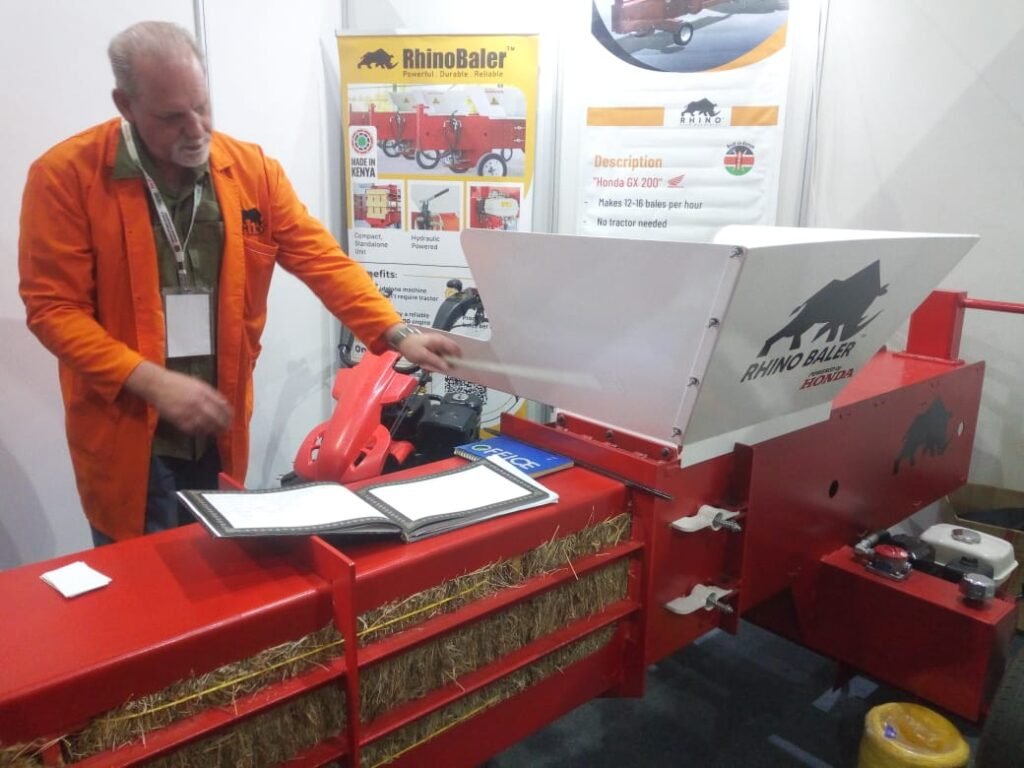
It is within this gap that Rhino Baler, a Kenyan-based company providing feed management technology tailored specifically to smallholder farmers across Kenya and East Africa, is positioning itself as a transformative solution with its Rhino Baler machine.
A machine built for Africa’s smallholders
Rhino Baler’s compact, petrol-powered baler converts loose cut grass into tightly packed, easy-to-handle bales—making fodder storage practical and profitable at the village level.
Jerome Cupido, a Canadian entrepreneur and founder of Rhino Baler, says the balers use Honda’s GX industrial engine model, designed for heavy-duty applications.
“Honda guarantees their engines and the GX model is their industrial engine. This is the engine for industrial use,” he says, noting that the machines are manufactured in Kenya under local regulatory approval.
For smallholders, this local manufacturing approach addresses one of the major barriers identified by FAO: the mismatch between imported equipment and local realities.
The machines are portable and easy to operate in small plots, often accessed through farmer groups, cooperatives or service providers who bale fodder for a fee.
Turning surplus into security
The benefits of baling for smallholder farmers are significant.
First, baling reduces post-harvest losses as instead of allowing cut grass to rot in the field or be trampled by livestock, farmers can dry and compress it into uniform bales. These bales are easier to transport, stack and store under simple sheds or tarpaulins, preserving feed quality for months.
Second, baled hay creates a buffer against climate shocks.
“There is a huge need for good, nutritious feed,” Cupido says. “When the grass comes up—as it will do in a few weeks—anyone with initiative can go out, bale hay from underused pastures, bale tons of it, store it properly and sell it when the inevitable drought comes.”
He says that fodder conservation should be seen not just as survival, but as enterprise.
“Right now, many people are just trying to survive. They sell an animal only in times of dire need,” he says. “But planning to feed is planning to bring a cow to market size and weight and sell it for income. And income is what changes everything. Financial planning must have one key component—income. Steady income. Farming can do that, big time.”
Third, baling opens up new income streams as farmers can sell surplus hay bales to neighbours or to pastoralists in drier regions. In counties prone to recurrent drought, hay markets are expanding as livestock keepers increasingly appreciate the value of conserved fodder.
“Another consideration is market,” Cupido adds. “Farmers sometimes resist buying machines because of uncertainty of the market. That is not a problem in Kenya. Every good-sized, healthy animal that comes to market will get a good price. The need is there.”
He believes that once farmers clearly see the financial reward, behaviour will shift.
“Behaviour changes when there is a big cash prize at the end,” he says. “Instead of just grazing and hoping for the best, a small-scale farmer is planting grasses, nurturing grasses, harvesting grasses and baling grass—saving nutrition for the feeding of his cash crop: beef or milk. Then he says, ‘I’m going to make some money here and have a better life, long term.’”
From vulnerability to resilience
Smallholder farmers are among the most vulnerable to climate change, yet they are also central to Africa’s food systems. In the Lake Victoria basin and beyond, improved fodder management could dramatically shift their trajectory.
Baling does more than store grass—it stores opportunity. It allows farmers to plan beyond the next rainy season, to stabilise production and to negotiate better prices because they are not forced into distress sales during drought.
After four years of developing its machine shop, supply lines and trained staff, Rhino Baler says it is ready to scale.
“We have spent four years developing our machine shop and our supply lines and our trained staff. Now we’re ready. We have got 26 machines ready to go. Let’s go,” Cupido says.
If widely adopted, such technology could help transform livestock systems in East Africa—from reactive and crisis-prone to resilient and market-oriented. For smallholder farmers standing at the frontline of climate change, a compact baler may seem like a simple machine.
But in the broader fight against poverty and food insecurity, it represents something far larger: the power of appropriate technology to unlock productivity, protect livelihoods and build a more secure agricultural future.