By Maike Sommerhäuser
From talk to action: How GIZ is driving CAADP’s Kampala Agenda through cross-country learning
When Africa’s leaders reaffirmed their ambition to transform agri-food systems under the African Union’s CAADP Kampala Agenda, one message was clear: continental commitments only matter if they land in budgets, institutions, and fields.
That imperative took centre stage in Addis Ababa, Ethiopia at a peer learning workshop on CAADP Kampala Implementation, hosted by the Deutsche Gesellschaft für Internationale Zusammenarbeit (GIZ) GmbH – and resulted in tangible country action plans and cross-country peer learning commitments.
GIZ is a German federal enterprise that provides services in international cooperation for sustainable development. Owned by the German government, it works in over 120 countries, focusing on economic development, climate protection, peace, security, and governance.
Three days – from May 11-13 – were dedicated to moving from talk to action. Fifty-five participants from eight African Union member states convened around one question: How do we translate Kampala priorities into practical steps that countries can implement? And what can countries learn from each other already?
Organised in close coordination with continental institutions, the workshop was opened by Kennedy Ayason, Principal Policy Officer at the African Union Commission’s Department of Agriculture, Rural Development, Blue Economy, and Sustainable Environment (AUC-ARBE/DARBE) and closed by Dr Rudo Makunike, Principal Programme Officer at AUDA-NEPAD. Alignment with CAADP’s governance and implementation modalities took centre stage from the onset.
During an interactive “country fair”, delegations from Cameroon, Kenya, Madagascar, Namibia, Nigeria, Togo, Uganda, and Zambia presented their Kampala implementation status: first achievements, remaining bottlenecks, and concrete peer-support needs.
Short pitches, followed by informal Q&A, created an interactive marketplace for solutions, allowing peers to identify who had tried what and under which conditions it worked.
From these conversations, five common bottlenecks emerged across contexts:
- Aligning Kampala priorities with national agricultural investment planning and budgeting, including integration within or alongside NASIPs [national agri-food systems investment plans].
- Strengthening monitoring and evaluation to track outcomes linked to Kampala, without overloading existing systems.
- Improving coordination across ministries and levels of government to ensure coherence from national to subnational – and alignment with continental processes.
- Scaling tested practices from pilots into institutionalised approaches that deliver at sector level, with attention to inclusion and climate resilience.
- Financing the transition by mobilising domestic resources and partner support and engaging private capital with instruments fit for agri-food systems.
Based on the bottlenecks identified, CAADP focal points joined representatives from civil society, academia, farmer organisations, the private sector, and GIZ in hands-on working sessions. Structured exchanges brought together experienced practitioners and peers seeking solutions, creating space for in-depth technical dialogue on concrete implementation challenges.
By the close of the workshop, every country delegation had distilled specific takeaways into a short action plan – and agreed on follow-up engagements with those countries or experts from whom they wanted to learn and exchange going forward, from Addis to action.
As one of the participants put it during the workshop wrap-up: “We came with problems. We leave with partners.”
The CAADP Peer Learning Workshop was organised by GIZ’s global Sustainable Agricultural Systems and Policies (AgSys) programme, in which the majority of GIZ’s work towards the Kampala domestication is embedded.
Implemented by GIZ, the AgSys programme is commissioned by Germany’s Federal Ministry for Economic Cooperation and Development (BMZ).
Cooperation with the African Union and alignment to its policy priorities is a key cornerstone for BMZ’s cooperation approach. Consequently, AgSys leverages GIZ’s extensive expertise and portfolio towards the CAADP Kampala Agenda.
“While the AgSys CAADP workstream is only implemented in six of our AgSys partner countries – Cameroon, Kenya, Madagascar, Nigeria, Togo and Zambia – we actively seek to leverage the entire GIZ portfolio working towards Kampala domestication,” says Hannah Scheuermann, Component Lead for the AgSys CAADP workstream. “This includes teams in Namibia and Uganda, where GIZ is actively involved in Kampala domestication work, as well as other experts and networks at our disposal”.
Inclusive and evidence-based policy reform is a key focus area for AgSys. In this, the project works in partnership with key continental partners to accelerate delivery.
“We partnered with AKADEMIYA2063 to support continental knowledge sharing as well as country diagnostics in Kenya and Togo. In addition, we collaborate with the CAADP Non-State Actors Group to strengthen non-state actor involvement in all our partner countries,” explains Hannah Scheuermann.
Going forward, take-aways from the workshop will inform GIZ’s work on CAADP Kampala domestication, both at country level and for complementary activities at continental level.
The AgSys programme seeks to foster policy reform towards sustainable agri-food systems by linking substantive work streams on national level to continental and global agendas.
“Our mission is to work with partner countries in making their agrifood systems more sustainable, inclusive, and resilient,” says Heike Höffler, Head of Programme for AgSys. “We do this by working side-by-side with national partners and by creating spaces where peers can learn quickly from each other and from continental institutions. Global and regional strategies such as the Kampala Agenda give us a common compass; country teams turn it into measurable change.”
With teams in nine partner countries – Burkina Faso, Cameroon, India, Kenya, Madagascar, Mali, Nigeria, Togo, and Zambia – and a global team, the programme simultaneously supports country-level priorities and links those to global agendas.
“Policy reform sticks when it is owned locally and informed globally,” says Heike Höffler. “Our approach invests in trusted relationships at country level and complements them with curated exchange across borders and institutions. That is where implementation accelerates.”
A key format for cross-country learning and inspiration is the annual AgSys Regional Forum. Now in its third edition, the forum convened from May 6-8 in Addis Ababa, prior to the AgSys CAADP Workshop. Around 70 participants from all nine partner countries came together to explore cross-cutting themes at the core of agrifood systems transformation: financing the transition, agroecology as a pathway to resilience and productivity, and inclusive governance that systematically brings women, youth, non-state actors and private sector into decision-making.
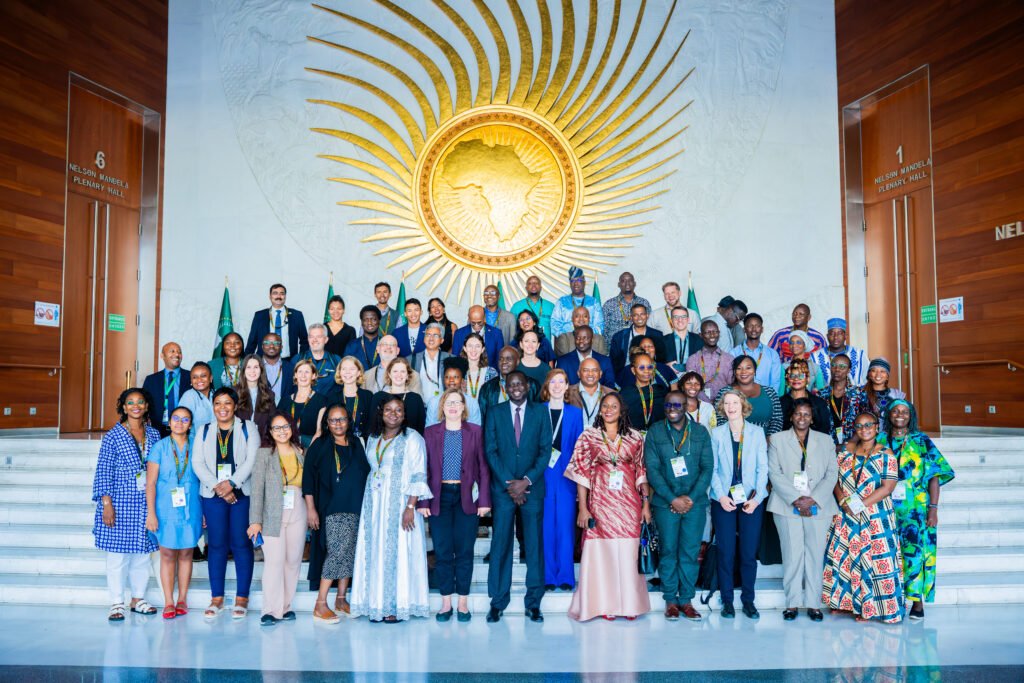
A highlight of this year’s forum was a visit to the African Union headquarters in Addis Ababa. Participants were received by Bongani Masugu, Special Advisor to ARBE Commissioner Moses Vilakati, and by Kennedy Ayason, Principal Policy Officer at AUC-ARBE. Agnes Obua Ogwal, CAADP M&E Advisor, presented the state of Kampala implementation, connecting continental priorities with national delivery.
“The guided tour through the AU premises really underscored the relevance of continental processes – because they frame and amplify country action,” explains Heike Höffler.
The strong turnout and tangible follow-up from both events underline why the Kampala Declaration matters: it provides a continental compass that aligns partners and accelerates country-level delivery, turning commitments into measurable results.