By Busani Bafana
From a village women’s club to the United Nations, Zimbabwean farmer and agroecology pioneer, Elizabeth Mpofu is showing how indigenous wisdom and peasant solidarity can feed a warming continent.
At 4:30 a.m., before the heat blankets the fields, Elizabeth Mpofu gazes at the sky.
Forming clouds will determine whether she plants, tends livestock or prepares for another day of uncertainty.
Reading the weather is not just a routine for farmers like Mpofu. It is navigating an increasingly unpredictable climate where drought, erratic rainfall and extreme heat can determine whether a family eats or goes hungry.
Mpofu’s response has been turning to farmers’ enduring gift: knowledge of the land.
Today, Mpofu is one of Africa’s top voices for agroecology—a way of farming that combines ecological science with indigenous and farmers’ knowledge, while placing biodiversity, healthy soils and food sovereignty at the heart of food production.
But her journey began far from global conferences and United Nations negotiations rooms.
As the eldest daughter in a family of eight, Mpofu did not get the opportunity to further her education. While her brothers went to boarding school, she remained at home, helping her mother with farming—the work that sustained the family and eventually became her own profession.
“What motivated me to go into sustainable agriculture or agroecology way is the fact that agroecology takes care of Mother Earth by promoting the use of our native seeds and empowering smallholder farmers through knowledge sharing,” says Mpofu, who for years, had practised conventional agriculture, relying on chemical fertilisers and pesticides.
That changed in 1988.
A women’s club she belonged to joined the Association of Zimbabwe Traditional Environmental Conservationists (AZTREC), an organisation established by traditional chiefs, spirit mediums and war veterans to promote organic farming and environmental conservation.
Mpofu embraced the approach with so much conviction that within two years she became the organisation’s chairperson.
The change was more than a shift in the way she farmed. It was the start of a lifelong campaign to reconnect food production with the health of the soil, the diversity of seeds and the knowledge of farmers.
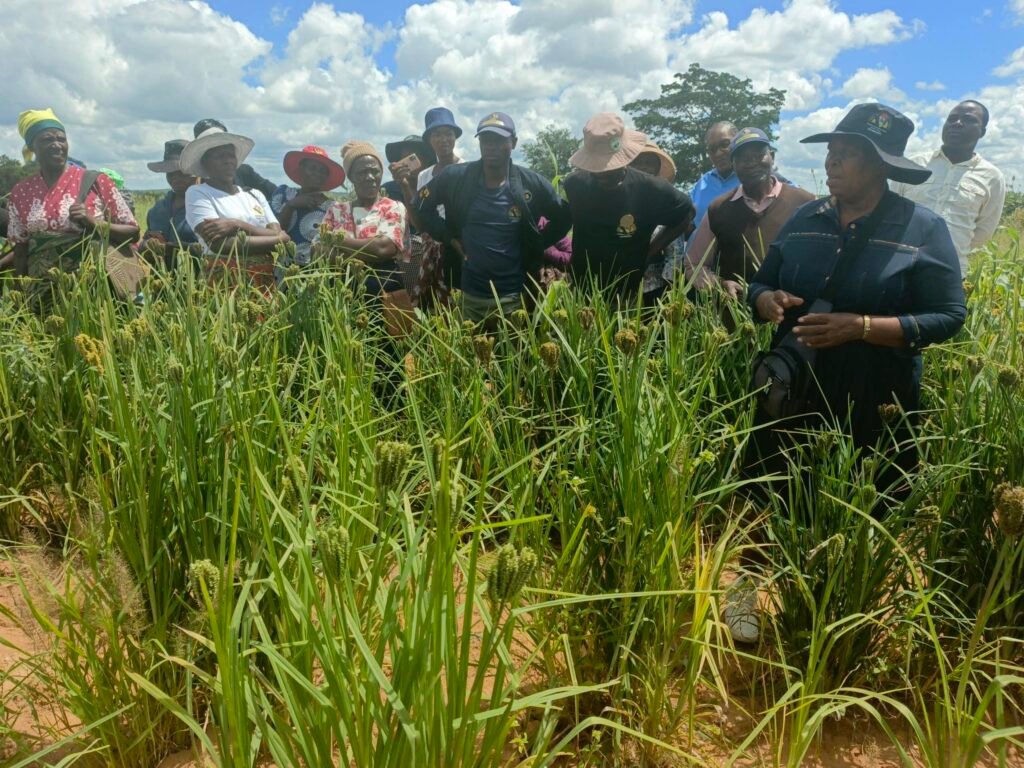
On her 10-hectare farm in Shashe, in Masvingo Province southeast of Zimbabwe, Mpofu now grows various crops, including maize varieties, small grains, legumes and different beans, following agroecological principles.
Today, Mpofu is challenging an agricultural system that promises higher yields while leaving behind exhausted soils, declining biodiversity and growing risks to people and animals.
Through agroecology, Mpofu is restoring the relationship between farming and the land: protecting traditional seeds, sharing knowledge and adapting to a climate defined by erratic rainfall, droughts and extreme heat.
For Mpofu, that approach is particularly important as climate change places smallholder farmers under growing pressure.
“As a farmer, resilience is the ability to adapt to harsh situations such as the climate crisis we are facing, where in most cases there is limited rainfall, floods or extreme heatwaves,” she says.
“In such conditions, a farmer should be able to produce enough food for the family but, at the same time, take care of the environment and make use of the surrounding resources.”
Agroecology’s principles include recycling nutrients and energy on the farm, rather than introducing external chemical inputs; integrating crops and livestock; diversifying species and genetic resources; and focusing on interactions and productivity across the agroecosystem, rather than on individual species.
From one farm to a movement
Mpofu did not hoard what she learned to herself.
In 2007, she was instrumental in forming the Zimbabwe Organic Smallholder Farmers’ Forum (ZIMSOFF), which now represents nearly 20,000 small-scale farmers, about 13,000 of them women.
Its members practise agroecology and share knowledge through farmer-to-farmer learning.
Her influence also extended beyond Zimbabwe. She chaired the Eastern and Southern Africa Farmers’ Forum (ESAFF) and served on the board of the Alliance for Food Sovereignty in Africa (AFSA).
A pivotal moment came in 2004, when Mpofu attended a La Via Campesina conference. The encounter connected Zimbabwe’s smallholder farmers to a global movement of peasants, rural women, indigenous peoples, pastoralists, fishers, landless workers and others whose livelihoods are tied to the land and food systems.
ZIMSOFF subsequently joined La Via Campesina, strengthening Mpofu’s conviction that changing agriculture requires more than changing what happens on individual farms.
It also requires changing who gets to make decisions about food.
La Via Campesina’s idea of food sovereignty puts that question at the centre: communities should have the right to decide what food they produce, how they produce it and how their food systems are shaped.
For Mpofu, that principle is inseparable from women’s rights.
Through her engagement with communities and traditional leaders, she has advocated women’s right to participate in decision-making and to have greater freedom over what they grow.
“Despite women farmers being the backbone of food production, their recognition is still very low, and they are not part and parcel of the policy formulation processes. It is very unfortunate to learn that NGOs and governments talk about empowering women to enable them to participate in decision-making processes, but this is not fulfilled,” says Mpofu.
She points to a familiar contradiction: governments and development organisations frequently speak about empowering women, while women farmers remain excluded from many of the decisions that shape agriculture.
Taking the farmer’s voice to the UN
Mpofu’s campaign eventually moved from village meetings and farmers’ organisations to the global policy arena.
From 2013 to 2021, she served as General Coordinator of La Via Campesina, using the position to advocate the recognition of agroecology, food sovereignty and peasant rights at the international level. A moment of pride was the adoption of the United Nations Declaration on the Rights of Peasants and Other People Working in Rural Areas (UNDROP).
For a farmer whose journey began in a village women’s club, it was a remarkable progression: from working the land to helping shape international recognition of the people who depend on it.
But Mpofu’s activism has never been confined to policy.
She has also focused on the practical economic barriers confronting women farmers. One strategy she promotes is collective savings. “To solve some of these financial problems as women farmers, we have to organise ourselves into savings clubs, where we contribute an agreed amount of money every month and this is rotated among members,” she says.
The approach reflects a central theme in Mpofu’s work: communities do not have to wait for outside institutions to solve every problem. Organisation, knowledge-sharing and collective action can themselves become tools of resilience.
Why women farmers matter
Mpofu’s argument is especially relevant as the world turns its attention to the contribution of women to food systems. The United Nations General Assembly has declared 2026 the International Year of the Woman Farmer, recognising the essential role women play across agrifood systems and calling for greater action on the inequalities they face.
Women are involved throughout the food chain—from production and processing to distribution and trade—yet they continue to face greater barriers than men in accessing land, finance, technology, services and decision-making opportunities. “Food sovereignty is about embracing our own diverse food crops and not accepting imposed food systems, and agroecology is a solution that works,” she says.
Her conviction has earned international recognition. In 2016, she was appointed Special Ambassador for Pulses in Africa by the Food and Agriculture Organization, highlighting her advocacy for healthy and nutritious foods. A year later, she founded the African Women’s Collaborative for Healthy Food Systems, bringing together women leaders from across the continent to promote food sovereignty and women’s rights.
In 2023, she received the inaugural Charlotte Maxeke African Women Leadership Award for her work advancing women’s rights, gender equality and community service. The economic cost of those inequalities is significant. The Food and Agriculture Organization estimates that closing gender gaps in agricultural productivity and wages could increase Africa’s regional GDP by $53 billion while reducing food insecurity by 3.79 percent. For Mpofu, however, the issue is beyond economics. It is about who controls the food on the plate, who owns the seed, who has access to land and whose knowledge is valued.
From her farm in Shashe to international policy forums, Mpofu has spent decades making the same argument in different settings: food production cannot be separated from the people, ecosystems and cultures that sustain it.