
By Murimi Gitari
Diaspora remittances have long been a lifeline for African households, sustaining education, healthcare, and daily consumption.
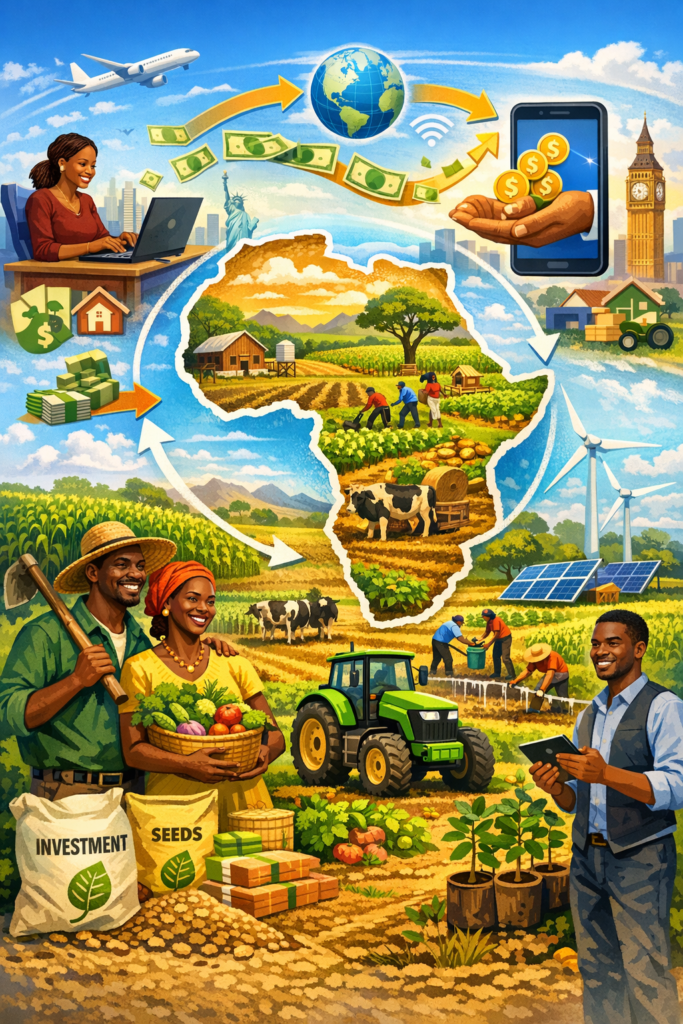
Yet in recent years, a quiet transformation has been underway: these funds are increasingly being directed into agriculture, turning sentimental transfers into engines of rural development and food security.
According to the World Bank’s 2023 Migration and Development Brief, remittance flows to low- and middle-income countries reached an estimated $669 billion, marking a 3.8 percent increase from 2022. Sub-Saharan Africa received over $100 billion, with Nigeria, Egypt, and Kenya among the top recipients. Kenya alone recorded $4.2 billion in remittance inflows in 2023, a sharp rise from $3.7 billion in 2022, making remittances the country’s largest source of foreign exchange, surpassing tourism, tea, and horticulture exports.
Globally, remittances now outpace official development assistance and rank just behind foreign direct investment as a driver of external capital for developing nations, underscoring their scale as a development finance source.
Across the continent, case studies reveal how diaspora capital is reshaping farming landscapes and agribusiness ventures.
In Nigeria, diaspora-backed cassava processing plants have reduced post-harvest losses and created new markets for smallholder farmers.
“We realised that sending money for school fees was important, but investing in a cassava mill meant the community could stand on its own,” said Adewale Ojo, a Nigerian diaspora investor based in London, in an interview with The Guardian Nigeria.
According to the World Bank, Nigeria’s experiment with diaspora bonds has also opened pathways for channelling funds into agricultural infrastructure.
Ghana’s diaspora has been equally active, with cooperatives in Accra formed by Ghanaians abroad having funded cold storage facilities, extending the shelf life of perishable horticultural produce.
“Without proper storage, half of our vegetables never make it to market. Diaspora investment has changed that,” said Kwame Mensah, a greenhouse farmer, speaking to Business & Financial Times Ghana.
The African Development Bank has noted that such diaspora-backed ventures are strengthening Ghana’s cocoa and horticulture value chains.
Ethiopia has gone further by actively courting diaspora investors through agribusiness parks. Ethiopian entrepreneurs based in the United States have financed modern coffee washing stations, improving quality and boosting export competitiveness.
“We wanted to give back to our homeland, and coffee was the natural choice,” said Dr Selamawit Bekele, an Ethiopian-American investor, in remarks reported by the International Organization for Migration.
Ethiopia’s diaspora engagement policies have been described as among the most deliberate in Africa.
Uganda’s story is more grassroots but equally impactful. Diaspora-funded hatcheries in central Uganda have scaled up egg production, while dairy cooperatives have improved household incomes and nutrition.
“My brother in Canada sent money not just for us, but to start a poultry farm. Now we supply eggs to three districts,” said Sarah Nakato, a farmer in Mukono, quoted in The EastAfrican.
These investments, though modest in scale, ripple through communities by creating jobs and stabilising food supplies.
Kenya stands out for its structured approach to harnessing diaspora remittances. The government has developed the Kenya Diaspora Investment Strategy 2025–2030, which explicitly seeks to channel funds into productive sectors, with agriculture at the forefront.
“We are moving from remittances as consumption to remittances as investment,” said Roseline Njogu, Principal Secretary for Diaspora.
According to the Kenya Institute for Public Policy Research and Analysis (KIPPRA), remittances have already surpassed income from tourism and exports, underscoring their immense impact. On the ground, diaspora-backed greenhouse farming in Kiambu County and dairy cooperatives in Nyeri County demonstrate how remittances are moving beyond household support into structured agribusiness ventures.
Yet despite these promising examples, barriers remain.
Dr Timothy Njagi, Development Economist and Research Fellow at Tegemeo Institute of Agricultural Policy & Development, has spent years studying why remittances are not flowing into agriculture at the scale they could. In an interview with PanAfrican Agriculture, he explained that one of the biggest obstacles is information asymmetry.
“Investors in the diaspora often lack credible, reliable, and timely data on agriculture such as yields, prices, or even the area under cultivation,” he said. “This creates perceptions that agricultural markets do not work, or that they are controlled by cartels exploiting both producers and consumers. Without accurate information, risks are exaggerated and fraud becomes rife, discouraging investment.”
Beyond data gaps, Dr Njagi pointed to the absence of structured investment frameworks. Unlike real estate, which has REITs and other vehicles, agriculture lacks similar instruments.
“Publicly listed agribusiness firms face high risks from climate and market shocks. Before fintech, there were very few blended finance products. Now fintech has proliferated, but the market is saturated, and agricultural lending is still seen as high risk,” he noted.
Factor markets and governance constraints also weigh heavily. Land fragmentation and weak tenure systems make long-term investments uncertain, while labour, capital, and technology face binding constraints.
“Investors seeking short-term returns struggle with agriculture because it requires capital costs that can only be recouped over the long term,” he explained. “Operational costs are incurred every cycle, but realistic returns take years to materialise.”
Dr Njagi believes governments and financial institutions must create mechanisms that make agricultural investment more attractive and secure for diaspora communities.
“We need structured investment vehicles—professionally managed funds where diaspora investors can pool resources. These must be regulated to protect investors from fraud,” he said.
He added that governments could absorb initial losses through first-loss equity protection, while fiscal incentives could offset capital expenditures and support infrastructure like irrigation, warehousing, and logistics.
On innovative models, he noted that agribusiness funds are more effective in channelling remittances to agriculture. Cooperative farming has worked in Asia and Latin America, but in Africa trust and governance challenges have limited its success.
He pointed to examples of successful ventures.
“Silicon Valley investments in disruptive agriculture technologies show that foreign direct investment can generate positive returns. In Kenya, Twiga Foods and Apollo Agriculture demonstrate the potential of diaspora-backed innovations. They create value for farmers and investors alike, but growth must be managed with realistic expectations and adaptive business models,” Dr Njagi said.
Trust and transparency remain critical. Dr Njagi emphasised the role of strong regulatory institutions and contract farming models, which provide certainty for both producers and buyers.
“Credible public data on yields and prices is essential. It shapes expectations of returns and informs investment decisions,” he said.
Risk management is another pillar. Credit guarantees, insurance against climate shocks, and diversification across value chains can make agriculture more viable for remittance senders.
“Diversification allows investors to offset potential losses in one area with gains in another,” Dr Njagi explained.
Policy reforms could further align remittances with national goals. Dr Njagi suggested accrediting professional farm management services, creating public databases on land leases and commodity benchmarks, and strengthening dispute resolution mechanisms in contract farming.
“We must also support structured investment options like agricultural funds where diaspora can pool resources, and promote investment-ready opportunities in the diaspora,” he said.
Infrastructure is equally vital.
“Transformation in agriculture drives other sectors, including agro-processing and retail. As production increases, excess produce must be processed to avoid price collapses. Investments in aggregation, storage, and logistics must go hand in hand with production,” Dr Njagi observed.
Looking ahead, he sees diaspora remittances evolving.
“Initially, remittances were used for consumption smoothing. But as households stabilise, there is growing potential to channel funds into productive investments. With the right frameworks, diaspora capital can reshape agriculture in the next decade,” he said.