By Zablon Oyugi
When you think of sausages, the more familiar image is that of a savoury, sizzling delicacy made from beef, pork, chicken, or even mushroom—easy to prepare, widely accessible in supermarkets, and loved across breakfast tables. But in an increasingly health-conscious and culturally diverse Kenya, a new contender is quietly making its way onto the plate: camel meat sausages. More than a culinary novelty, these sausages mark a significant shift toward inclusivity and health-focused consumption.
For many young Muslims in Kenya—who often avoid conventional sausages due to concerns about concealed pork ingredients—this product meets long-standing cultural and religious needs.
At the same time, the sausages tap into a growing appetite for Halal-certified, nutrient-rich foods in Kenya’s evolving marketplace. At this year’s Kenya Meat Expo at the Nairobi’s Kenyatta International Convention Centre (KICC), the excitement around camel meat innovation was unmistakable. Between discussions on sustainability, modern livestock insurance tools, feed manufacturing, and vaccine technology, one stand consistently drew curious crowds: the Garissa Butchers Co[1]operative.
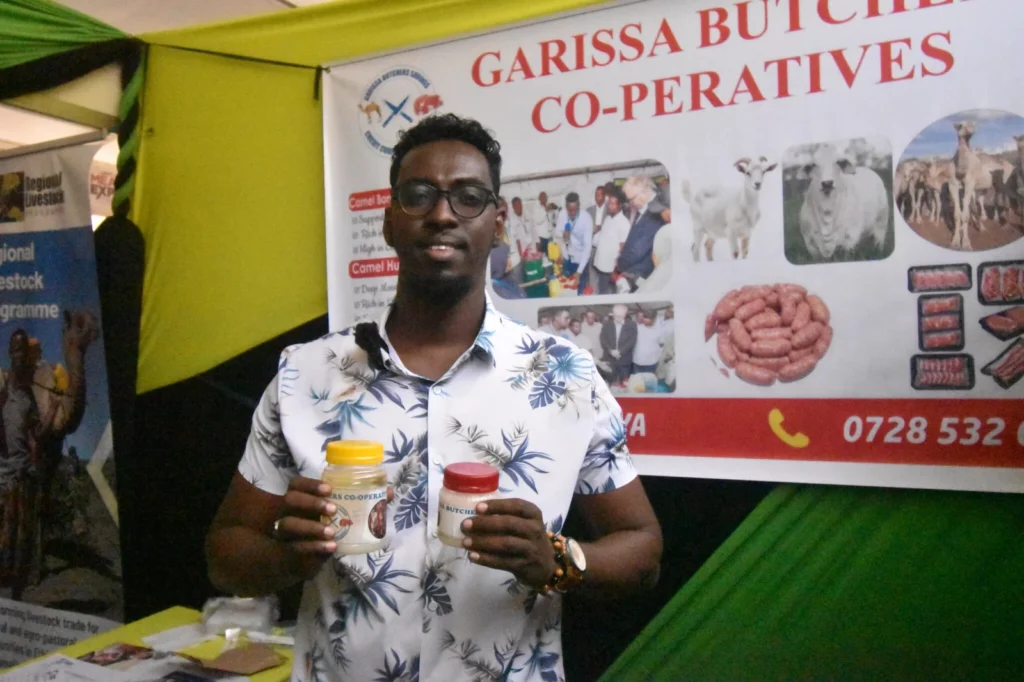
Standing behind a neatly arranged display of camel-based products was Abdi Aden, a 26-year-old IT graduate from Garissa University and vice[1]chairperson of the 64-member co[1]operative. Confident and soft-spoken, Aden introduced visitors to their now[1]signature offerings: camel hump oil, camel bone marrow oil, nyirinyiri (dried and fried camel meat), and the star attraction that has taken months of experimentation—camel meat sausages.
The co-operative has been refining recipes, testing textures, and sampling flavours with consumers in Garissa, Nairobi, and select diaspora customers. The result is a product born from both cultural sensitivity and a keen understanding of shifting market dynamics.
The Garissa Butchers Co-operative was formed in 2021, bringing together butchers who previously operated independently. Beyond pursuing better pricing and a unified voice, the group aimed to attract partners such as Mercy Corps and gain visibility in Kenya’s growing meat value chain.
“Many of our members run individual butcheries,” Aden said. “But working alone makes it difficult to scale. Coming together helps us innovate and reach bigger markets.” Innovation has indeed become one of their defining strengths. With new processing equipment already installed and value-addition training ongoing, the co-operative has moved quickly from selling raw camel meat to producing specialty oils, dried meat products, and now sausages.
Why camel sausages?
Asked why the co-operative chose to develop sausages—particularly in a market already dominated by beef, chicken, and pork—Aden’s answer was simple: “We are a Muslim community. We do not eat pork, and many people avoid commercial sausages because they’re unsure of what is inside. We wanted a Halal product we could trust—and one that tastes good.”
Halal certification is not only about avoiding pork; it encompasses cleanliness, humane handling, and ritual slaughter facing Mecca. Many mainstream processed meats do not meet these standards, leading to decades of hesitation among Muslim households. Yet young people in the community increasingly desire the convenience and taste of sausages.
“We saw the demand,” Aden said. “So we decided to create an option made entirely from camel meat—a meat our people have eaten for generations, but now shaped into something modern.”
Nutritional value
While cultural sensitivity inspired the idea, nutrition is what will likely propel camel sausages to mainstream success. Research shows camel meat is remarkably rich in essential nutrients, boasting components often missing in other red meats. Researchers have documented that camel meat contains essential amino acids and minerals; vitamins and bioactive components such as carnosine, anserine, and glutathione; and high levels of essential fatty acids.
Fifty grams of camel meat product contain 2.38 g/100 g of Vitamin B12—equivalent to 118 percent of the recommended daily allowance (RDA), according to a 2022 study published by the National Library of Medicine (NLM).
The study on nutritional values and health benefits of dromedary camel meat also found that the meat has a protein range of 17.1 percent to 22.1 percent, making it comparable to or even higher than beef and goat in protein density. Its intramuscular fat contains only 50 mg/100 g of cholesterol, dramatically lower than lamb (196 mg) and beef (206 mg). Moreover, camel meat is known to be a superior source of non-essential amino acids compared to beef, lamb, and goat.
These qualities translate into sausages that are not only Halal but also appealing to athletes, gym lovers, diabetics, and individuals seeking heart-friendly diets. Globally, camel meat products are receiving increasing attention for precisely these functional and nutritive properties.
The market response
The trial sausage batches from Garissa are already attracting attention in the market. Young Muslim consumers, especially university students and urban professionals, have welcomed a product that aligns with both faith and lifestyle. Meanwhile, non-Muslim customers— particularly those prioritising low-fat and nutrient-rich foods—have also taken interest. “Some Nairobi buyers told us they didn’t even know camel meat could be used this way,” Aden noted. “But once they tasted it, they loved the difference.” Distribution remains limited as the co-operative fine-tunes recipes and packaging. But online orders through social media platforms have helped bridge the gap. Repeat customers have emerged in Garissa, Eastleigh, South C, and South B—neighbourhoods with strong Muslim populations and diverse culinary tastes.
Broader camel value chain
Although sausages are gradually becoming the co-operative’s signature product, their other camel-based products such as camel hump oil, camel bone marrow oil and nyirinyiri remain strong revenue drivers. These products have found their way not only across Kenya but also to diaspora customers in the US, Europe, and the Middle East.
A new frontier
Camel sausages may have started as an experiment, but they are quickly evolving into a promising market niche. As Kenya’s food landscape shifts toward inclusivity, transparency, and wellness, the Garissa Butchers Co-operative is positioning itself to lead in the Halal processed meat category. With trial products already winning over customers at Ksh400 per 500 grams, the co-operative is poised for scale-up. And if current trends are anything to go by, camel sausages may soon move from novelty to necessity— appearing not just at expos, but on supermarket shelves, hotel buffets, and Kenyan breakfast tables. For Aden and his co-operative members, this is just the beginning. Camel meat has been part of their heritage for centuries. Today, they are reinventing it for a new generation— one sausage at a time.
More than meat
Aden’s leadership in the camel meat value chain is remarkable not only because he is young, but also because he juggles a second passion— technology. He runs Innovate with IT, a youth hub in Garissa offering training in programming, coding, and digital marketing. “Innovation is not limited to tech,” he said cheerfully. “It can happen in the butchery equally. What matters is solving a problem in your community.” His journey exemplifies a new wave of Kenyan youth entrepreneurship—one that blends tradition with modernity, local culture with global trends