
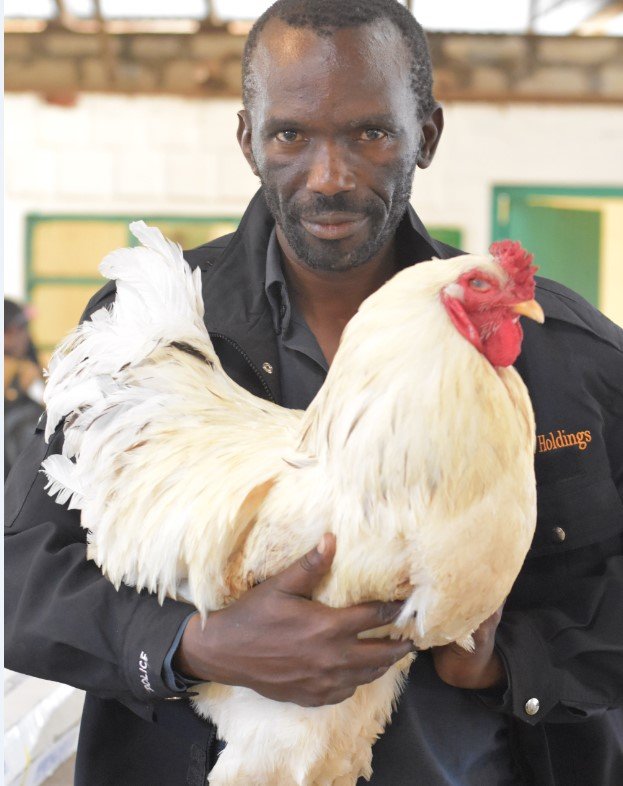
By Zablon Oyugi, January 14, 2026 – Standing nearly 1.5 to 2 feet tall, the giant Brahma chicken—one of the largest poultry breeds in the world—is steadily carving out a niche in Kenya’s poultry industry, driven by premium prices that far outstrip those of indigenous Kienyeji birds.
At Kimalat Holdings, a Kiserian-based poultry firm in Kajiado County, the breed is fast becoming one of the most lucrative on the market. According to the company’s director, Fredrick Omondi, Brahma chickens can fetch between two and ten times more income than improved indigenous breeds, making them increasingly attractive to commercial and semi-commercial farmers.
“The demand is on a sharp rise,” Omondi said, noting growing interest from urban consumers, restaurants and hotels seeking specialty poultry products.
A comparison of market prices highlights the gap. While an improved indigenous rooster such as a Sasso F1 weighing about 2.5 kilograms sells for roughly Ksh1,200—and a hen for about Ksh1,000—a seven-month-old Brahma rooster can fetch up to Ksh10,000, with hens going for as much as Ksh8,000. Fully grown birds weighing between 5.5 and 7 kilograms can command prices of Ksh10,000 to Ksh15,000 per bird.
Although Brahmas mature more slowly than improved indigenous breeds, Omondi says the returns more than compensate. The ideal slaughter age is around seven months, when the birds’ meat is still tender and flavourful. Mature roosters can weigh up to seven kilograms, while hens reach between 3.5 and 4 kilograms, offering significantly more meat than Kienyeji chickens.
At Kimalat Holdings, fully vaccinated two-month-old Brahma chicks retail at about Ksh2,000 each. The farm supplies more than 500 chicks monthly, translating to roughly Ksh1 million in sales from chicks alone.
Egg production and premium pricing
Brahmas are not known for high egg production. According to the U.S.-based Livestock Conservancy, which works to protect endangered and heritage livestock breeds, a Brahma hen lays about 150 eggs per year—far fewer than commercial layers. However, scarcity and large egg size sustain premium prices.
In Kenya, Brahma eggs sell for between Ksh250 and Ksh300 each, compared to Ksh15–20 for Kienyeji eggs. At Kimalat Holdings, daily egg collections range from 80 to 100 eggs, generating up to Ksh30,000 per day depending on season and demand. Festive periods attract especially strong orders from hotels and restaurants.
Based on current production and sales levels, Omondi estimates that intensive Brahma producers can earn more than Ksh22 million annually from a combination of live bird and egg sales.
Housing, feeding and management
Despite their size, Brahma chickens are relatively easy to manage. Their heavy build makes them poor fliers, allowing farmers to confine them using simple housing structures similar to those used for indigenous chickens.
“They live comfortably in simple houses like Kienyeji chickens,” Omondi explained. “Their size also makes them less destructive and easier to control.”
At Kimalat Holdings, the birds are largely raised under a free-range system, foraging on greens, worms and kitchen leftovers. However, their large frames come with higher nutritional demands, with each bird consuming about 170 grams of feed per day. To supplement feeding and enhance egg production, the farm occasionally grazes Brahmas in nearby bushland alongside Guinea fowls, where they feed naturally on worms and vegetation.
All chicks sold by Kimalat Holdings are fully vaccinated against common poultry diseases, including Gumboro, Newcastle Disease, Fowl Pox and Infectious Coryza. Omondi says this approach boosts buyer confidence and improves survival rates for a breed that can live up to five years.
Parent stock is kept exclusively for breeding and is only sold after about three years, when productivity declines.
A heritage breed with global roots
The Brahma breed originated in the United States in the mid-19th century, developed by crossbreeding large fowls imported from China with Malay-type birds. Historically dubbed the “King of Chickens,” Brahmas were once highly prized as meat birds before the rise of modern industrial poultry breeds.
The Livestock Conservancy recognises Brahmas as a heritage breed, distinguished by traits such as a pea comb, beetle brow, heavily feathered legs and a calm temperament. Their unique appearance and rarity have fuelled renewed global interest—now extending to Kenya.
Kimalat Holdings also rears a range of other exotic and improved breeds, including Guinea fowls, pigeons, Polish bantams, Japanese Silky chickens and improved Kienyeji. Even so, Brahmas continue to dominate sales and draw the most attention from customers.
The growing popularity of Brahma chickens reflects a broader shift among Kenyan farmers toward diversifying poultry enterprises with high-value exotic breeds.
“Brahmas stand tall both in stature and profits,” Omondi said. “They attract attention, they sell well, and they give farmers an edge in a competitive market.”