
By Arun Tiwari
Barely 50 years ago, much of Africa’s agriculture functioned primarily as subsistence farming—smallholder families cultivating land mainly to feed themselves, with limited integration into large-scale commercial markets. Food production was local, seasonal, and deeply tied to community survival rather than global trade. Post-harvest losses existed, but they were often constrained by localised production-consumption cycles.
Today, however, Africa’s agricultural systems are undergoing rapid transformation. Population growth, urbanisation, market expansion, export-oriented farming, and climate pressures have shifted agriculture from household sustenance toward broader agri-food systems. Yet this transition has also exposed one of the continent’s greatest developmental paradoxes: Africa loses or wastes enormous portions of its food while millions remain food insecure.
Food loss and waste in Africa must be understood not merely in financial terms, but in absolute biological and human terms. Every tonne of maize spoiled in storage, cassava lost to poor transport, or vegetables rotting before reaching urban markets represents wasted solar energy converted through photosynthesis, depleted soils, scarce freshwater, fertiliser inputs, fuel, and irreplaceable human labour. Across Africa, where farming remains labour-intensive and heavily dependent on human effort rather than mechanisation, food loss also signifies the erosion of physical toil—countless hours spent planting, weeding, harvesting, carrying, and trading food that never fulfils its purpose of nourishing people.
In this context, wasted food is wasted development.
Unlike wealthier nations, where food waste often occurs at consumer and retail levels, Africa’s losses are concentrated earlier in the supply chain. Poor rural roads, inadequate storage facilities, weak cold chain systems, fragmented markets, limited agro-processing infrastructure, and inconsistent energy access all contribute significantly.
Perishable crops such as tomatoes, mangoes, and leafy vegetables often spoil before reaching consumers. In many regions, grain losses due to pests, mould, or moisture remain substantial because of insufficient storage technologies. Thus, Africa’s food loss crisis is fundamentally rooted in structural inefficiency rather than excessive consumerism.
This distinction matters deeply. The issue is not that African farmers or households inherently waste food due to careless attitudes; rather, systemic barriers prevent food from moving efficiently from field to plate. A smallholder farmer may secure a bumper harvest, only to see a large percentage of it decay because markets are too distant, transportation is too expensive, or storage is inadequate. Here, food loss becomes a symptom of underdeveloped systems rather than social neglect.
Yet attitudes still matter—particularly as urbanisation reshapes African consumption patterns. Growing middle classes, supermarket expansion, and changing dietary habits are introducing new forms of waste at retail and household levels. Imported consumption models that normalise over-purchasing, cosmetic standards, and disposable culture risk replicating the waste patterns seen in developed economies. Africa, therefore, stands at a critical crossroads: it can either build efficient, resilient agri-food systems while preserving traditional respect for food, or repeat the inefficiencies of industrial food cultures.
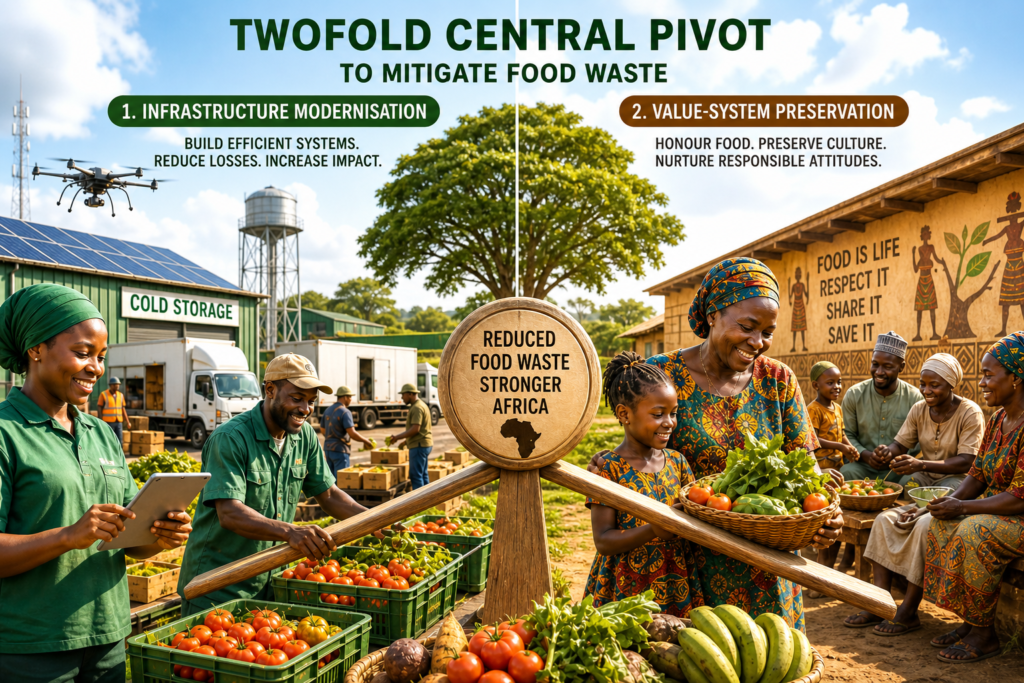
The central pivot for Africa is therefore twofold: infrastructure modernisation and the preservation of values.
First, investments in post-harvest infrastructure are essential. Rural storage technologies, decentralised cold chains, farm-to-market roads, solar-powered refrigeration, agro-processing hubs, digital price discovery tools, and regional trade integration can dramatically reduce losses. Technology—including AI-based forecasting, mobile extension services, and supply chain digitisation—offers unprecedented opportunities to leapfrog traditional inefficiencies.
Second, Africa must preserve and modernise its longstanding cultural understanding of food as survival, community, and dignity—not mere commodity. In many African societies, food historically symbolised resilience and social cohesion. This cultural memory can serve as a strategic advantage. If development pathways integrate technological advancement with ethical food stewardship, Africa can avoid the extreme consumer waste patterns of richer nations.
Policy must therefore frame food loss reduction not solely as agricultural reform, but as energy conservation, labour protection, and nation-building. Reducing food loss directly improves farmer incomes, strengthens nutrition security, conserves ecosystems, and lowers pressure to expand into fragile lands. It is one of the most efficient ways to enhance food availability without proportionally increasing production inputs.
In a continent where agriculture remains central to livelihoods, reducing food loss is equivalent to multiplying productive capacity without expanding acreage. It transforms inefficiency into opportunity.
Africa’s future food security challenge is not only about producing more food—it is about protecting the immense biological wealth already produced through the sweat of millions. As climate change, water scarcity, and population pressures intensify, minimising loss across agri-food systems may prove more transformative than simply increasing yields.
The continent’s agricultural evolution—from subsistence to sophisticated systems—must therefore be guided by a new philosophy: food is not surplus to be discarded, but life-energy to be preserved. If approached wisely, Africa has the opportunity not merely to modernise agriculture, but to redefine global food sustainability through a model that unites efficiency with human dignity.
aruntiwari.com