By Ngalame Elias
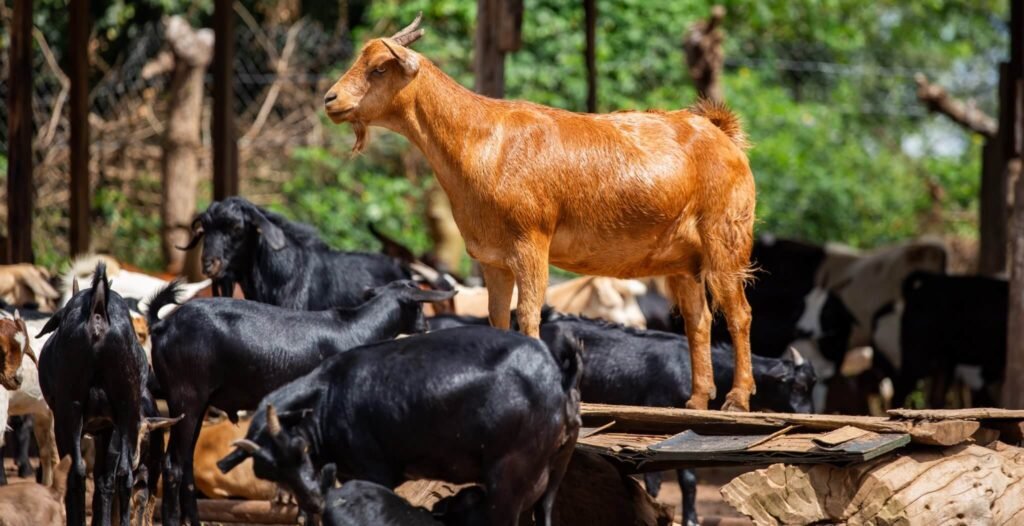
Like in many parts of Africa, goats are popular with livestock keepers in Cameroon because of their hardiness, value as social currency, and the reduced risk associated with smaller animals compared with cattle.
Smallholder goat farmers in Ndu in the country’s North Western region mostly keep indigenous breeds under in low-input, low-yielding systems.
However, a Swedish-funded innovation systems project that teaches farmers how to harness genetic diversity and promotes best practices in goat keeping is helping goat farmers improve productivity and access markets.
The project led by the BecA-ILRI Hub is part of a BecA-Sweden partnership on food security and climate change mitigation, said Kilian Asongwe, the divisional delegate for Livestock, Fisheries and Animal Industries.
Goat farmers are given practical advice on management of breeding within their flocks like distinguishing animals from the same family and keeping records of identification, origin and purchases.
Participants at the trainings also receive tips on proper feeding of their animals to improve the productivity and growth rates of their animals and management of flocks by confining them to pens to prevent them from destroying crops.
“I did not realise at first that I was undernourishing my goats by letting them graze in open fields.
Since the training I have been supplementing their feed with soybean meal and making sure they have water and salt,” said Emmanuel Ndzi. Other farmers said project had not only helped them improve productivity but has also seen increase in demand for goats and goat meat.
“The demand has grown to a point that we sell an encouraging number of our goats each market day,” said Stephen Ngala, president of the Goat and Pig Traders Union of Ndu, which has more than 200 members. Souleymane Aba, a farmer, said goat keepers had seen substantial improvements, with production capacity increasing from 300 to 600 goats per year in their villages and purchase agreements secured ensuring stable markets and fair prices. The renewed hope in production has also sparked growing interest in goat farming in the area as a source of income. “Three of my sons, encouraged by the improved sales have now joined our goat farmers network,” said Aba. Other young people have joined goat meat trade as a source of income.
“I did not know that I could make a decent living and even pay my children’s school fees from roasted goat meat sales,” said Japhet Njoya, a goat meat trader. “I have encouraged my family and friends to start keeping as well as selling goats.” Albert Nzog, a veterinary officer in the Ministry of Livestock said that although goat breeding and commercialisation have intensified in many parts of the country, there is still a significant untapped potential in the goat farming business.
“The smallholder sector is comprised of goat farmers that produce for family consumption and are usually found in the communal areas of the country. Herd numbers are usually small, and the goats are often left to fend for themselves and are occasionally supplemented with household leftovers. There is need to encourage large scale production through cooperatives and partnerships,” Nzog said.
To address challenges in the sector, he advised, a government extension programme in partnership with other farmer support programmes should be established. “Attention should be given to range management, feeding systems and herd health management, efficiency of production, and use of unconventional feeds,” he said.