
By Zablon Oyugi
Most smallholder farmers in rural sub-Saharan Africa struggle to achieve maximum yields and stable incomes despite spending long hours in their fields as they still rely on guesswork when making critical decisions like choosing seeds and fertilisers, managing pests and diseases, and post-harvest handling.
Studies show that access to information on inputs such as fertilisers, seeds and pesticides, post-harvest handling, and market prices can significantly increase farmers’ productivity, incomes, and overall livelihoods.
Information, when delivered at the right time and in the right format, can mean the difference between profit and loss.
A study by Egerton University’s Tegemeo Institute of Agricultural Policy and Development found that agricultural extension plays a critical role in transforming subsistence farming into modern, commercial agriculture.
Effective extension services improve household food security, raise incomes, and help reduce poverty. Yet across much of Africa, public extension systems remain under-resourced, overstretched, and unable to reach millions of farmers consistently.
But what if farmers had all the answers in their pockets, just like people in finance, health, or transport now do through digital tools?
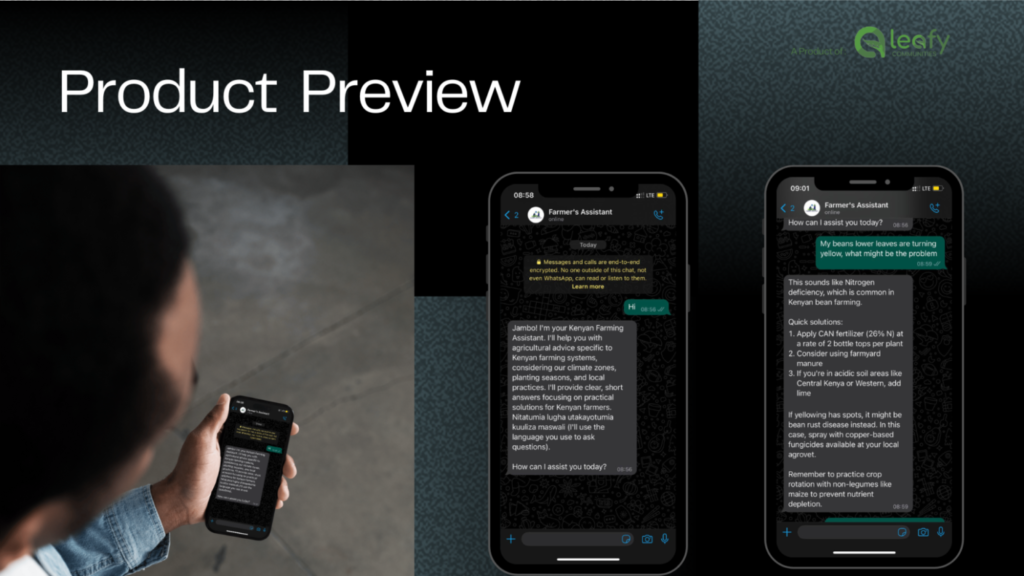
This question sits at the heart of Farmers Assistant AI, an AI-powered chat assistant designed to deliver agricultural knowledge instantly to smallholder farmers through a platform they already use every day — WhatsApp.
It is the brainchild of Kipyegon Sigey, a young Kenyan innovator, beekeeper, and Project Lead at Farmers Assistant AI.
From farmer to problem solver
Sigey’s journey into agricultural technology did not begin in a laboratory or tech hub. It began on the farm.
“I am a farmer myself and a beekeeper, so I understand these challenges firsthand,” Sigey says. “I’ve seen farmers lose entire harvests simply because they lacked one piece of information at the right time.”
Growing up and working closely with farmers, Sigey noticed a recurring pattern: extension officers were few, experts were far away, and credible information was difficult to access when it mattered most. Farmers often depended on neighbours, agro-dealers with conflicting advice, or outdated practices passed down through generations.
“That gap between the farmer and the expert is where most losses happen,” he ays. “We asked ourselves — what if technology could bridge that gap instantly?”
That question led to the development of Farmers Assistant AI, built through Agrisync Lab, which provides foundational tools for agricultural knowledge access and data insights.
The solution combines artificial intelligence with expert oversight, ensuring that farmers receive accurate, contextual, and actionable advice.
Through a simple WhatsApp chat, farmers can ask questions in real time about crop diseases, pest control, fertiliser application, soil health, weather patterns, and even markets.
“Farmers don’t need smartphones with complex apps or expensive data bundles,” Sigey says. “If you can send a WhatsApp message, you can access expert agricultural support.”
Unlike generic AI systems, Farmers Assistant AI is designed to be localised, drawing on region-specific farming practices, crops, climate conditions, and local languages where possible.
“Our goal is not just to give answers, but to give the right answers for that specific farmer, crop, and location,” Sigey says.
Restoring extension through technology
Across Africa, the extension officer-to-farmer ratio remains extremely low, making it impossible for traditional systems to meet demand. Farmers Assistant AI does not aim to replace human experts, but to extend their reach.
“This is not about removing experts from agriculture,” Sigey explains. “It’s about scaling their knowledge so one expert can support thousands of farmers instead of just a few.”
The platform operates with expert oversight, meaning responses are guided, verified, and continuously improved by agricultural professionals. This hybrid approach ensures trust — a critical factor in farmer adoption.
“When farmers trust the information, they act on it. And when they act on it correctly, yields improve,” he says.
The power of digital agricultural information has already been recognised at continental policy levels. Speaking at the African Development Bank Group (AfDB) Virtual Evaluation Week in Kigali in September 2022, Dr Babafemi Oyewole, CEO of the Pan-African Farmers Organization, emphasised the transformative role of information technology in agriculture.
“Information technology can support better crop, fertiliser, and pesticide selection. It also improves land and water management, provides access to weather information, and links farmers to sources of credit,” Dr Oyewole said.
“Simply giving farmers information about crop prices in different markets can increase their bargaining power. It is estimated that mobile crop information services can boost the incomes of smallholder farmers by 10–30 percent.”
This vision closely aligns with what Farmers Assistant AI is trying to achieve at the grassroots level.
“We are not guessing about impact,” Sigey says. “The evidence already exists. Our work is about delivering that impact to farmers who have been excluded from digital agriculture.”
Markets and decision-making
While much attention in agriculture focuses on production, Sigey believes decision-making beyond the farm gate is equally important.
“Farmers often don’t fail because they can’t grow crops,” he notes. “They fail because they sell at the wrong time, to the wrong buyer, or without knowing the real market price.”
By integrating market insights and advisory support, Farmers Assistant AI aims to help farmers make informed decisions that improve profitability, not just yields.
“When a farmer knows the price in different markets, they negotiate better. Knowledge shifts power,” Sigey says.
Scaling across Africa
Currently, Farmers Assistant AI is being refined and expanded, with the long-term vision of reaching millions of smallholder farmers across Africa. Sigey sees WhatsApp as a strategic entry point because of its widespread adoption, even in rural communities.
“We chose WhatsApp because farmers already trust it,” he explains. “You don’t need to teach someone a new behaviour — you just enhance what they already use.”
Looking ahead, Sigey envisions integrating weather prediction tools, credit linkages, and more advanced data-driven insights into the platform.
“This is about building a digital companion for the farmer,” he says. “One that walks with them through the entire farming cycle.”
As Africa grapples with climate change, food insecurity, and youth disengagement from agriculture, solutions like Farmers Assistant AI point to a different future — one where technology empowers rather than excludes.
“For young people, this shows that agriculture and technology can work together,” Sigey says. “Farming doesn’t have to be backward. It can be smart, data-driven, and profitable.”
In a continent where millions of farmers still operate without reliable extension services, putting answers directly into their pockets may be one of the most powerful innovations of all. And for Sigey, it is not just about technology — it is about dignity, opportunity, and giving farmers the tools they need to thrive.
“As long as farmers are guessing, they will keep losing,” he says. “But when farmers are informed, they win — and so does food security.”